


Page 291 - Hall et al (2015) Principles of Critical Care-McGraw-Hill
P. 291
CHAPTER 28: Interpretation of Hemodynamic Waveforms  195


                       A                                                      B                 Baseline
                                Baseline                                      20      Pra 18
                                                  – 37.5 –
                                                   – 25 –
                                   Ppw ~ 28       – 12.5 –
                                                   – 0 –
                                                                              0
                                                                                            Pra 10      Sipping
                                                                              20
                                       – 25 –      Postparalysis
                                      – 12.5 –
                                       – 0 –      Ppw ~ 28
                                                                               0
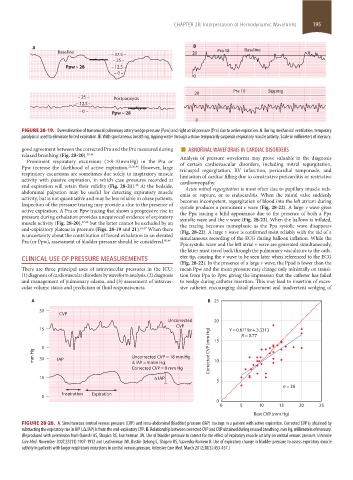
                    FIGURE 28-19.  Overestimation of transmural pulmonary artery wedge pressure (Ppw) and right atrial pressure (Pra) due to active expiration. A. During mechanical ventilation, temporary
                    paralysis is used to eliminate forced expiration. B. With spontaneous breathing, sipping water through a straw temporarily suspends respiratory muscle activity. Scale in millimeters of mercury.

                    good agreement between the corrected Pra and the Pra measured during     ■  ABNORMAL WAVEFORMS IN CARDIAC DISORDERS
                    relaxed breathing (Fig. 28-20). 45,46                 Analysis of pressure waveforms may prove valuable in the diagnosis
                     Prominent respiratory excursions (>8-10 mm Hg) in the Pra or   of certain cardiovascular disorders, including mitral regurgitation,
                    Ppw increase the likelihood of active expiration. 25,26,46  However, large     tricuspid regurgitation, RV infarction, pericardial tamponade, and
                    respiratory excursions are sometimes due solely to inspiratory muscle   limitation of cardiac filling due to constrictive pericarditis or restrictive
                    activity with passive expiration, in which case pressures recorded at   cardiomyopathy.
                    end expiration will retain their validity (Fig. 28-21).  At the bedside,   Acute mitral regurgitation is most often due to papillary muscle isch-
                                                          46
                    abdominal palpation may be useful for detecting expiratory muscle   emia  or  rupture,  or  to  endocarditis.  When  the  mitral  valve  suddenly
                    activity, but is not quantitative and may be less reliable in obese patients.   becomes incompetent, regurgitation of blood into the left atrium during
                    Inspection of the pressure tracing may provide a clue to the presence of   systole produces a prominent v wave (Fig. 28-22). A large v wave gives
                    active expiration. A Pra or Ppw tracing that shows a progressive rise in   the Ppa tracing a bifid appearance due to the presence of both a Ppa
                    pressure during exhalation provides unequivocal evidence of expiratory    systolic wave and the v wave (Fig. 28-22). When the balloon is inflated,
                    muscle activity (Fig. 28-20), 27,46  but the latter cannot be excluded by an   the tracing becomes monophasic as the Ppa systolic wave disappears
                    end-expiratory plateau in pressure (Figs. 28-19 and 21). 46,47  When there   (Fig. 28-22). A large v wave is confirmed most reliably with the aid of a
                    is uncertainty about the contribution of forced exhalation to an elevated   simultaneous recording of the ECG during balloon inflation. While the
                    Pra (or Ppw), assessment of bladder pressure should be considered. 45,46  Ppa systolic wave and the left atrial v wave are generated simultaneously,
                                                                          the latter must travel back through the pulmonary vasculature to the cath-
                    CLINICAL USE OF PRESSURE MEASUREMENTS                 eter tip, causing the v wave to be seen later when referenced to the ECG
                                                                          (Fig. 28-22). In the presence of a large v wave, the Ppad is lower than the
                    There are three principal uses of intravascular pressures in the ICU:    mean Ppw and the mean pressure may change only minimally on transi-
                    (1) diagnosis of cardiovascular disorders by waveform analysis, (2) diagnosis    tion from Ppa to Ppw, giving the impression that the catheter has failed
                    and management of pulmonary edema, and (3) assessment of intravas-  to wedge during catheter insertion. This may lead to insertion of exces-
                    cular volume status and prediction of fluid responsiveness.  sive catheter, encouraging distal placement and inadvertent wedging of

                       A                                                           B 25
                          30
                                CVP
                                                                      Uncorrected    20
                                                                        CVP
                          15                                                              Y = 0.6719x + 3.3313
                                                                                               R = 0.77

                          0                                                         Corrected CVP (mm Hg)  15
                        mm Hg  30  IAP                   Uncorrected CVP = 18 mm Hg  10
                                                           IAP = 9 mm Hg
                                                         Corrected CVP = 9 mm Hg
                          15                                       IAP
                                                                                      5
                                                                                                             n = 36
                                 Inspiration  Expiration
                          0
                                                                                      0
                                                                                       0      5     10     15     20     25
                                                                                                   Best CVP (mm Hg)
                    FIGURE 28-20.  A. Simultaneous central venous pressure (CVP) and intra-abdominal (bladder) pressure (IAP) tracings in a patient with active expiration. Corrected CVP is obtained by
                    subtracting the expiratory rise in IAP (Δ IAP) is from the end-expiratory CVP. B. Relationship between corrected CVP and CVP obtained during relaxed breathing. mm Hg, millimeters of mercury.
                    (Reproduced with permission from Qureshi AS, Shapiro RS, Leatherman JW. Use of bladder pressure to correct for the effect of expiratory muscle activity on central venous pressure. Intensive
                    Care Med. November 2007;33(11):1907-1912 and Leatherman JW, Bastin-DeJong C, Shapiro RS, Saavedra-Romero R. Use of expiratory change in bladder pressure to assess expiratory muscle
                    activity in patients with larger respiratory excursions in central venous pressure. Intensive Care Med. March 2012;38(3):453-457.)


            section02.indd   195                                                                                       1/13/2015   2:05:37 PM

