


Page 306 - Hall et al (2015) Principles of Critical Care-McGraw-Hill
P. 306
210     PART 2: General Management of the Patient

                     ■  INDICATIONS AND PATIENT SELECTION              contents into sterile cavities. Conscious sedation is preferred, though

                 Percutaneous drainage is the treatment of choice for abscesses and other   in select circumstances, general anesthesia may be necessary. In some
                                                                       patients, the procedure can be performed with local anesthetic only.
                 fluid collections such as urinomas and bilomas. Compared with surgical
                 exploration, percutaneous approaches are less invasive and associated   A thorough review of imaging studies will determine the safest access
                                                                       route. The best route is usually the shortest and straightest pathway.
                 with decreased mortality.  In some instances, percutaneous approaches
                                    1
                 are less costly. Percutaneous drainage is particularly favored in critically   Ideally, the catheter is placed in a convenient location for ongoing care. In
                                                                       solid organ collections, a small amount of normal parenchyma is traversed
                 ill patients as they are often not surgical candidates.
                   When an abscess is suspected in an ICU patient, cross-sectional imag-  to aid fixation and mitigate against peritoneal or retroperitoneal spillage.
                 ing is typically performed. CT scanning is preferred over sonography. If   Large, superficial collections can often be drained sonographically with
                 possible,  oral  and  intravenous  contrast  should  be  administered.  Enteric   fluoroscopic guidance. US is readily available, typically has a shorter pro-
                                                                       cedure time than CT, and provides the best visualization of direct needle
                 contrast aids in differentiation between an abscess and adjacent bowel
                 loops. CT allows superior visualization of adjacent organs and better plan-  advancement and adjacent vascular structures. Other drainage procedures
                                                                       require CT guidance to confirm appropriate catheter positioning. While
                 ning of the access route. US is operator dependent and limited by patient
                 body habitus, dressings, and the inability to penetrate gaseous interfaces.   most  collections  are  accessible  percutaneously,  deep  pelvic  abscesses
                                                                       pose unique problems. The pelvic bones, bladder, bowel loops, and rich
                 However, sonography is superior at detection of septations and loculations
                 within a collection and may be used in conjunction with radiography for   pelvic vasculature pose many obstacles to a direct percutaneous path.
                                                                       Additionally, percutaneous transgluteal drainage is often painful (espe-
                 pleural space collections. US may also be sufficient for detection of solid
                 organ abscesses. Once a collection is identified, it is crucial to realize that an   cially when above the level of the piriformis muscle) and risks injuring the
                                                                       sciatic nerve and sacral plexus. In these cases, US-guided transrectal or
                 abscess (or biloma, urinoma, lymphocele, hematoma, etc) cannot be diag-
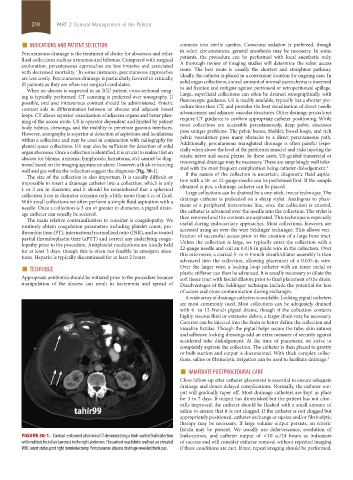
                 nosed based on the imaging appearance alone. However, a thick enhancing   transvaginal drainage may be necessary. These are surprisingly well toler-
                                                                       ated with the most frequent complication being catheter dislodgement.
                                                                                                                         2
                 wall and gas within the collection suggest the diagnosis (Fig. 30-1).
                   The size of the collection is also important. It is usually difficult or   If the nature of the collection is uncertain, diagnostic fluid aspira-
                 impossible to insert a drainage catheter into a collection, which is only   tion with a 20- or 22-gauge needle can be performed first. If the sample
                 1 or 2 cm in diameter, and it should be remembered that a spherical   obtained is pus, a drainage catheter can be placed.
                                                                         Large collections can be drained by a one-stick, trocar technique. The
                 collection 2 cm in diameter contains only a little more than 4 cc of fluid.
                 With small collections we often perform a simple fluid aspiration with a   drainage catheter is preloaded on a sharp stylet. Analogous to place-
                                                                       ment of a peripheral intravenous line, once the collection is entered,
                 needle. Once a collection is 3 cm or greater in diameter, a pigtail drain-
                 age catheter can usually be secured.                  the catheter is advanced over the needle into the collection. The stylet is
                                                                       then removed and the contents are aspirated. This technique is especially
                   The main relative contraindication to consider is coagulopathy. We
                 routinely obtain coagulation parameters including platelet count, pro-  useful during endocavitary approaches. Most collections, however, are
                                                                       accessed using an over-the-wire Seldinger technique. This allows veri-
                 thrombin time (PT), international normalized ratio (INR), and activated
                 partial thromboplastin time (aPTT) and correct any underlying coagu-  fication of successful access prior to the creation of a large bore tract.
                                                                       Unless the collection is large, we typically enter the collection with a
                 lopathy prior to the procedure. Antiplatelet medications are ideally held
                 for at least 3 days, though this is often not feasible in emergent situa-  22-gauge needle and coil an 0.018-in guide wire in the collection. Over
                                                                       this microwire, a coaxial 5- or 6-French sheath/dilator assembly is then
                 tions. Heparin is typically discontinued for at least 2 hours.  advanced into the collection, allowing placement of a 0.035-in wire.
                     ■  TECHNIQUE                                      Over the larger wire, a locking loop catheter with an inner metal or
                 Appropriate antibiotics should be initiated prior to the procedure because   plastic stiffener can then be advanced. It is usually necessary to dilate the
                                                                       soft tissue tract with fascial dilators prior to final placement of the drain.
                 manipulation of the abscess can result in bacteremia and spread of   Disadvantages of the Seldinger technique include the potential for loss
                                                                       of access and cross-contamination during exchanges.
                                                                         A wide array of drainage catheters is available. Locking pigtail catheters
                                                                       are most commonly used. Most collections can be adequately drained
                                                                       with 6- to 12-French pigtail drains, though if the collection contains
                                                                       highly viscous fluid or extensive debris, a larger drain may be necessary.
                                                                       Contrast can be injected into the drain to better define the collection and
                                                                       visualize fistulas. Though the pigtail helps secure the tube, skin sutures
                                                                       and adhesive locking dressings add an extra measure of security against
                                                                       accidental tube dislodgement. At the time of placement, we strive to
                                                                       completely aspirate the collection. The catheter is then placed to gravity
                                                                       or bulb suction and output is documented. With thick complex collec-
                                                                       tions, saline or fibrinolytic irrigation can be used to facilitate drainage. 3
                                                                           ■  IMMEDIATE POSTPROCEDURAL CARE

                                                                       Close follow-up after catheter placement is essential to ensure adequate
                                                                       drainage and detect delayed complications. Normally, the catheter out-
                                                                       put will gradually taper off. Most drainage catheters are kept in place
                                                                       for 3 to 7 days. If output has diminished but the patient has not clini-
                                                                       cally improved, the catheter should be flushed with a small amount of
                                                                       saline to ensure that it is not clogged. If the catheter is not clogged but
                                                                       appropriately positioned, catheter exchange or upsize and/or fibrinolytic
                                                                       therapy may be necessary. If large volume output persists, an enteric
                                                                       fistula may be present. We usually use defervescence, resolution of
                 FIGURE 30-1.  Contrast-enhanced abdominal CT demonstrating a thick-walled fluid collection   leukocytosis,  and  catheter  output  of  <10  cc/24  hours  as  indicators
                 with multiple foci of air (arrows) in the right abdomen. The patient was febrile and had an elevated   of success and will consider catheter removal without repeated imaging
                 WBC count status post right hemicolectomy. Percutaneous abscess drainage revealed frank pus.  if these conditions are met. If not, repeat imaging should be performed.


            section02.indd   210                                                                                       1/13/2015   2:05:47 PM

