


Page 309 - Hall et al (2015) Principles of Critical Care-McGraw-Hill
P. 309
CHAPTER 30: Interventional Radiology  213


                    patients, a bridge to adjunctive therapies such as gallbladder ablation,   fluoroscopic guidance is used for tract dilatation and catheter place-
                    stone dissolution, shock-wave lithotripsy, and/or basket extraction. 13-16    ment. In trocar technique, a small-bore catheter fitted over a stiffening
                    Adjunctive techniques for stone removal have been associated with a   cannula and sharp stylet is advanced as a unit under US guidance, and
                    high rate of gallstone recurrence in retrospective studies—10% to 30%   the catheter is advanced off the cannula directly into the gallbladder.
                    per year with a symptomatic recurrence rate of approximately 6% to   Most radiologists place self-retaining, locking loop catheters. While
                    18%  per year.  Therefore, most high-risk  patients undergo eventual   there is likely no difference in the incidence of peritonitis after trans-
                              17
                    surgical cholecystectomy, and poor candidates may require permanent   peritoneal versus transhepatic placement, transhepatic placement may
                    cholecystostomy.                                      improve stability during and after placement and is favored by some
                     In the case of acute acalculous cholecystitis, the drainage catheter can   radiologists. Gram stain and culture results of the bile are not sensi-
                    be removed after resolution in most cases, without the need for elec-  tive (30%-50%) but may aid in determining specific antibiotic therapy
                    tive interval cholecystectomy, since the risk of recurrence is likely to be   when positive.
                    low (<10%) based on retrospective studies.  Predisposing conditions
                                                    15
                    include diabetes, malignancy, burn injury, recent surgery, recent trauma,     ■  POSTPROCEDURE CARE
                    cardiac disease, positive pressure ventilation, and total parenteral nutri-
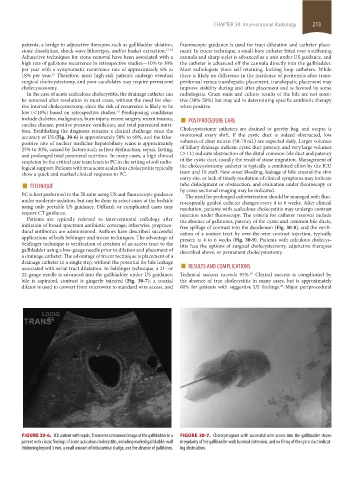
                    tion. Establishing the diagnosis remains a clinical challenge since the   Cholecystostomy catheters are drained to gravity bag, and output is
                    accuracy of US (Fig. 30-6) is approximately 50% to 60%, and the false-  monitored every shift. If the cystic duct is indeed obstructed, low
                    positive rate of nuclear medicine hepatobiliary scans is approximately   volumes of clear mucus (50-70 mL) are expected daily. Larger volumes
                    25% to 30%, caused by factors such as liver dysfunction, sepsis, fasting,   of biliary drainage indicate cystic duct patency, and very large volumes
                    and prolonged total parenteral nutrition. In many cases, a high clinical   (>1 L) indicate obstruction of the distal common bile duct and patency
                    suspicion by the critical care team leads to PC in the setting of soft radio-  of the cystic duct, usually the result of stone migration. Management of
                    logical support. Patients with true acute acalculous cholecystitis typically   the cholecystostomy catheter is typically a combined effort by the ICU
                    show a quick and marked clinical response to PC.      team and IR staff. New onset bleeding, leakage of bile around the skin
                        ■  TECHNIQUE                                      tube dislodgment or obstruction, and evaluation under fluoroscopy or
                                                                          entry site, or lack of timely resolution of clinical symptoms may indicate
                    PC is best performed in the IR suite using US and fluoroscopic guidance   by cross-sectional imaging may be indicated.
                                                                           The need for prolonged catheterization should be managed with fluo-
                    under moderate sedation, but can be done in select cases at the bedside   roscopically guided catheter changes every 4 to 6 weeks. After clinical
                    using only portable US guidance. Difficult or complicated cases may   resolution, patients with acalculous cholecystitis may undergo contrast
                    require CT guidance.                                  injection under fluoroscopy. The criteria for catheter removal include
                     Patients are typically referred  to interventional radiology  after   the absence of gallstones, patency of the cystic and common bile ducts,
                    initiation of broad-spectrum antibiotic coverage; otherwise, preproce-  free spillage of contrast into the duodenum (Fig. 30-8), and the verifi-
                    dural antibiotics are administered. Authors have described successful   cation of a mature tract by over-the-wire contrast injection, typically
                    applications of both Seldinger and trocar techniques. The advantage of     present at 4 to 6 weeks (Fig. 30-9). Patients with calculous cholecys-
                    Seldinger technique is verification of creation of an access tract to the   titis face the options of surgical cholecystectomy, adjunctive therapies
                    gallbladder using a low-gauge needle prior to dilation and placement of    described above, or permanent cholecystostomy.
                    a drainage catheter. The advantage of trocar technique is placement of a
                    associated with serial tract dilatation. In Seldinger technique, a 21- or   ■  RESULTS AND COMPLICATIONS
                    drainage catheter in a single step, without the potential for bile leakage
                    22-gauge needle is advanced into the gallbladder under US guidance,   Technical success exceeds 95%.  Clinical success is complicated by
                                                                                                 19
                    bile is aspirated, contrast is gingerly injected (Fig.  30-7), a coaxial   the absence of true cholecystitis in many cases, but is approximately
                    dilator is used to convert from microwire to standard wire access, and   60% for  patients with  suggestive  US findings.  Major  periprocedural
                                                                                                            20


                    FIGURE 30-6.  ICU patient with sepsis. Transverse ultrasound image of the gallbladder in a   FIGURE 30-7.  Cholecystogram with successful wire access into the gallbladder shows
                    patient with classic findings of acute acalculous cholecystitis, including marked gallbladder wall   irregularity of the gallbladder wall, luminal distension, and no filling of the cystic duct indicat-
                    thickening beyond 3 mm, a small amount of intraluminal sludge, and the absence of gallstones.  ing obstruction.


            section02.indd   213                                                                                       1/13/2015   2:05:49 PM

