


Page 311 - Hall et al (2015) Principles of Critical Care-McGraw-Hill
P. 311
CHAPTER 30: Interventional Radiology  215


                    been used successfully though medium-sized particles are most commonly   entirely account for the hemoptysis, a search of nonbronchial systemic col-
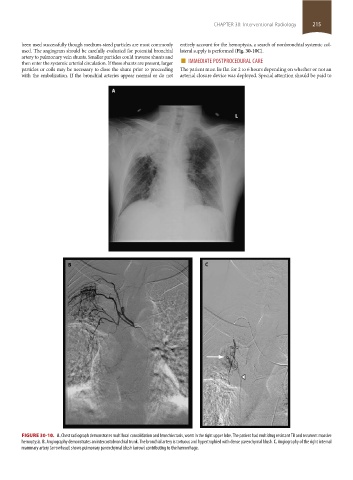
                    used. The angiogram should be carefully evaluated for potential bronchial   lateral supply is performed (Fig. 30-10C).
                    then enter the systemic arterial circulation. If these shunts are present, larger   ■  IMMEDIATE POSTPROCEDURAL CARE
                    artery to pulmonary vein shunts. Smaller particles could traverse shunts and
                    particles or coils may be necessary to close the shunt prior to proceeding   The patient must lie flat for 2 to 6 hours depending on whether or not an
                    with the embolization. If the  bronchial arteries appear normal or do not   arterial closure device was deployed. Special attention should be paid to


                    FIGURE 30-10.  A. Chest radiograph demonstrates multifocal consolidation and bronchiectasis, worst in the right upper lobe. The patient had multidrug resistant TB and recurrent massive
                    hemoptysis. B. Angiography demonstrates an intercostobronchial trunk. The bronchial artery is tortuous and hypertrophied with dense parenchymal blush. C. Angiography of the right internal
                    mammary artery (arrowhead) shows pulmonary parenchymal blush (arrow) contributing to the hemorrhage.


            section02.indd   215                                                                                       1/13/2015   2:05:54 PM

