


Page 308 - Hall et al (2015) Principles of Critical Care-McGraw-Hill
P. 308
212     PART 2: General Management of the Patient


                 similar technical and clinical success rates,  and both procedures   percutaneous nephrolithotomy by basket or snare in the IR suite, or
                                                   5,6
                 remain viable, first-line options for this indication. The presence of   require extracorporeal shock wave lithotripsy by urologists. If prolonged
                 thrombocytopenia associated with sepsis makes percutaneous access   PCN or PCNU is required, fluoroscopically guided catheter exchange
                 less optimal in many cases, and severe, uncorrectable coagulopathy is   is  recommended every  4  to 6  weeks.  PCNU  catheters  can  be capped
                 the main, relative contraindication to PCN. 7         for patient comfort if the patient remains asymptomatic. In many cases
                     ■  TECHNIQUE                                      involving neoplastic, fibrotic, inflammatory, or iatrogenic obstruction,
                                                                       prolonged internal drainage is preferred to external drainage for patient
                 PCN and PCNU are best performed in the IR suite using a combina-  comfort, and the PCN or PCNU can be converted to internal double J
                 tion of US and fluoroscopic guidance with the patient in the prone or   ureteral stents in the IR suite. Internal stents require routine cystoscopi-
                 semiprone position under moderate sedation. Preprocedural antibiotics   cally guided changes every 3 months by urology.
                 initiated prior to referral to radiology. Using Seldinger technique, a 21-   ■  CATHETER MANAGEMENT
                 are administered unless broad-spectrum antibiotic coverage has been
                 or 22-gauge needle is advanced through a posterior calyx into the renal   Management of the PCN catheter is typically a combined effort by the
                 pelvis under US guidance, urine is aspirated to verify access, contrast   ICU team and rounding IR staff. Typically, the collected urine progresses
                 is gingerly injected, a coaxial dilator is used to convert from microwire   from blood tinged to clear over 2 to 3 days. Severe bleeding at the time of
                 to standard wire access, and fluoroscopic guidance is used during tract   placement may respond to capping the catheter for a few hours to create
                 dilatation and catheter placement. Performance of a diagnostic neph-  a tamponade effect. Delayed onset of bleeding or persistent low-grade
                 rostogram involves intraluminal distension by contrast material with the   bleeding is typically caused by venous injury and addressed by reposi-
                 risk of symptom exacerbation, and is often deferred pending resolution   tioning or upsizing the catheter under fluoroscopic guidance. Leakage of
                 of fever and leukocytosis. The retention mechanism of a self-retaining   urine around the skin entry site, or lack of timely resolution of clinical
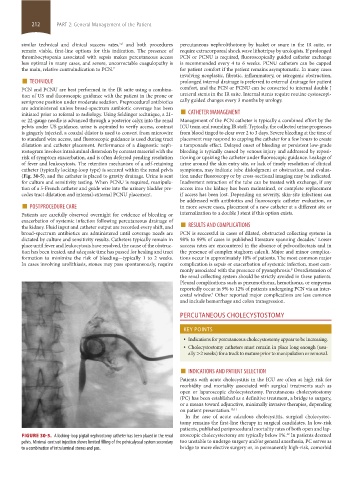
                 catheter (typically locking-loop type) is secured within the renal pelvis   symptoms, may indicate tube dislodgment or obstruction, and evalua-
                 (Fig. 30-5), and the catheter is placed to gravity drainage. Urine is sent   tion under fluoroscopy or by cross-sectional imaging may be indicated.
                 for culture and sensitivity testing. When PCNU is required, manipula-  Inadvertent retraction of the tube can be treated with exchange, if any
                 tion of a 5-French catheter and guide wire into the urinary bladder pre-  access into the kidney has been maintained, or complete replacement
                 cedes tract dilatation and internal-external PCNU placement.  if access has been lost. Depending on severity, skin-site infections can
                     ■  POSTPROCEDURE CARE                             be addressed with antibiotics and fluoroscopic catheter evaluation, or
                                                                       in more severe cases, placement of a new catheter at a different site or
                 Patients are carefully observed overnight for evidence of bleeding or   internalization to a double J stent if this option exists.
                 the kidney. Fluid input and catheter output are recorded every shift, and   ■  RESULTS AND COMPLICATIONS
                 exacerbation of systemic infection following percutaneous drainage of
                 broad-spectrum antibiotics are administered until coverage needs are   PCN is successful in cases of dilated, obstructed collecting systems in
                 dictated by culture and sensitivity results. Catheters typically remain in   98% to 99% of cases in published literature spanning decades.  Lower
                                                                                                                     7
                 place until fever and leukocytosis have resolved, the cause of the obstruc-  success rates are encountered in the absence of pelvocaliectasis and in
                 tion has been treated, and adequate time has passed for healing and tract   the presence of complex staghorn calculi. Major and minor complica-
                 formation to  minimize  the  risk  of  bleeding—typically  1  to  2  weeks.     tions occur in approximately 10% of patients. The most common major
                 In cases involving urolithiasis, stones may pass spontaneously, require   complication is sepsis or exacerbation of systemic infection, most com-
                                                                       monly associated with the presence of pyonephrosis.  Overdistension of
                                                                                                             8
                                                                       the renal collecting system should be strictly avoided in these patients.
                                                                       Pleural complications such as pneumothorax, hemothorax, or empyema
                                                                       reportedly occur in 9% to 12% of patients undergoing PCN via an inter-
                                                                       costal window.  Other reported major complications are less common
                                                                                  9
                                                                       and include hemorrhage and colon transgression.

                                                                       PERCUTANEOUS CHOLECYSTOSTOMY

                                                                        KEY POINTS
                                                                           • Indications for percutaneous cholecystostomy appear to be increasing.
                                                                           • Cholecystostomy catheters must remain in place long enough (usu-
                                                                          ally >2 weeks) for a track to mature prior to manipulation or removal.
                                                                           ■  INDICATIONS AND PATIENT SELECTION

                                                                       Patients with acute cholecystitis in the ICU are often at high risk for
                                                                       morbidity and mortality associated with surgical treatments such as
                                                                       open or laparoscopic cholecystectomy. Percutaneous cholecystostomy
                                                                       (PC) has been established as a definitive treatment, a bridge to surgery,
                                                                       or a means toward adjunctive, minimally invasive therapies, depending
                                                                       on patient presentation. 10,11
                                                                         In the case of acute calculous cholecystitis, surgical cholecystec-
                                                                       tomy remains the first-line therapy in surgical candidates. In low-risk
                                                                       patients, published periprocedural mortality rates of both open and lap-
                                                                                                            12
                 FIGURE 30-5.  A locking-loop pigtail nephrostomy catheter has been placed in the renal   aroscopic cholecystectomy are typically below 1%.  In patients deemed
                 pelvis. Minimal contrast injection shows limited filling of the pelvicalyceal system secondary   too unstable to undergo surgery and/or general anesthesia, PC serves as
                 to a combination of intraluminal stones and pus.      bridge to more elective surgery or, in permanently high-risk, comorbid


            section02.indd   212                                                                                       1/13/2015   2:05:48 PM

