


Page 365 - Hall et al (2015) Principles of Critical Care-McGraw-Hill
P. 365
CHAPTER 31: The Pathophysiology of the Circulation in Critical Illness  235

                        ■  EFFECTS OF PRESSURE OUTSIDE THE HEART ON CARDIAC OUTPUT  intravenous infusion to increase vascular stressed volume. In contrast,

                    In the figures cited and the preceding discussions, values of Pms and Pra   well-hydrated or overhydrated patients may tolerate even large amounts
                                                                          of PEEP or increased mean intrathoracic pressure from elevated
                    were expressed relative to atmospheric pressure. However, the transmu-
                    ral pressure of the right atrium exceeds the Pra by the subatmospheric   mechanical tidal volumes (V ) with no reduction in Q ˙ t because their
                                                                                               T
                                                                          previously inactive vascular reflexes  can increase  Pms in well-filled
                    value (about −4 mm Hg) of the Ppl surrounding the heart. Consider
                    the effect of opening the thorax, which raises Ppl from −4 to 0 mm Hg:     systemic vessels by the amount that Ppl increases with PEEP. These con-
                                                                          siderations allow the physician to anticipate and treat the hypotension
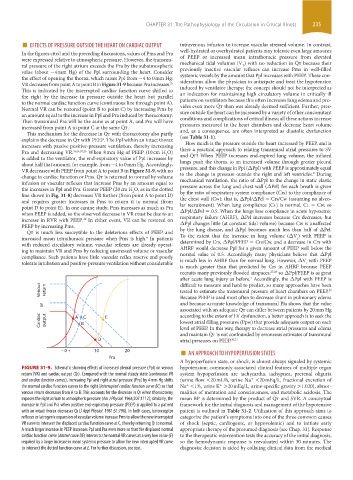
                    VR decreases from point A to point B in Figure 31-9 because Pra increases.
                                                                      25
                    This is indicated by the interrupted cardiac function curve shifted to    induced by ventilator therapy; the concept should not be interpreted as
                                                                          an indication for maintaining high circulatory volume in critically ill
                    the right by the increase in pressure outside the heart but parallel
                    to the normal cardiac function curve (continuous line through point A).   patients on ventilators because this often increases lung edema and pro-
                                                                          vides even more Q ˙ t than was already deemed sufficient. Further, pres-
                    Normal VR can be restored (point B to point C) by increasing Pms by
                    an amount equal to the increase in Ppl and Pra induced by thoracotomy.   sure outside the heart can be increased by a variety of other concomitant
                                                                          conditions and complications of critical illness; all these actions increase
                    Then transmural Pra will be the same as at point A, and Pra will have
                    increased from point A to point C at the same Q ˙ t.  pressures measured in the heart chambers and decrease heart volume
                                                                          and, as a consequence, are often interpreted as diastolic dysfunction
                     This mechanism for the decrease in Q ˙ t with thoracotomy also partly
                    explains the decrease in Q ˙ t with PEEP. The Ppl within an intact thorax   (see Table 31-1).
                                                                           How much is the pressure outside the heart increased by PEEP, and is
                    increases with passive positive-pressure ventilation, thereby increasing
                    Pra and decreasing VR. 5,6,9,10,26  When 8 mm Hg of PEEP (10 cm H O)   there a practical approach to relating transmural atrial pressures to SV
                                                                          and Q ˙ t? When PEEP increases end-expired lung volume, the inflated
                                                                     2
                    is added to the ventilator, the end-expiratory value of Ppl increases by
                    about half that amount, for example, from −4 to 0 mm Hg. Accordingly,   lungs push the thorax to an increased volume through greater pleural
                                                                          pressure, and this change in Ppl (ΔPpl) with PEEP is approximately equal
                    VR decreases with PEEP from point A to point B in Figure 31-9, with no                             9
                    change in cardiac function or Pms. Q ˙ t is returned to normal by volume   to the change in pressure outside the right and left ventricles.  During
                                                                          mechanical ventilation, the ratio of ΔPpl to the change in static elastic
                    infusion or vascular reflexes that increase Pms by an amount equal to
                    the increases in Ppl and Pra. Greater PEEP (20 cm H O, as in the dotted   pressure across the lung and chest wall (ΔPel) for each breath is given
                                                                          by the ratio of respiratory system compliance (Crs) to the compliance of
                                                         2
                    line shown in Fig. 31-8) decreases VR further (from point A to point D)
                    and requires greater increases in Pms to return it to normal (from   the chest wall (Cw); that is, ΔPpl/ΔPel = Crs/Cw ( assuming no alveo-
                                                                          lar recruitment). When lung compliance (Cl) is normal, Cl = Cw, so
                    point D to point E). In one canine study, Pms increases as much as Pra
                    when PEEP is added, so the observed decrease in VR must be due to an   ΔPpl/ΔPel = 0.5. When the lungs lose compliance in acute hypoxemic
                                                                          respiratory failure (AHRF),  ΔPel increases because Crs decreases, but
                    increase in RVR with PEEP.  In either event, VR can be restored on
                                         20
                    PEEP by increasing Pms.                               ΔPpl changes little (at constant tidal volume) because Cw is unaffected
                                                                          by the lung disease, and  ΔPpl becomes much less than half of  ΔPel.
                     Q ˙ t  is  much  less  susceptible  to  the  deleterious  effects  of  PEEP  and
                                                              4
                    increased mean intrathoracic pressure when Pms is high.  In patients   To the extent that the increase  in lung volume (ΔV ) with PEEP is
                                                                                                                 l
                                                                          determined by Crs, ΔPpl/PEEP = Crs/Cw, and a decrease in Crs with
                    with reduced circulatory volume, vascular reflexes are already operat-
                    ing to maintain VR and Pms by reducing unstressed volume or vascular   AHRF would decrease Ppl for a given amount of PEEP well below the
                                                                          normal value of 0.5. Accordingly many physicians believe that  ΔPpl
                    compliance. Such patients have little vascular reflex reserve and poorly
                    tolerate intubation and positive-pressure ventilation without  considerable    is much less in AHRF than for normal lung. However, ΔV  with PEEP
                                                                                                                    l
                                                                          is much greater than that predicted by Crs in AHRF because PEEP
                                                                          recruits many previously flooded airspaces, 27,28  so ΔPpl/PEEP is as great
                                                                          after acute lung injury as before.  Accordingly, the ΔPpl with PEEP is
                                                                                                 4
                          Venous  return                                  difficult to measure and hard to predict, so many approaches have been
                                                                          tested to estimate the transmural pressure of heart chambers on PEEP.
                                                                                                                            29
                                                                          Because PEEP is used most often to decrease shunt in pulmonary edema
                                                                          and because accurate knowledge of transmural Pla shows that the value
                           or
                                                                          associated with an adequate Q ˙ t can differ between patients by 20 mm Hg
                          Cardiac  output  A  B C  E                      according to the extent of LV dysfunction, a better approach is to seek the
                                                                          lowest atrial filling pressures (Ppw) that provide adequate output on each
                                                                          level of PEEP. In this way, therapy to decrease atrial pressures and edema
                                                                          and maintain Q ˙ t is not confounded by erroneous estimates of transmural
                                              D                           atrial pressures on PEEP. 30,31
                                 – 0 +      10         20                     ■  AN APPROACH TO HYPOPERFUSION STATES
                                                 Pra
                                                                          A hypoperfusion state, or shock, is almost always signaled by systemic
                    FIGURE 31-9.  Schematic showing effects of increased pleural pressure (Ppl) on venous   hypotension; commonly associated clinical features of multiple organ
                    return (VR) and cardiac output (Qt). Compared with the normal steady state (continuous VR   system hypoperfusion are tachycardia, tachypnea, prerenal oliguria
                                      ˙
                    and cardiac function curves), increasing Ppl and right atrial pressure (Pra) by 4 mm Hg shifts   (urine flow  <20 mL/h, urine Na   <20 mEq/L, fractional excretion of
                                                                                                  +
                                                                                       +
                    the normal cardiac function curves to the right (interrupted cardiac function curve BC) so that   Na  <1%, urine K  >20 mEq/L, urine-specific gravity >1.020), abnor-
                                                                            +
                                                           ˙
                    venous return decreases from A to B. This accounts for the decrease in Qt when thoracotomy   malities of mentation and consciousness, and metabolic acidosis. The
                    exposes the right atrium to atmospheric pressure (Am J Physiol. 1964;207:1112); similarly, the   mean BP is determined by the product of Q ˙ t and SVR. A conceptual
                    increase in Ppl and Pra when positive end-expiratory pressure (PEEP) is applied to a patient   framework for the initial diagnosis and management of the hypotensive
                                      ˙
                    with an intact thorax decreases Qt (J Appl Physiol. 1981;51:798). In both cases, baroreceptor   patient is outlined in Table 31-2. Utilization of this approach aims to
                    reflexes or iatrogenic expansion of vascular volume increase Pms to allow the new interrupted   categorize the patient’s symptoms into one of the three common causes
                                                                ˙
                    VR curve to intersect the displaced cardiac function curve at C, thereby returning Qt to normal.   of shock (septic, cardiogenic, or hypovolemic) and to initiate early
                    A much larger increase in PEEP increases Ppl and Pra even more so that the displaced normal   appropriate therapy of the presumed diagnosis (see Chap. 33). Response
                    cardiac function curve (dotted curve DE) intersects the normal VR curves at a very low value (E)   to the therapeutic intervention tests the accuracy of the initial diagnosis,
                    required by a larger increase in mean systemic pressure to allow the new interrupted VR curve   so the hemodynamic response is reevaluated within 30 minutes. The
                    to intersect the dotted function curve at E. For further discussion, see text.  diagnostic decision is aided by collating clinical data from the medical
            section03.indd   235                                                                                       1/23/2015   2:06:43 PM

