


Page 384 - Hall et al (2015) Principles of Critical Care-McGraw-Hill
P. 384
254     PART 3: Cardiovascular Disorders

                     ■  CATHETERS AND MONITORING DURING INITIAL RESUSCITATION  150

                 After an airway is established and breathing ensured, correction of the
                 circulatory abnormality always requires good intravenous access. For
                 large-volume administration, two peripheral intravenous catheters of
                 gauge 16 or larger or large-bore central venous access is required. Early   100
                 Goal-Directed  Therapy  mandates  immediate  placement  of  a  central
                 venous catheter. Electrocardiographic monitoring is easily accomplished
                 and usefully measures heart rate and rhythm for early detection and,   LV Pressure
                 hence, rational treatment of tachyarrhythmias or bradyarrhythmias
                 aggravating the low-flow state.                           50
                   The urinary bladder should be catheterized to measure urine output
                 and to facilitate urine sampling. A nasogastric or orogastric tube to
                 decompress the stomach and later to deliver medication and nutrition is
                 generally  required  in  the intubated  patient.  Measuring  arterial  pressure
                 with a peripheral arterial or femoral arterial catheter is useful because, in   0
                 the patient in shock with low cardiac output or low blood pressure, cuff   0  50        100           150
                 pressures may be inaccurate.  Appreciation of MAP, pulse pressure (related    LV Volume
                                     1
                 to stroke volume), and pulse pressure variation with respiration (values
                 greater than ~15% suggest volume-responsive hypovolemia ) are enabled.
                                                          26
                 Arterial blood-gas and other blood samples are also readily obtained.  12
                   Effective use and interpretation of Scv  and echocardiography often
                                               O 2
                 obviate pulmonary artery catheterization when the clinical hypothesis
                 of hypovolemic, cardiogenic, or septic shock is confirmed and corrected   10
                 by initial therapeutic intervention. There is no role for pulmonary artery
                 catheterization for routine monitoring or management of uncompli-  8
                 cated shock states. 27,28  Use of pulmonary artery catheterization should be
                 restricted to circumstances in which the derived measurements will alter
                 management or direct therapeutic interventions.          Cardiac output  6  Normal
                     ■  TEMPO                                               4


                 One of the most important contributions the intensivist can make to the   Hypovolemic Shock
                 care of a shock patient is to establish an appropriately rapid management   2
                 tempo. Rapid initial resuscitation improves survival (“time is tissue”). In
                 many instances, resuscitation driven by protocol can achieve adequate   0
                 resuscitation faster. Effective protocol-driven resuscitation requires   –5  0  5  10    15     20     25
                 significant preliminary discussion, buy in, and training of emergency      End-diastolic pressure
                 room physicians, house staff, nurses, respiratory therapists, and others.
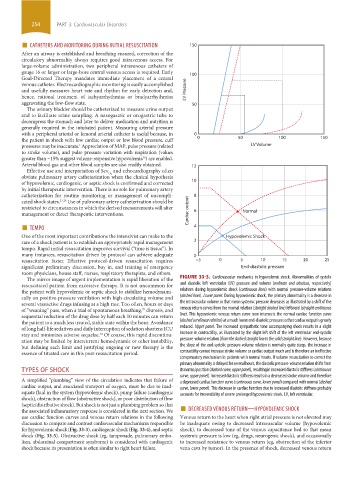
                   The mirror image of urgent implementation is rapid liberation of the    FIGURE 33-3.  Cardiovascular mechanics in hypovolemic shock. Abnormalities of systolic
                 resuscitated patient from excessive therapy. It is not uncommon for     and diastolic left ventricular (LV) pressure and volume (ordinate and abscissa, respectively)
                 the patient with hypovolemic or septic shock to stabilize hemodynami-  relations during hypovolemic shock (continuous lines) with normal pressure-volume relations
                 cally on positive-pressure ventilation with high circulating volume and   (dashed lines). Lower panel. During hypovolemic shock, the primary abnormality is a decrease in
                 several vasoactive drugs infusing at a high rate. Too often, hours or days   the intravascular volume so that mean systemic pressure decreases as illustrated by a shift of the
                 of “weaning” pass, when a trial of spontaneous breathing,  diuresis, and   venous return curves from the normal relation (straight dashed line) leftward (straight continuous
                                                          29
                 sequential reduction of the drug dose by half each 10 minutes can return   line). This hypovolemic venous return curve now intersects the normal cardiac function curve
                 the patient to a much less treated, stable state within the hour. Avoidance   (dashed curvilinear relation) at a much lower end-diastolic pressure so that cardiac output is greatly
                 of long half-life sedatives and daily interruption of sedation shortens ICU   reduced. Upper panel. The increased sympathetic tone accompanying shock results in a slight
                 stay and minimizes adverse sequelae.  Of course, this rapid discontinu-  increase in contractility, as illustrated by the slight left shift of the left ventricular end-systolic
                                            30
                 ation may be limited by intercurrent hemodynamic or other instability,   pressure-volume relation (from the dashed straight line to the solid straight line). However, because
                 but defining each limit and justifying ongoing or new therapy is the   the slope of the end-systolic pressure-volume relation is normally quite steep, the increase in
                 essence of titrated care in this post-resuscitation period.  contractility cannot increase stroke volume or cardiac output much and is therefore an ineffective
                                                                       compensatory mechanism in patients with normal hearts. If volume resuscitation to correct the
                                                                       primary abnormality is delayed for several hours, the diastolic pressure-volume relation shifts from
                 TYPES OF SHOCK                                        its normal position (dashed curve, upper panel), resulting in increased diastolic stiffness (continuous
                                                                       curve, upper panel). Increased diastolic stiffness results in a decreased stroke volume and therefore
                 A simplified “plumbing” view of the circulation indicates that failure of    a depressed cardiac function curve (continuous curve, lower panel) compared with normal (dashed
                 cardiac output, and associated transport of oxygen, must be due to inad-  curve, lower panel). This decrease in cardiac function due to increased diastolic stiffness probably
                 equate fluid in the system (hypovolemic shock), pump failure (cardiogenic   accounts for irreversibility of severe prolonged hypovolemic shock. LV, left ventricular.
                 shock), obstruction of flow (obstructive shock), or poor distribution of flow
                 the associated inflammatory response is considered in the next section. We   ■  DECREASED VENOUS RETURN—HYPOVOLEMIC SHOCK
                 (septic/distributive shock). But shock is not just a plumbing problem so that
                 use cardiac function curves and venous return relations in the following   Venous return to the heart when right atrial pressure is not elevated may
                 discussion to compare and contrast cardiovascular mechanisms responsible   be inadequate owing to decreased intravascular volume (hypovolemic
                 for hypovolemic shock (Fig. 33-3), cardiogenic shock (Fig. 33-4), and septic   shock), to decreased tone of the venous capacitance bed so that mean
                 shock (Fig. 33-5). Obstructive shock (eg, tamponade, pulmonary embo-  systemic pressure is low (eg, drugs, neurogenic shock), and occasionally
                 lism, abdominal compartment syndrome) is considered with cardiogenic   to increased resistance to venous return (eg, obstruction of the inferior
                 shock because its presentation is often similar to right heart failure.  vena cava by tumor). In the presence of shock, decreased venous return


            section03.indd   254                                                                                       1/23/2015   2:06:55 PM

