


Page 382 - Hall et al (2015) Principles of Critical Care-McGraw-Hill
P. 382
252     PART 3: Cardiovascular Disorders


                                                      Vital signs, laboratory data, cardiac monitoring,
                                                        pulse oximetry, urinary catheterization,
                                                       arterial and central venous catheterization

                                            Intervention            Dose                     Goal

                                                                                        CVP 8–12 mm Hg
                                         Crystalloid resuscitation  Minimum: 500 mL q30m
                                       1
                                         (warmed)               Moderate: 1000 mL q10m
                                                                                        MAP   65 mm Hg
                                       2  Norepinephrine        0.5–50 µg/min

                                                                                          Scv    70%
                                                                                            O 2
                                       3  Red blood cell transfusion  Hct   30%

                                       4  Dobutamine            2–20 µg/kg/min


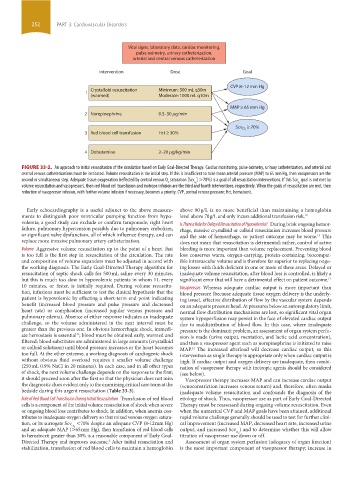
                 FIGURE 33-2.  An approach to initial resuscitation of the circulation based on Early Goal-Directed Therapy. Cardiac monitoring, pulse oximetry, urinary catheterization, and arterial and
                 central venous catheterizations must be instituted. Volume resuscitation is the initial step. If this is insufficient to raise mean arterial pressure (MAP) to 65 mm Hg, then vasopressors are the
                 second or simultaneous step. Adequate tissue oxygenation (reflected by central venous O  saturation [Scv ] >70%) is a goal of all resuscitation interventions. If this Scv  goal is not met by
                                                                   2
                                                                            o 2
                                                                                                               o 2
                 volume resuscitation and vasopressors, then red blood cell transfusion and inotrope infusion are the third and fourth interventions, respectively. When the goals of resuscitation are met, then
                 reduction of vasopressor infusion, with further volume infusion if necessary, becomes a priority. CVP, central venous pressure; Hct, hematocrit.
                   Early echocardiography is a useful adjunct to the above measure-  above 90 g/L is no more beneficial than maintaining a hemoglobin
                 ments  to  distinguish  poor  ventricular  pumping  function  from  hypo-  level above 70 g/L and only incurs additional transfusion risk. 12
                 volemia; a good study can exclude or confirm tamponade, right heart   Is There a Role for Delayed Resuscitation of Hypovolemia?  During brisk ongoing hemor-
                 failure, pulmonary hypertension possibly due to pulmonary embolism,   rhage, massive crystalloid or colloid resuscitation increases blood pressure
                 or significant valve dysfunction, all of which influence therapy, and can   and the rate of hemorrhage, so patient outcome may be worse.  This
                                                                                                                      13
                 replace more invasive pulmonary artery catheterization.  does not mean that resuscitation is detrimental; rather, control of active
                 Volume  Aggressive volume resuscitation up to the point of a heart that   bleeding is more important than volume replacement. Preventing blood
                 is too full is the first step in resuscitation of the circulation. The rate   loss conserves warm, oxygen-carrying, protein-containing, biocompat-
                 and composition of volume expanders must be adjusted in accord with   ible intravascular volume and is therefore far superior to replacing ongo-
                 the working diagnosis. The Early Goal-Directed Therapy algorithm for   ing losses with fluids deficient in one or more of these areas. Delayed or
                 resuscitation of septic shock calls for 500 mL saline every 30 minutes,   inadequate volume resuscitation, after blood loss is controlled, is likely a
                 but this is much too slow in hypovolemic patients in whom 1 L every   significant error that will have a detrimental effect on patient outcome. 11
                 10 minutes, or faster, is initially required. During volume resuscita-  Vasopressors  Whereas adequate cardiac output is more important than
                 tion, infusions must be sufficient to test the clinical hypothesis that the   blood pressure (because adequate tissue oxygen delivery is the underly-
                 patient is hypovolemic by effecting a short-term end point indicating   ing issue), effective distribution of flow by the vascular system depends
                 benefit (increased blood pressure and pulse pressure and decreased   on an adequate pressure head. At pressures below an autoregulatory limit,
                 heart rate) or complication (increased jugular venous pressure and   normal flow distribution mechanisms are lost, so significant vital organ
                 pulmonary edema). Absence of either response indicates an inadequate   system hypoperfusion may persist in the face of elevated cardiac output
                 challenge, so the volume administered in the next interval must be   due to maldistribution of blood flow. In this case, where inadequate
                 greater than the previous one. In obvious hemorrhagic shock, immedi-  pressure is the dominant problem, an assessment of organ system perfu-
                 ate hemostasis is essential ; blood must be obtained early, warmed and   sion is made (urine output, mentation, and lactic acid concentration),
                                    11
                 filtered; blood substitutes are administered in large amounts (crystalloid   and then a vasopressor agent such as norepinephrine is initiated to raise
                 or colloid solutions) until blood pressure increases or the heart becomes   MAP.  The increased afterload will decrease cardiac output, so this
                                                                           14
                 too full. At the other extreme, a working diagnosis of cardiogenic shock   intervention as single therapy is appropriate only when cardiac output is
                 without obvious fluid overload requires a smaller volume challenge   high. If cardiac output and oxygen delivery are inadequate, then combi-
                 (250 mL 0.9% NaCl in 20 minutes). In each case, and in all other types   nation of vasopressor therapy with inotropic agents should be consi dered
                 of shock, the next volume challenge depends on the response to the first;   (see below).
                 it should proceed soon after the first so that the physician does not miss     Vasopressor therapy increases MAP and can increase cardiac output
                 the diagnostic clues evident only to the examining critical care team at the    (venoconstriction increases venous return) and, therefore, often masks
                 bedside during this urgent resuscitation (Table 33-3).  inadequate volume resuscitation  and confounds the diagnosis of the
                 Role of Red Blood Cell Transfusion During Initial Resuscitation  Transfusion of red blood    etiology of shock. Thus, vasopressor use as part of Early Goal-Directed
                 cells is a component of the initial volume resuscitation of shock when severe   Therapy must be reassessed during ongoing volume resuscitation. Even
                 or ongoing blood loss contributes to shock. In addition, when anemia con-  when the numerical CVP and MAP goals have been attained, additional
                 tributes to inadequate oxygen delivery so that mixed venous oxygen satura-  rapid volume challenge generally should be used to test for further clini-
                 tion, or its surrogate Scv  <70% despite an adequate CVP (8-12 mm Hg)    cal improvement (increased MAP, decreased heart rate, increased urine
                                  O 2
                 and an adequate MAP (>65 mm Hg), then transfusion of red blood cells   output, and increased Scv ) and to determine whether this will allow
                                                                                          O 2
                 to hematocrit greater than 30% is a reasonable component of Early Goal-  titration of vasopressor use down or off.
                 Directed Therapy and improves outcome.  After initial resuscitation and   Assessment of organ system perfusion (adequacy of organ function)
                                               3
                 stabilization, transfusion of red blood cells to maintain a hemoglobin    is the most important component of vasopressor therapy; increase in


            section03.indd   252                                                                                       1/23/2015   2:06:54 PM

