


Page 381 - Hall et al (2015) Principles of Critical Care-McGraw-Hill
P. 381
CHAPTER 33: Shock   251


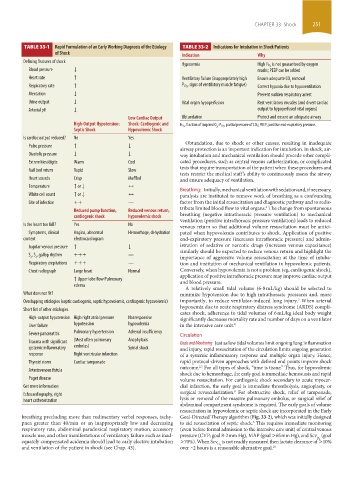
                      TABLE 33-1     Rapid Formulation of an Early Working Diagnosis of the Etiology     TABLE 33-2    Indications for Intubation in Shock Patients
                               of Shock                                   Indication                Why
                    Defining features of shock
                                                                          Hypoxemia                 High Fi O 2  is not guaranteed by oxygen
                      Blood pressure  ↓                                                             masks; PEEP can be added
                      Heart rate     ↑                                    Ventilatory failure (inappropriately high   Ensure adequate CO  removal
                                                                                                               2
                      Respiratory rate  ↑                                 P CO 2 , signs of ventilatory muscle fatigue)  Correct hypoxia due to hypoventilation
                      Mentation      ↓                                                              Prevent sudden respiratory arrest
                      Urine output   ↓                                    Vital organ hypoperfusion  Rest ventilatory muscles (and divert cardiac
                      Arterial pH    ↓                                                              output to hypoperfused vital organs)
                                                        Low Cardiac Output   Obtundation            Protect and ensure an adequate airway
                                     High-Output Hypotension:    Shock: Cardiogenic and   FiO 2 , fraction of inspired O ; PCO 2 , partial pressure of CO2; PEEP, positive end-expiratory pressure.
                                     Septic Shock       Hypovolemic Shock             2
                    Is cardiac output reduced?  No      Yes
                      Pulse pressure  ↑                 ↓                  Obtundation, due to shock or other causes, resulting in inadequate
                                                                          airway protection is an important indication for intubation. In shock, air-
                      Diastolic pressure  ↓             ↓                 way intubation and mechanical ventilation should precede other compli-
                      Extremities/digits  Warm          Cool              cated procedures, such as central venous catheterization, or complicated
                                                                          tests that require transportation of the patient when these procedures and
                      Nail bed return  Rapid            Slow
                                                                          tests restrict the medical staff’s ability to continuously assess the airway
                      Heart sounds   Crisp              Muffled           and ensure adequacy of ventilation.
                      Temperature    ↑ or ↓             ↔
                                                                          Breathing:  Initially, mechanical ventilation with sedation and, if necessary,
                      White cell count  ↑ or ↓          ↔                 paralysis are instituted to remove work of breathing as a confounding
                      Site of infection  ++             —                 factor from the initial resuscitation and diagnostic pathway and to redis-
                                                                          tribute limited blood flow to vital organs.  The change from spontaneous
                                                                                                       6
                                     Reduced pump function,   Reduced venous return,   breathing (negative intrathoracic pressure ventilation) to mechanical
                                       cardiogenic shock    hypovolemic shock  ventilation (positive intrathoracic pressure ventilation) leads to reduced
                    Is the heart too full?  Yes         No                venous return so that additional volume resuscitation must be antici-
                      Symptoms, clinical   Angina, abnormal    Hemorrhage, dehydration  pated when hypovolemia contributes to shock. Application of positive
                    context          electrocardiogram                    end-expiratory pressure (increases intrathoracic pressure) and admin-
                      Jugular venous pressure  ↑        ↓                 istration of  sedative  or  narcotic  drugs  (increases  venous  capacitance)
                                                                          similarly should be expected to reduce venous return and highlight the
                      S , S , gallop rhythm  +++        —
                       3  4                                               importance of aggressive volume resuscitation at the time of intuba-
                      Respiratory crepitations  +++     —                 tion and institution of mechanical ventilation in hypovolemic patients.
                      Chest radiograph  Large heart     Normal            Conversely, when hypovolemia is not a problem (eg, cardiogenic shock),
                                                                          application of positive intrathoracic pressure may improve cardiac output
                                     ↑ Upper lobe flow Pulmonary          and blood pressure.
                                     edema
                                                                           A relatively  small tidal  volume  (6-8 mL/kg)  should  be selected  to
                    What does not fit?                                    minimize hypotension due to high intrathoracic pressures and, more
                                                                                                                  7
                    Overlapping etiologies (septic cardiogenic, septic hypovolemic, cardiogenic hypovolemic)  importantly, to reduce ventilator-induced lung injury.  When arterial
                                                                          hypoxemia due to acute respiratory distress syndrome (ARDS) compli-
                    Short list of other etiologies
                                                                          cates shock, adherence to tidal volumes of 6 mL/kg ideal body weight
                      High-output hypotension High right atrial pressure   Nonresponsive   significantly decreases mortality rate and number of days on a ventilator
                      Liver failure    hypotension        hypovolemia     in the intensive care unit. 8
                      Severe pancreatitis  Pulmonary hypertension  Adrenal insufficiency  Circulation
                       Trauma with significant    (Most often pulmonary   Anaphylaxis  Goals and Monitoring  Just as low tidal volumes limit ongoing lung inflammation
                      systemic inflammatory   embolus)  Spinal shock      and injury, rapid resuscitation of the circulation limits ongoing generation
                      response       Right ventricular infarction         of a systemic inflammatory response and multiple organ injury. Hence,
                      Thyroid storm  Cardiac tamponade                    rapid protocol-driven approaches with defined end points improve shock
                                                                                2,3
                      Arteriovenous fistula                               outcome.  For all types of shock, “time is tissue.” Thus, for hypovolemic
                                                                          shock due to hemorrhage, the early goal is immediate hemostasis and rapid
                      Paget disease                                       volume resuscitation. For cardiogenic shock secondary to acute myocar-
                    Get more information                                  dial infarction, the early goal is immediate thrombolysis, angioplasty, or
                                                                                            9
                    Echocardiography, right                               surgical revascularization.  For obstructive shock, relief of tamponade,
                    heart catheterization                                 lysis or removal of the massive pulmonary embolus, or surgical relief of
                                                                          abdominal compartment syndrome is required. The early goals of volume
                                                                          resuscitation in hypovolemic or septic shock are incorporated in the Early
                    breathing precluding more than rudimentary verbal responses, tachy-  Goal-Directed Therapy algorithm (Fig. 33-2), which was initially designed
                    pnea greater than 40/min or an inappropriately low and decreasing   to aid resuscitation of septic shock.  This requires immediate monitoring
                                                                                                  3
                    respiratory rate, abdominal paradoxical respiratory motion, accessory   (even before formal admission to the intensive care unit) of central venous
                    muscle use, and other manifestations of ventilatory failure such as inad-  pressure (CVP; goal 8-2 mm Hg), MAP (goal >65 mm Hg), and Scv  (goal
                                                                                                                        O 2
                    equately compensated acidemia should lead to early elective intubation   >70%). When Scv  is not readily measured then lactate clearance of >10%
                                                                                      O 2
                    and ventilation of the patient in shock (see Chap. 43).  over ~2 hours is a reasonable alternative goal. 10


            section03.indd   251                                                                                       1/23/2015   2:06:53 PM

