


Page 380 - Hall et al (2015) Principles of Critical Care-McGraw-Hill
P. 380
250     PART 3: Cardiovascular Disorders


                 is minimized by rapid and adequate (usefully driven by protocol) initial   Interpretations of the data and response to initial therapy frequently con-
                 resuscitation. 2,3                                    firm the multiple etiologies or lead to a broader differential diagnosis of the
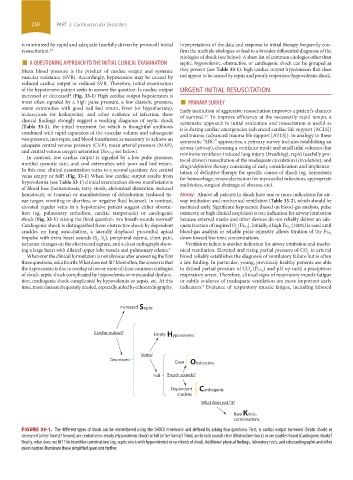
                     ■  A QUESTIONING APPROACH TO THE INITIAL CLINICAL EXAMINATION  etiologies of shock (see below). A short list of common etiologies other than
                                                                       septic, hypovolemic, obstructive, or cardiogenic shock can be grouped as
                 Mean blood pressure is the product of cardiac output and systemic   they present (see Table 33-1): high cardiac output hypotension that does
                 vascular resistance (SVR). Accordingly, hypotension may be caused by   not appear to be caused by sepsis and poorly responsive hypovolemic shock.
                 reduced cardiac output or reduced SVR. Therefore, initial examination
                 of the hypotensive patient seeks to answer the question: Is cardiac output  URGENT INITIAL RESUSCITATION
                 increased or decreased? (Fig. 33-1) High cardiac output hypotension is
                 most often signaled by a high pulse pressure, a low diastolic pressure,     ■  PRIMARY SURVEY
                 warm extremities with good nail bed return, fever (or hypothermia),   Early institution of aggressive resuscitation improves a patient’s chances
                 leukocytosis (or leukopenia), and other evidence of infection; these   of survival.  To improve efficiency at the necessarily rapid tempo, a
                                                                               2,3
                 clinical findings strongly suggest a working diagnosis of septic shock   systematic approach to initial evaluation and resuscitation is useful as
                 (Table  33-1), the initial treatment for which is thoughtful antibiosis   it is during cardiac emergencies (advanced cardiac life support [ACLS])
                 combined with rapid expansion of the vascular volume and subsequent   and trauma (advanced trauma life support [ATLS]). In analogy to these
                 vasopressors, inotropes, and blood transfusion as necessary to achieve an   systematic “ABC” approaches, a primary survey includes establishing an
                 adequate central venous pressure (CVP), mean arterial pressure (MAP),   airway (airway), choosing a ventilator mode and small tidal volumes that
                                                ; see below).
                 and central venous oxygen saturation (Scv O 2         minimize ventilator-induced lung injury (breathing), rapid (usefully pro-
                   In  contrast,  low  cardiac  output  is  signaled  by  a  low  pulse  pressure,   tocol driven) resuscitation of the inadequate circulation (circulation), and
                 mottled cyanotic skin, and cool extremities with poor nail bed return.   drugs/definitive therapy consisting of early consideration and implemen-
                 In this case, clinical examination turns to a second question: Are central   tation of definitive therapy for specific causes of shock (eg, hemostasis
                 veins empty or full? (Fig. 33-1) When low cardiac output results from   for hemorrhage, revascularization for myocardial infarction, appropriate
                 hypovolemia (see Table 33-1) clinical examination shows manifestations   antibiotics, surgical drainage of abscess, etc).
                 of blood loss (hematemesis, tarry stools, abdominal distention, reduced
                 hematocrit, or trauma) or manifestations of dehydration (reduced tis-  Airway:  Almost all patients in shock have one or more indications for air-
                 sue turgor, vomiting or diarrhea, or negative fluid balance). In contrast,   way intubation and mechanical ventilation (Table 33-2), which should be
                 elevated jugular veins in a hypotensive patient suggest either obstruc-  instituted early. Significant hypoxemia (based on blood-gas analysis, pulse
                 tion (eg, pulmonary embolism, cardiac tamponade) or cardiogenic   oximetry, or high clinical suspicion) is one indication for airway intubation
                 shock (Fig. 33-1) raising the third question: Are breath sounds normal?   because external masks and other devices do not reliably deliver an ade-
                 Cardiogenic shock is distinguished from obstructive shock by dependent   quate fraction of inspired O  (Fi O 2 ). Initially, a high Fi O 2  (100%) is used until
                                                                                          2
                 crackles on lung auscultation, a laterally displaced precordial apical   blood-gas analysis or reliable pulse oximetry allows titration of the Fi O 2
                 impulse with extra heart sounds (S , S ), peripheral edema, chest pain,   down toward less toxic concentrations.
                                           3
                                             4
                 ischemic changes on the electrocardiogram, and a chest radiograph show-  Ventilatory failure is another indication for airway intubation and mecha-
                 ing a large heart with dilated upper lobe vessels and pulmonary edema. 4  nical ventilation. Elevated and rising partial pressure of CO  in arterial
                                                                                                                   2
                   Whenever the clinical formulation is not obvious after answering the first   blood reliably establishes the diagnosis of ventilatory failure but is often
                 three questions, ask a fourth: What does not fit? Most often, the answer is that   a late finding. In particular, young, previously healthy patients are able
                 the hypotension is due to overlap of two or more of these common etiologies   to defend partial pressure of CO  (P CO 2 ) and pH up until a precipitous
                                                                                               2
                 of shock: septic shock complicated by hypovolemia or myocardial dysfunc-  respiratory arrest. Therefore, clinical signs of respiratory muscle fatigue
                 tion, cardiogenic shock complicated by hypovolemia or sepsis, etc. At this   or subtle evidence of inadequate ventilation are more important early
                 time, more data are frequently needed, especially aided by echocardiography.     indicators.  Evidence of respiratory muscle fatigue, including labored
                                                                               5
                                                   Increased  Septic


                                          Cardiac output?     Empty  Hypovolemic


                                                          Veins?
                                               Decreased
                                                                     Clear  Obstructive
                                                              Full  Breath sounds?

                                                                    Dependent  Cardiogenic
                                                                      crackles
                                                                              What does not fit?
                                                                                          Rare Kinds,
                                                                                          combinations
                 FIGURE 33-1.  The different types of shock can be remembered using the SHOCK mnemonic and defined by asking four questions. First, is cardiac output increased (Septic shock) or
                 decreased (other forms)? Second, are central veins empty (Hypovolemic shock) or full (other forms)? Third, are breath sounds clear (Obstructive shock) or are crackles heard (Cardiogenic shock)?
                 Finally, what does not fit? This identifies combinations (eg, septic shock with hypovolemia) or rare kinds of shock. Additional physical findings, laboratory tests, and echocardiographic and other
                 examinations illuminate these simplified questions further.


            section03.indd   250                                                                                       1/23/2015   2:06:53 PM

