


Page 385 - Hall et al (2015) Principles of Critical Care-McGraw-Hill
P. 385
CHAPTER 33: Shock   255


                         150                                                  150


                         100                                                  100
                        LV Pressure                                          LV Pressure


                          50                                                   50


                          0
                           0            50          100          150           0 0            50           100          150
                                            LV Volume
                                                                                                  LV Volume

                          12
                                                                               12
                          10
                                                                               10
                          8                                                    8                    Septic shock,
                         Cardiac output  6 4  Normal   Cardiogenic shock      Cardiac output  6  Normal
                                                                                                    compliant ventricle


                                                                                                          diastolic stiffness
                          2                                                    4                          Septic shock,
                                                                               2
                          0
                           −5     0      5     10     15    20     25
                                         End–diastolic pressure                0 −5    0      5      10     15     20     25
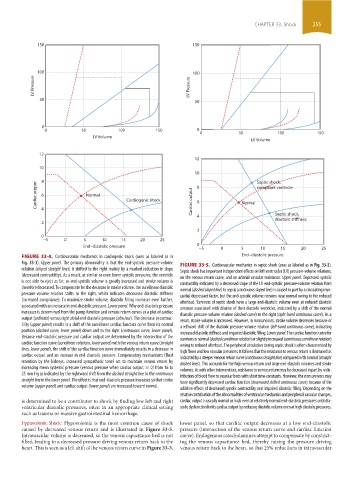
                    FIGURE 33-4.  Cardiovascular mechanics in cardiogenic shock (axes as labeled as in   End–diastolic pressure
                    Fig. 33-3). Upper panel. The primary abnormality is that the end-systolic pressure-volume   FIGURE 33-5.  Cardiovascular mechanics in septic shock (axes as labeled as in Fig. 33-3).
                    relation (sloped straight lines) is shifted to the right mainly by a marked reduction in slope   Septic shock has important independent effects on left ventricular (LV) pressure-volume relations,
                    (decreased contractility). As a result, at similar or even lower systolic pressures, the ventricle   on the venous return curve, and on arterial vascular resistance. Upper panel. Depressed systolic
                    is not able to eject as far, so end-systolic volume is greatly increased and stroke volume is   contractility indicated by a decreased slope of the LV end-systolic pressure-volume relation from
                    therefore decreased. To compensate for the decrease in stroke volume, the curvilinear diastolic   normal (dashed sloped line) to sepsis (continuous sloped line) is caused in part by a circulating myo-
                    pressure-volume relation shifts to the right, which indicates decreased diastolic stiffness   cardial depressant factor, but the end-systolic volume remains near normal owing to the reduced
                    (increased compliance). To maximize stroke volume, diastolic filling increases even further,   afterload. Survivors of septic shock have a large end-diastolic volume even at reduced diastolic
                    associated with an increase in end-diastolic pressure. Lower panel. Why end-diastolic pressure   pressure associated with dilation of their diastolic ventricles, indicated by a shift of the normal
                    increases is determined from the pump function and venous return curves as a plot of cardiac   diastolic pressure-volume relation (dashed curve) to the right (right-hand continuous curve). As a
                    output (ordinate) versus right atrial end-diastolic pressure (abscissa). The decrease in contrac-  result, stroke volume is increased. However, in nonsurvivors, stroke volume decreases because of
                    tility (upper panel) results in a shift of the curvilinear cardiac function curve from its normal   a leftward shift of the diastolic pressure-volume relation (left-hand continuous curve), indicating
                    position (dashed curve, lower panel) down and to the right (continuous curve, lower panel).   increased diastolic stiffness and impaired diastolic filling. Lower panel. The cardiac function curve for
                    Because end-diastolic pressure and cardiac output are determined by the intersection of the   survivors is normal (dashed curvilinear relation) or slightly increased (continuous curvilinear relation)
                    cardiac function curve (curvilinear relations, lower panel) with the venous return curve (straight   owing to reduced afterload. The peripheral circulation during septic shock is often characterized by
                    lines, lower panel), the shift of the cardiac function curve immediately results in a decrease in   high flows and low vascular pressures. It follows that the resistance to venous return is decreased as
                    cardiac output and an increase in end-diastolic pressure. Compensatory mechanisms (fluid   indicated by a steeper venous return curve (continuous straight line) compared with normal (straight
                    retention by the kidneys, increased sympathetic tone) act to maintain venous return by   dashed lines). This accounts for the high venous return and large end-diastolic volumes and stroke
                    increasing mean systemic pressure (venous pressure when cardiac output = 0) from 16 to   volumes. As with other interventions, resistance to venous return may be decreased in part by redis-
                    25 mm Hg as indicated by the rightward shift from the dashed straight line to the continuous   tribution of blood flow to vascular beds with short time constants. However, the nonsurvivors may
                    straight line in the lower panel. The effect is that end-diastolic pressure increases so that stroke   have significantly depressed cardiac function (downward shifted continuous curve) because of the
                    volume (upper panel) and cardiac output (lower panel) are increased toward normal.
                                                                          additive effects of decreased systolic contractility and impaired diastolic filling. Depending on the
                                                                          relative contribution of the abnormalities of ventricular mechanics and peripheral vascular changes,
                    is determined to be a contributor to shock by finding low left and right   cardiac output is usually normal or high even at relatively normal end-diastolic pressures until dia-
                    ventricular diastolic pressures, often in an appropriate clinical setting   stolic dysfunction limits cardiac output by reducing diastolic volume even at high diastolic pressures.
                    such as trauma or massive gastrointestinal hemorrhage.
                    Hypovolemic Shock:  Hypovolemia is the most common cause of shock   lower panel, so that cardiac output decreases at a low end-diastolic
                    caused by decreased venous return and is illustrated in  Figure 33-3.   pressure (intersection of the venous return curve and cardiac function
                    Intravascular volume is decreased, so the venous capacitance bed is not   curve). Endogenous catecholamines attempt to compensate by constrict-
                    filled, leading to a decreased pressure driving venous return back to the   ing  the venous  capacitance  bed,  thereby raising the  pressure driving
                    heart. This is seen as a left shift of the venous return curve in Figure 33-3,    venous return back to the heart, so that 25% reductions in  intravascular


            section03.indd   255                                                                                       1/23/2015   2:06:56 PM

