


Page 400 - Hall et al (2015) Principles of Critical Care-McGraw-Hill
P. 400
270     PART 3: Cardiovascular Disorders


                          150                                              150
                                        Doubled contractility                       Doubled contractility
                                        Normal initial contractility
                          100                                              100                             Low initial
                         LV Pressure                                      LV Pressure                      contractility


                           50                                               50


                           0                                                 0
                             0           50         100          150          0           50         100          150


                           12                                               12

                           10                                               10

                          Cardiac output  8 6  Doubled contractility       Cardiac output  8     Doubled contractility

                                                                             6
                                           Normal initial contractility
                            4
                                                                             4
                                                                                                           Low initial
                                                                                                           contractility
                            2                                                2
                            0                                                0
                            –5     0     5     10    15     20    25         –5     0     5     10    15     20    25
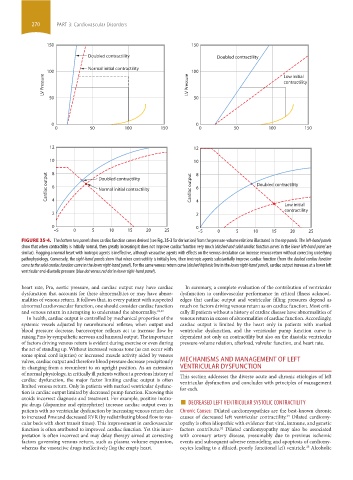
                 FIGURE 35-4.  The bottom two panels show cardiac function curves derived (see Fig. 35-3 for derivation) from the pressure-volume relations illustrated in the top panels. The left-hand panels
                 show that when contractility is initially normal, then greatly increasing it does not improve cardiac function very much (dashed and solid cardiac function curves in the lower left-hand panel are
                 similar). Flogging a normal heart with inotropic agents is ineffective, although vasoactive agents with effects on the venous circulation can increase venous return without correcting underlying
                 pathophysiology. Conversely, the right-hand panels show that when contractility is initially low, then inotropic agents substantially improve cardiac function (from the dashed cardiac function
                 curve to the solid cardiac function curve in the lower right-hand panel). For the same venous return curve (dashed biphasic line in the lower right-hand panel), cardiac output increases at a lower left
                 ventricular end-diastolic pressure (blue dot versus red dot in lower right-hand panel).

                 heart rate, Pra, aortic pressure, and cardiac output may have cardiac   In summary, a complete evaluation of the contribution of ventricular
                 dysfunction that accounts for these abnormalities or may have abnor-  dysfunction to cardiovascular performance in critical illness acknowl-
                 malities of venous return. It follows that, in every patient with suspected   edges  that  cardiac  output  and  ventricular  filling  pressures  depend  as
                 abnormal cardiovascular function, one should consider cardiac function   much on factors driving venous return as on cardiac function. Most criti-
                 and venous return in attempting to understand the abnormality. 21,23  cally ill patients without a history of cardiac disease have abnormalities of
                   In health, cardiac output is controlled by mechanical properties of the   venous return in excess of abnormalities of cardiac function. Accordingly,
                 systemic vessels adjusted by neurohumoral reflexes; when output and   cardiac output is limited by the heart only in patients with marked
                 blood pressure decrease, baroreceptor reflexes act to increase flow by   ventricular dysfunction, and the ventricular pump function curve is
                   raising Pms by sympathetic nervous and humoral output. The importance   dependent not only on contractility but also on the diastolic ventricular
                 of factors driving venous return is evident during exercise or even during   pressure-volume relation, afterload, valvular function, and heart rate.
                 the act of standing up. Without increased venous tone (as can occur with
                 some spinal cord injuries) or increased muscle activity aided by venous
                 valves, cardiac output and therefore blood pressure decrease precipitously   MECHANISMS AND MANAGEMENT OF LEFT
                 in changing from a recumbent to an upright position. As an extension   VENTRICULAR DYSFUNCTION
                 of normal physiology, in critically ill patients without a previous history of    This section addresses the diverse acute and chronic etiologies of left
                 cardiac dysfunction, the major factor limiting cardiac output is often   ventricular dysfunction and concludes with principles of management
                 limited venous return. Only in patients with marked ventricular dysfunc-  for each.
                 tion is cardiac output limited by decreased pump function. Knowing this
                 pic drugs (dopamine and epinephrine) increase cardiac output even in   ■  DECREASED LEFT VENTRICULAR SYSTOLIC CONTRACTILITY
                 avoids incorrect diagnosis and treatment. For example, positive inotro-
                 patients with no ventricular dysfunction by increasing venous return due   Chronic Causes:  Dilated cardiomyopathies are the best-known chronic
                 to increased Pms and decreased RVR (by redistributing blood flow to vas-  causes of decreased left ventricular contractility.  Dilated cardiomy-
                                                                                                            24
                 cular beds with short transit times). This improvement in cardiovascular   opathy is often idiopathic with evidence that viral, immune, and genetic
                 function is often attributed to improved cardiac function. Yet this inter-  factors  contribute.   Dilated  cardiomyopathy  may  also  be  associated
                                                                                     24
                 pretation is often incorrect and may delay therapy aimed at correcting     with coronary artery disease, presumably due to previous ischemic
                 factors governing venous return, such as plasma volume expansion,   events and subsequent adverse remodeling and apoptosis of cardiomy-
                                                                                                                  25
                 whereas the vasoactive drugs ineffectively flog the empty heart.  ocytes leading to a dilated, poorly functional left ventricle.  Alcoholic


            section03.indd   270                                                                                       1/23/2015   2:07:03 PM

