


Page 401 - Hall et al (2015) Principles of Critical Care-McGraw-Hill
P. 401
CHAPTER 35: Ventricular Dysfunction in Critical Illness   271


                            150                                              150


                                          Normal initial contractility
                            100           and afterload                      100
                           LV Pressure                                      LV Pressure                      Low initial

                                                                                                             contractility
                             50           Afterload decreased                 50
                                                                                                 Afterload decreased


                              0                                                0
                               0           50          100         150          0           50          100         150


                             12                                               12

                             10                                               10

                            Cardiac output  8 6 4  Afterload decreased       Cardiac output  8         Afterload decreased

                                                                               6
                                              Normal initial contractility


                              2                                                4                              Low initial
                                                                               2
                                                                                                              contractility
                              0                                                0
                               –5    0      5    10     15    20    25          –5    0      5     10    15    20    25
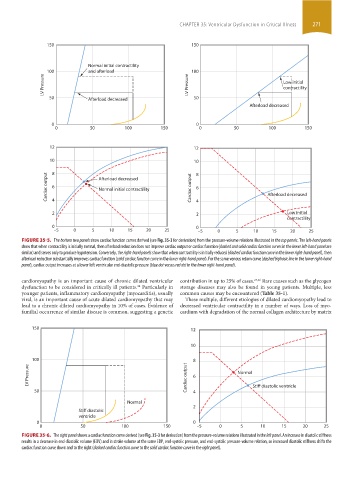
                    FIGURE 35-5.  The bottom two panels show cardiac function curves derived (see Fig. 35-3 for derivation) from the pressure-volume relations illustrated in the top panels. The left-hand panels
                    show that when contractility is initially normal, then afterload reduction does not improve cardiac output or cardiac function (dashed and solid cardiac function curves in the lower left-hand panel are
                    similar) and serves only to produce hypotension. Conversely, the right-hand panels show that when contractility is initially reduced (dashed cardiac function curve in the lower right-hand panel), then
                    afterload reduction substantially improves cardiac function (solid cardiac function curve in the lower right-hand panel). For the same venous return curve (dashed biphasic line in the lower right-hand
                    panel), cardiac output increases at a lower left ventricular end-diastolic pressure (blue dot versus red dot in the lower right-hand panel).


                    cardiomyopathy is an important cause of chronic dilated ventricular   contribution in up to 25% of cases. 24,26  Rare causes such as the glycogen
                    dysfunction to be considered in critically ill patients.  Particularly in   storage diseases may also be found in young patients. Multiple, less
                                                           24
                    younger patients, inflammatory cardiomyopathy (myocarditis), usually   common causes may be encountered (Table 35-1).
                    viral, is an important cause of acute dilated cardiomyopathy that may   These multiple, different etiologies of dilated cardiomyopathy lead to
                    lead to a chronic dilated cardiomyopathy in 10% of cases. Evidence of   decreased ventricular contractility in a number of ways. Loss of myo-
                    familial occurrence of similar disease is common, suggesting a genetic   cardium with degradation of the normal collagen architecture by matrix


                       150                                                   12

                                                                             10

                       100                                                    8
                      LV Pressure                                           Cardiac output  6  Normal


                        50                                                    4                   Sti  diastolic ventricle

                                                        Normal
                                                                              2
                                       Sti  diastolic
                                       ventricle
                         0                                                    0
                          0             50            100           150        –5      0      5      10     15     20      25
                    FIGURE 35-6.  The right panel shows a cardiac function curve derived (see Fig. 35-3 for derivation) from the pressure-volume relations illustrated in the left panel. An increase in diastolic stiffness
                    results in a decrease in end-diastolic volume (EDV) and in stroke volume at the same EDP, end-systolic pressure, and end-systolic pressure-volume relation, so increased diastolic stiffness shifts the
                    cardiac function curve down and to the right (dashed cardiac function curve to the solid cardiac function curve in the right panel).


            section03.indd   271                                                                                       1/23/2015   2:07:04 PM

