


Page 403 - Hall et al (2015) Principles of Critical Care-McGraw-Hill
P. 403
CHAPTER 35: Ventricular Dysfunction in Critical Illness   273


                    can also rapidly decrease ionized calcium levels and, as a result, may   associated with an increase in lactic acid production because bicarbonate
                    depress ventricular contractility.  In addition to ionized hypocalcemia,   increases the rate-limiting step of glycolysis. Bicarbonate therapy also
                                           42
                    other electrolyte abnormalities, including hypophosphatemia, hypo-  decreases blood levels of ionized calcium. 41,42
                    magnesemia, and hypokalemia  or hyperkalemia,  may contribute  to   Decreased contractility due to ionized hypocalcemia can be corrected
                    decreased contractility or, more importantly, to arrhythmias.  using  an  intravenous  infusion  of  calcium.  After  approximately  6  U  of
                                                                          transfusion, ionized hypocalcemia should be measured and corrected, if
                    Management of Decreased Left Ventricular Contractility    necessary. Hypophosphatemia, hypomagnesemia, hypokalemia, hyperka-
                    in Critical Illness                                   lemia, and other metabolic disturbances should also be corrected because
                    Identify and Correct Acute Reversible Causes  It is important to identify the mul-  they may lead directly or indirectly to altered cardiovascular function.
                    tiple, different potentially reversible causes for depressed contractility in   Managing the Depressed Heart  Having reversed the acute contributors to
                    critically ill patients because, although alone they may be insufficient to   depressed left ventricular contractility, standard therapy of decreased left
                    account for the left ventricular dysfunction, together they may signifi-  ventricular contractility includes optimizing ventricular filling pressure,
                    cantly depress function. For example, if ischemia or hypoxemia is pres-  decreasing afterload when arterial pressure is adequate, and increasing
                    ent, aggressive attempts to correct it should be instituted. In the presence   contractility using inotropic agents. 45,46  These therapies are considered
                    of coronary artery disease, standard care including heparin, antiplatelet   in detail below (see “Acute on Chronic Heart Failure”). Assisted positive
                    therapy, β-blockade, and coronary vasodilation using nitrates may be   pressure ventilation may help by improving oxygenation, decreasing
                    helpful. Emergency percutaneous coronary intervention (PCI) to rapidly    dyspnea, and decreasing left ventricular afterload. This can be applied
                    reestablish perfusion or, if this is not possible, early thrombolytic therapy   using noninvasive mask ventilation (eg, CPAP or BiPAP) or, following
                    after acute coronary thrombosis decreases the incidence of congestive   intubation, using conventional mechanical ventilation modes. 47,48
                    heart failure and improves outcome (see Chap. 37).     When vasodilator and inotropic therapy is insufficient, temporary
                     Limitation  of the  intramyocardial  inflammatory  response  by early   support using intra-aortic balloon counterpulsation, ventricular assist
                    aggressive treatment of myocardial ischemia or by early aggressive treat-  devices, or ECMO is appropriate when damaged myocardium is
                    ment of sepsis and its associated systemic inflammatory response are   expected to recover or as supportive therapy leading to surgical correc-
                    effective. 43,44  Specific treatment using anti-inflammatory strategies has   tion of an anatomic abnormality (see Chap. 53). 49,50  Resynchronization
                    not yet been shown to definitively improve ventricular function.  therapy using biventricular pacing may help.  Finally, heart transplan-
                                                                                                          51
                     Correction of hypoxemia and anemia may result in substantial   tation may be necessary. Stem cell transplantation is a promising new
                    improvement in  ventricular  function.  Attention  should  be paid  to   approach under investigation to repair damaged myocardium. 52,53
                    decreasing factors that increase myocardial oxygen demand. Therefore,   The ventricular pump function curve illustrates the Frank-Starling
                    when β-blockade is not feasible, choosing the lowest level of inotropic   mechanism, which shows that increased ventricular filling results
                    and vasoactive drugs that produces the desired therapeutic effect will   in  increased ejection even when contractility is depressed. The limit to
                    minimize their contribution to myocardial oxygen demand. Likewise,   increased ventricular filling is generally set by the onset of pulmonary
                    alleviating pain is important to diminish the associated tachycardia and   edema. Pulmonary edema fluid enters the lung interstitium according to
                    increased sympathetic tone.                           the Starling equation. At normal protein osmotic pressures (largely due
                     In ventilated patients with left ventricular dysfunction, the detrimental   to albumin) and normal permeability of the pulmonary endothelium, pul-
                    effects of acute respiratory acidosis should be considered; mixed venous   monary edema starts to develop at Ppw values of at least 20 to 25 mm Hg.
                                                                                                                            54
                    and, hence, tissue P   is much higher than the arterial partial pressure of   In the presence of decreased oncotic pressure due to decreased albumin
                                 CO 2
                    CO  when the cardiac output is low. In general, metabolic acidosis should   or in the presence of a leaky pulmonary endothelium, pulmonary edema
                      2
                    be treated by reversing its etiology. Alkali therapy for increased anion gap   may form at considerably lower Ppw values; in acute respiratory distress
                    metabolic acidosis is of no benefit and may be dangerous even at pH values     syndrome (ARDS) or pneumonia, pulmonary edema may form at very
                    as low as 7.0 for a number of reasons.  Bicarbonate infusion results in   low Ppw values. With this in mind, it is appropriate to search for the Ppw
                                               42
                    an increase in P   due to chemical equilibrium of HCO  with H O and   that produces the highest cardiac output without resulting in substantial
                                                            −
                                                            3
                                                                  2
                               CO 2
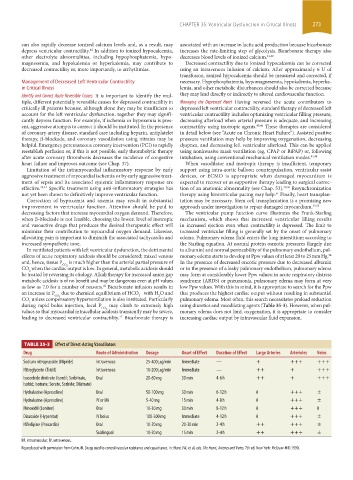
                    CO  unless compensatory hyperventilation is also instituted. Particularly   pulmonary edema. Most often, this search necessitates preload reduction
                      2
                    during rapid bolus injection, local P   may climb to extremely high   using diuretics and vasodilating agents (Table 35-3). However, when pul-
                                               CO 2
                    values so that myocardial intracellular acidosis transiently may be severe,   monary edema does not limit oxygenation, it is appropriate to consider
                    leading to decreased ventricular contractility.  Bicarbonate therapy is   increasing cardiac output by intravascular fluid expansion.
                                                     37
                      TABLE 35-3    Effect of Direct-Acting Vasodilators
                    Drug                     Route of Administration  Dosage  Onset of Effect  Duration of Effect  Large Arteries  Arterioles  Veins
                    Sodium nitroprusside (Nipride)  Intravenous  25-400 µg/min  Immediate  —        +          +++      +++
                    Nitroglycerin (Tridil)   Intravenous      10-200 µg/min  Immediate  —           ++         +        +++
                    Isosorbide dinitrate (Isordil; Sorbitrate,    Oral  20-60 mg  30 min  4-6 h     ++         +        +++
                    Isobid; Isotrate; Sorate, Sorbide; Dilatrate)
                    Hydralazine (Apresoline)  Oral            50-100 mg   30 min      6-12 h        0          +++      ±
                    Hydralazine (Apresoline)  IV or IM        5-40 mg     15 min      4-8 h         0          +++      ±
                    Minoxidil (Loniten)      Oral             10-30 mg    30 min      8-12 h        0          +++      0
                    Diazoxide (Hyperstat)    IV bolus         100-300 mg  Immediate   4-12 h        0          +++      ±
                    Nifedipine (Procardia)   Oral             10-20 mg    20-30 min   2-4 h         ++         +++      ±
                                             Sublingual       10-20 mg    15 min      2-4 h         ++         +++      ±
                    IM, intramuscular; IV, intravenous.
                    Reproduced with permission from Cohn JN. Drugs used to control vascular resistance and capacitance. In: Hurst JW, et al, eds. The Heart, Arteries and Veins. 7th ed. New York: McGraw-Hill; 1990.


            section03.indd   273                                                                                       1/23/2015   2:07:05 PM

