


Page 402 - Hall et al (2015) Principles of Critical Care-McGraw-Hill
P. 402
272     PART 3: Cardiovascular Disorders


                 metalloproteinases and replacement with fibrous connective tissue leads   S100A8/A9, HMGB1) bind innate immune Toll-like receptors. Once
                 to remodeling and decreased contractility. 24,27  Increased levels of circu-  triggered, Toll-like receptors signal through NF-κB and other pathways
                 lating renin, angiotensin II, endothelin, and norepinephrine promote   to increase expression of inflammatory cytokines, cell surface adhesion
                 cardiomyocyte hypertrophy, apoptosis, myocardial fibrosis, and vascular   molecules, calcium channel binding proteins like S100A8/A8, reactive
                 cell hypertrophy. Myocardial norepinephrine stores are depleted and   oxygen radicals, and nitric oxide; all of which can contribute to decreased
                 β-receptor density is reduced in chronic dilated cardiomyopathy. 25,27,28    ventricular contractility.  Coronary capillary endothelial activation,
                                                                                         31
                 Biochemical changes that may contribute to decreased contractility   damage, and dysfunction also contribute, in part due to impaired regu-
                 include  decreased  efficiency  of  the  sarcoplasmic  reticulum  calcium   lation of coronary microvascular blood flow, which impairs myocardial
                 pump, decreased actin-myosin adenosine triphosphatase activity, and   oxygen extraction, and in part due to edemagenesis.  Thus, multiple
                                                                                                              32
                 change in myosin isoenzyme composition.               pathways of the intramyocardial inflammatory response may contribute
                                                                       to myocardial dysfunction following myocardial ischemia-reperfusion
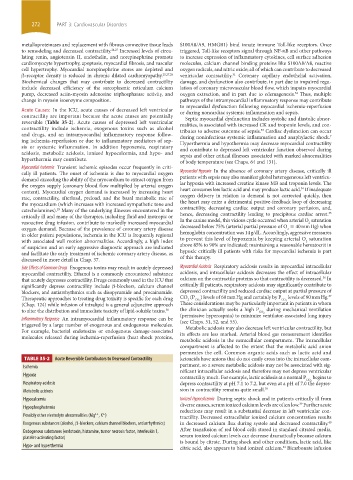
                 Acute Causes:  In the ICU, acute causes of decreased left ventricular   or during noncardiac systemic inflammation and sepsis.
                 contractility  are  important  because the  acute  causes  are  potentially   Septic myocardial dysfunction includes systolic and diastolic abnor-
                 reversible  (Table 35-2).  Acute  causes  of  depressed  left  ventricular   malities, is associated with increased CK and troponin levels, and con-
                 contractility include ischemia, exogenous toxins such as alcohol   tributes to adverse outcome of sepsis.  Cardiac dysfunction can occur
                                                                                                   33
                 and drugs, and an intramyocardial inflammatory response follow-  during noninfectious systemic inflammation and anaphylactic shock.
                                                                                                                          7
                 ing ischemia-reperfusion or due to inflammatory mediators of sep-  Hyperthermia and hypothermia may decrease myocardial contractility
                 sis or systemic inflammation. In addition hypoxemia, respiratory   and contribute to depressed left ventricular function observed during
                 acidosis, metabolic acidosis, ionized hypocalcemia, and hypo- and   sepsis and other critical illnesses associated with marked abnormalities
                   hyperthermia may contribute.                        of body temperature (see Chaps. 64 and 131).
                 Myocardial Ischemia  Transient ischemic episodes occur frequently in criti-
                 cally ill patients. The onset of ischemia is due to myocardial oxygen   Myocardial Hypoxia  In the absence of coronary artery disease, critically ill
                 demand exceeding the ability of the myocardium to extract oxygen from   patients with sepsis may also manifest global heterogeneous left ventricu-
                 the oxygen supply (coronary blood flow multiplied by arterial oxygen   lar hypoxia with increased creatine kinase MB and troponin levels. The
                                                                                                                34
                 content). Myocardial oxygen demand is increased by increasing heart   heart consumes less lactic acid and may produce lactic acid.  If inadequate
                 rate,  contractility, afterload, preload, and the  basal  metabolic  rate  of   oxygen delivery in relation to demand is not corrected quickly, then
                 the myocardium (which increases with increased sympathetic tone and   the heart may enter a detrimental positive-feedback loop of decreasing
                 catecholamines).  Many of the underlying illnesses encountered in the   contractility, decreasing cardiac output and coronary perfusion, and,
                             29
                                                                                                                          35
                 critically ill and many of the therapies, including fluid and inotropic or   hence,  decreasing  contractility  leading  to  precipitous  cardiac  arrest.
                 vasoactive drug infusion, contribute to markedly increased myocardial   In the canine model, this vicious cycle occurred when arterial O  saturation
                                                                                                                   2
                 oxygen demand. Because of the prevalence of coronary artery disease   decreased below 75% (arterial partial pressure of O  = 40 mm Hg) when
                                                                                                            2
                 in older patient populations, ischemia in the ICU is frequently regional   hemoglobin concentration was 14 g/dL. Accordingly, aggressive measures
                 with associated wall motion abnormalities. Accordingly, a high index   to prevent this level of hypoxemia by keeping arterial O  saturation
                                                                                                                  2
                 of suspicion and an early aggressive diagnostic approach are indicated   above 85% to 90% are indicated; maintaining a reasonable hematocrit in
                 and facilitate the early treatment of ischemic coronary artery disease, as   hypoxic critically ill patients with risks for myocardial ischemia is part
                 discussed in more detail in Chap. 37.                 of this therapy.
                 Side Effects of Common Drugs  Exogenous toxins may result in acutely depressed   Myocardial Acidosis  Respiratory acidosis results in myocardial intracellular
                 myocardial contractility. Ethanol is a commonly encountered substance   acidosis, and intracellular acidosis decreases the effect of intracellular
                                                                                                                        36
                 that acutely depresses contractility. Drugs commonly used in the ICU that   calcium on the contractile proteins so that contractility is decreased.  In
                 significantly depress contractility include  β-blockers, calcium channel   critically ill patients, respiratory acidosis may significantly contribute to
                 blockers, and antiarrhythmics such as disopyramide and procainamide.   depressed contractility and reduced cardiac output at partial pressure of
                                                                                                                          37
                 Therapeutic approaches to treating drug toxicity is specific for each drug   CO  (P CO 2 ) levels of 60 mm Hg and certainly by P CO 2  levels of 90 mm Hg.
                                                                          2
                 (Chap. 124) while infusion of intralipid is a general adjunctive approach   These considerations may be particularly important in patients in whom
                 to alter the distribution and immediate toxicity of lipid-soluble toxins. 30  the clinician actually seeks a high P CO 2  during mechanical ventilation
                 Inflammatory Response  An intramyocardial inflammatory response can be   (permissive hypercapnia) to minimize ventilator-associated lung injury
                                                                       (see Chaps. 51, 52, and 55).
                 triggered by a large number of exogenous and endogenous molecules.
                                                                         Metabolic acidosis may also decrease left ventricular contractility, but
                 For example, bacterial endotoxins or endogenous damage-associated   its effects are less marked. Arterial blood gas measurement identifies
                 molecules released during ischemia-reperfusion (heat shock proteins,
                                                                       metabolic acidosis in the extracellular compartment. The intracellular
                                                                       compartment is affected to the extent that the metabolic acid anion
                                                                       permeates the cell. Common organic acids such as lactic acid and
                   TABLE 35-2    Acute Reversible Contributors to Decreased Contractility  ketoacids have anions that do not easily cross into the intracellular com-
                  Ischemia                                             partment, so a severe metabolic acidosis may not be associated with sig-
                                                                       nificant intracellular acidosis and therefore may not depress ventricular
                  Hypoxia                                              contractility much. For example, lactic acidosis at a normal P   begins to
                                                                                                                  CO 2
                  Respiratory acidosis                                 depress contractility at pH 7.1 to 7.2, but even at a pH of 7.0 the depres-
                  Metabolic acidosis                                   sion in contractility remains quite small. 38
                  Hypocalcemia                                         Ionized Hypocalcemia  During septic shock and in patients critically ill from
                                                                       diverse causes, serum ionized calcium levels are often low.  Further acute
                                                                                                                39
                  Hypophosphatemia
                                                                       reductions may result in a substantial decrease in left ventricular con-
                                          2+
                                             +
                  Possibly other electrolyte abnormalities (Mg , K )   tractility. Decreased extracellular ionized calcium concentration results
                  Exogenous substances (alcohol, β-blockers, calcium channel blockers, antiarrhythmics)  in decreased calcium flux during systole and decreased contractility.
                                                                                                                          40
                  Endogenous substances (endotoxin, histamine, tumor necrosis factor, interleukin 1,   After transfusion of red blood cells stored in standard citrated media,
                  platelet-activating factor)                          serum ionized calcium levels can decrease dramatically because calcium
                                                                       is bound by citrate. During shock and other conditions, lactic acid, like
                  Hypo- and hyperthermia
                                                                       citric acid, also appears to bind ionized calcium.  Bicarbonate infusion
                                                                                                          41


            section03.indd   272                                                                                       1/23/2015   2:07:04 PM

