


Page 440 - Hall et al (2015) Principles of Critical Care-McGraw-Hill
P. 440
310     PART 3: Cardiovascular Disorders


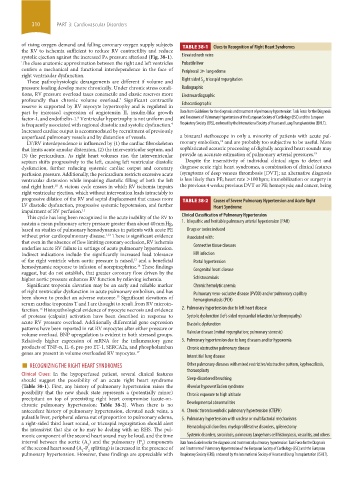
                 of rising oxygen demand and falling coronary oxygen supply subjects     TABLE 38-1    Clues to Recognition of Right Heart Syndromes
                 the RV to ischemia sufficient to reduce RV contractility and reduce
                 systolic ejection against the increased Pa pressure afterload (Fig. 38-1).   Elevated neck veins
                 The close anatomic approximation between the right and left ventricles   Pulsatile liver
                 confers  a  mechanical  and  functional  interdependence  in  the  face  of   Peripheral ≫ lung edema
                 right ventricular dysfunction.
                   These pathophysiologic derangements are different if volume and   Right sided S , tricuspid regurgitation
                                                                               3
                 pressure loading develop more chronically. Under chronic stress condi-  Radiographic
                 tions, RV pressure overload taxes contractile and elastic reserves more   Electrocardiographic
                 profoundly than chronic volume overload.   Significant  contractile
                                                   7
                 reserve is supported by RV myocyte hypertrophy and is regulated in   Echocardiographic
                 part by increased expression of angiotensin II, insulin-like growth   Data from Guidelines for the diagnosis and treatment of pulmonary hypertension: Task Force for the Diagnosis
                 factor-I, and endothelin-1.  Ventricular hypertrophy is not uniform and   and Treatment of Pulmonary Hypertension of the European Society of Cardiology (ESC) and the European
                                    8
                 is frequently associated with regional diastolic and systolic dysfunction.    Respiratory Society (ERS), endorsed by the International Society of Heart and Lung Transplantation (ISHLT).
                                                                    9
                 Increased cardiac output is accommodated by recruitment of previously
                 unperfused pulmonary vessels and by distention of vessels.  a binaural stethoscope in only a minority of patients with acute pul-
                                                                                     18
                   LV/RV interdependence is influenced by (1) the cardiac fibroskeleton   monary embolism,  and are probably too subjective to be useful. More
                 that limits acute annular distension, (2) the interventricular septum, and   sophisticated acoustic processing of digitally acquired heart sounds may
                 (3) the pericardium. As right heart volumes rise, the interventricular   provide an accurate estimation of pulmonary arterial pressures. 19
                 septum shifts progressively to the left, causing left ventricular diastolic   Despite the insensitivity of individual clinical signs to detect and
                 dysfunction, further reducing systemic cardiac output and coronary   diagnose acute right heart syndromes, a combination of clinical features
                 perfusion pressure. Additionally, the pericardium restricts excessive acute   (symptoms of deep venous thrombosis [DVT]; an alternative diagnosis
                 ventricular  distension  while  impairing  diastolic  filling  of  both  the  left   is less likely than PE; heart rate >100 bpm; immobilization or surgery in
                 and right heart.  A vicious cycle ensues in which RV ischemia impairs   the previous 4 weeks; previous DVT or PE; hemoptysis; and cancer, being
                             10
                 right ventricular ejection, which without intervention leads intractably to
                 progressive dilation of the RV and septal displacement that causes more     TABLE 38-2     Causes of Severe Pulmonary Hypertension and Acute Right
                 LV diastolic dysfunction, progressive systemic hypotension, and further   Heart Syndrome
                 impairment of RV perfusion. 11
                   This cycle has long been recognized in the acute inability of the RV to   Clinical Classification of Pulmonary Hypertension
                 sustain a mean pulmonary artery pressure greater than about 40 mm Hg,   1.  Idiopathic and heritable pulmonary arterial hypertension (PAH)
                 based on studies of pulmonary hemodynamics in patients with acute PE   Drugs or toxins induced
                 without prior cardiopulmonary disease.  There is significant evidence   Associated with:
                                              1,12
                 that even in the absence of flow limiting coronary occlusion, RV ischemia
                 underlies acute RV failure in settings of acute pulmonary hypertension.   Connective tissue diseases
                 Indirect indications include the significantly increased load tolerance   HIV infection
                 of the right ventricle when aortic pressure is raised,  and a beneficial   Portal hypertension
                                                       13
                 hemodynamic response to infusion of norepinephrine.  These findings
                                                         14
                 suggest, but do not establish, that greater coronary flow driven by the   Congenital heart disease
                 higher aortic pressure enhances RV function by relieving ischemia.  Schistosomiasis
                   Significant troponin elevation may be an early and reliable marker   Chronic hemolytic anemia
                 of right ventricular dysfunction in acute pulmonary embolism, and has   Pulmonary veno-occlusive disease (PVOD) and/or pulmonary capillary
                 been shown to predict an adverse outcome.  Significant elevations of     hemangiomatosis (PCH)
                                                  15
                 serum cardiac troponins T and I are thought to result from RV microin-
                 farction.  Histopathological evidence of myocyte necrosis and evidence   2.  Pulmonary hypertension due to left heart disease
                       16
                 of protease (calpain) activation have been described in response to   Systolic dysfunction (left-sided myocardial infarction/cardiomyopathy)
                 acute RV pressure overload. Additionally differential gene expression   Diastolic dysfunction
                 patterns have been reported in rat RV myocytes after either pressure or
                 volume overload. BNP upregulation is evident in both stressed groups.   Valvular disease (mitral regurgitation; pulmonary stenosis)
                 Relatively higher expression of mRNA for the inflammatory gene    3.  Pulmonary hypertension due to lung diseases and/or hypoxemia
                 products of TNF-α, IL-6, pre-pro ET-1, SERCA2a, and phospholamban   Chronic obstructive pulmonary disease
                 genes are present in volume overloaded RV myocytes. 17   Interstitial lung disease
                     ■  RECOGNIZING THE RIGHT HEART SYNDROMES             Other pulmonary diseases with mixed restrictive/obstructive pattern, kyphoscoliosis,

                 Clinical Clues:  In  the  hypoperfused  patient,  several  clinical  features     thoracoplasty
                 should suggest the possibility of  an acute  right heart syndrome   Sleep-disordered breathing
                 (Table 38-1). First, any history of pulmonary hypertension raises the   Alveolar hypoventilation syndrome
                 possibility that the new shock state represents a (potentially minor)    Chronic exposure to high altitude
                 precipitant on top of preexisting right heart compromise (acute-on-
                 chronic pulmonary hypertension;  Table 38-2). When there is no   Developmental abnormalities
                 antecedent history of pulmonary hypertension, elevated neck veins, a   4.  Chronic thromboembolic pulmonary hypertension (CTEPH)
                 pulsatile liver, peripheral edema out of proportion to pulmonary edema,   5.  Pulmonary hypertension with unclear or multifactorial mechanisms
                 a right-sided third heart sound, or tricuspid regurgitation should alert
                 the intensivist that she or he may be dealing with an RHS. The pul-  Hematological disorders: myeloproliferative disorders, splenectomy
                 monic component of the second heart sound may be loud, and the time   Systemic disorders, sarcoidosis, pulmonary Langerhans cell histiocytosis, vasculitis, and others
                 interval between the aortic (A ) and the pulmonary (P ) components     Data from Guidelines for the diagnosis and treatment of pulmonary hypertension: Task Force for the Diagnosis
                                                          2
                                        2
                 of the second heart sound (A -P  splitting) is increased in the presence of   and Treatment of Pulmonary Hypertension of the European Society of Cardiology (ESC) and the European
                                        2
                                      2
                 pulmonary hypertension. However, these findings are appreciable with   Respiratory Society (ERS), endorsed by the International Society of Heart and Lung Transplantation (ISHLT).


            section03.indd   310                                                                                       1/23/2015   2:07:25 PM

