


Page 439 - Hall et al (2015) Principles of Critical Care-McGraw-Hill
P. 439
CHAPTER 38: Acute Right Heart Syndromes  309


                                                                            exaggerated “hang out” period (ventricular outflow between the onset
                      combination of acute pulmonary hypertension with profound RV   of right ventricular pressure decline and pulmonary valve closure) opti-
                      systolic and diastolic dysfunction) results in spiraling end-organ   mizes pump efficiency and results in a triangular pressure-volume rela-
                      dysfunction.                                        tionship compared with the square wave pump of the LV. Consequently
                        •  Clues to recognizing RHS as a cause of shock include a history of a   RV wall stress is low under normal physiological conditions and RV
                      condition that is associated with pulmonary hypertension, elevated   coronary perfusion occurs in both diastole and systole, unlike the LV. 2
                      neck veins, peripheral edema greater than pulmonary edema, or a   The functional differences between RV and LV result from ontogenic,
                      right-sided third heart sound, in addition to electrocardiographic,   structural, cellular, and biochemical differences. The RV has a higher
                        radiographic, and echocardiographic findings.     proportion of rapidly contractile α-myosin heavy chain filaments than
                                                                               3
                        •  Plasma biomarkers  are nonspecific but echocardiography  is   the LV.  Additionally, while both LV and RV are equally inotropically
                                                                          responsive to selective β -adrenergic receptor (AR) agonism, RV and LV
                      extremely valuable, not only for demonstrating the presence of   myocytes respond differentially to α -adrenergic receptor stimulation.
                                                                                           1
                                                                                                                             4
                      RHS, but also for guiding hemodynamic management.   Selective α -AR stimulation is negatively inotropic in RV trabeculae but
                                                                                                    1
                                                                                 1
                       •  Progressive right heart shock can be worsened by excessive fluid infu-  positively inotropic in LV trabeculae.
                      sion, concomitant left ventricular failure, inappropriate application of
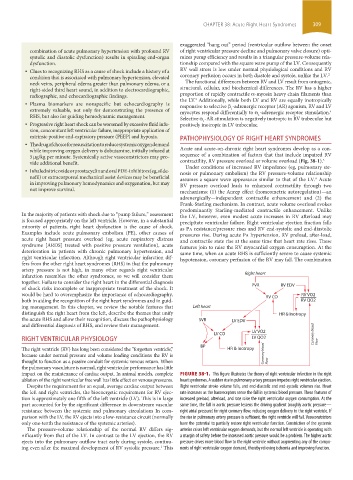
                      extrinsic positive end-expiratory pressure (PEEP) and hypoxia.  PATHOPHYSIOLOGY OF RIGHT HEART SYNDROMES
                        •  The drug of choice for resuscitation to reduce systemic oxygen demand
                      while improving oxygen delivery is dobutamine, initially infused at    Acute and acute-on-chronic right heart syndromes develop as a con-
                      5 µg/kg per minute. Systemically active vasoconstrictors may pro-  sequence of a combination of factors that that include impaired RV
                      vide additional benefit.                            contractility, RV pressure overload or volume overload (Fig. 38-1). 5
                                                                           Under conditions of increased RV impedance (eg, pulmonary ste-
                        •  Inhaled nitric oxide or prostacyclin and oral PDE-inhibitors (eg, silde-  nosis or pulmonary embolism) the RV pressure-volume relationship
                      nafil) or extracorporeal mechanical assist devices may be beneficial    assumes a square wave appearance similar to that of the LV.  Acute
                                                                                                                        6
                      in improving pulmonary hemodynamics and oxygenation, but may    RV pressure overload leads to enhanced contractility through two
                      not improve survival.                               mechanisms: (1) the Anrep effect (homeometric autoregulation)—an
                                                                          adrenergically—independent contractile enhancement and (2) the
                                                                          Frank-Starling mechanism. In contrast, acute volume overload evokes
                                                                          predominantly Starling-mediated contractile enhancement. Unlike
                    In the majority of patients with shock due to “pump failure,” assessment   the LV, however, even modest acute increases in RV afterload may
                    is focused appropriately on the left ventricle. However, in a substantial   precipitate ventricular failure. Right ventricular ejection fraction falls
                    minority of patients, right heart dysfunction is the cause of shock.   as Pa resistance/pressure rises and RV end-systolic and end-diastolic
                    Examples include acute pulmonary embolism (PE), other causes of     pressures rise. During acute Pa hypertension, RV preload, after-load,
                    acute right heart pressure overload (eg, acute respiratory distress     and contractile state rise at the same time that heart rate rises. These
                    syndrome [ARDS] treated with positive pressure ventilation), acute   features join to raise the RV myocardial oxygen consumption. At the
                    deterioration  in  patients  with  chronic  pulmonary  hypertension,  and   same time, when an acute RHS is sufficiently severe to cause systemic
                    right ventricular infarction. Although right ventricular infarction dif-  hypotension, coronary perfusion of the RV may fall. The combination
                    fers from the other right heart syndromes (RHS) in that the pulmonary
                    artery pressure is not high, in many other regards right ventricular
                    infarction resembles the other syndromes, so we will consider them          Right heart
                    together. Failure to consider the right heart in the differential diagnosis
                    of shock risks incomplete or inappropriate treatment of the shock. It         PVR       RV EDV
                    would be hard to overemphasize the importance of echocardiography,                 RV CO       RV VO2
                    both in aiding the recognition of the right heart syndromes and in guid-                       RV QO2
                    ing management. In this chapter, we review the notable features that   Left heart
                    distinguish the right heart from the left, describe the themes that unify              HR & Inotropy
                    the acute RHS and allow their recognition, discuss the pathophysiology   SVR  LV EDV
                    and differential diagnosis of RHS, and review their management.
                                                                                                  LV VO2
                                                                                     LV CO                             Coronary blood
                    RIGHT VENTRICULAR PHYSIOLOGY                                                  LV QO2
                                                                                 BP                                     Flow
                    The right ventricle (RV) has long been considered the “forgotten ventricle,”   HR & Inotropy
                    because under normal pressure and volume loading conditions the RV is             Coronary blood
                    thought to function as a passive conduit for systemic venous return. When          Flow
                    the pulmonary vasculature is normal, right ventricular performance has little
                    impact on the maintenance of cardiac output. In animal models, complete   FIGURE 38-1.  This figure illustrates the theory of right ventricular infarction in the right
                    ablation of the right ventricular free wall has little effect on venous pressures.  heart syndromes. A sudden rise in pulmonary artery pressure impedes right ventricular ejection.
                     Despite the requirement for an equal, average cardiac output between   Right ventricular stroke volume falls, and end-diastolic and end-systolic volumes rise. Heart
                    the left and right ventricles, the bioenergetic requirement for RV ejec-  rate increases as the baroreceptors sense the fall in systemic blood pressure. These features of
                    tion is approximately one fifth of the left ventricle (LV). This is in large   increased preload, afterload, and rate raise the right ventricular oxygen consumption. At the
                    part accounted for by the significant difference in downstream vascular   same time, the fall in aortic pressure lessens the driving gradient (roughly aortic pressure—
                    resistance between the systemic and pulmonary circulations In com-  right atrial pressure) for right coronary flow, reducing oxygen delivery to the right ventricle. If
                    parison with the LV, the RV ejects into a low-resistance circuit (normally   the rise in pulmonary artery pressure is sufficient, the right ventricle will fail. Vasoconstrictors
                    only one-tenth the resistance of the systemic arteries).  have the potential to partially restore right ventricular function. Constriction of the systemic
                     The pressure-volume relationship of the normal RV differs sig-  arteries raises left ventricular oxygen demands, but the normal left ventricle is operating with
                    nificantly from that of the LV. In contrast to the LV ejection, the RV   a margin of safety before the increased aortic pressure would be a problem. The higher aortic
                    ejects into the pulmonary outflow tract early during systole, continu-  pressure drives more blood flow to the right ventricle without augmenting any of the compo-
                    ing even after the maximal development of RV systolic pressure.  This   nents of right ventricular oxygen demand, thereby relieving ischemia and improving function.
                                                                   1


            section03.indd   309                                                                                       1/23/2015   2:07:25 PM

