


Page 444 - Hall et al (2015) Principles of Critical Care-McGraw-Hill
P. 444
314     PART 3: Cardiovascular Disorders


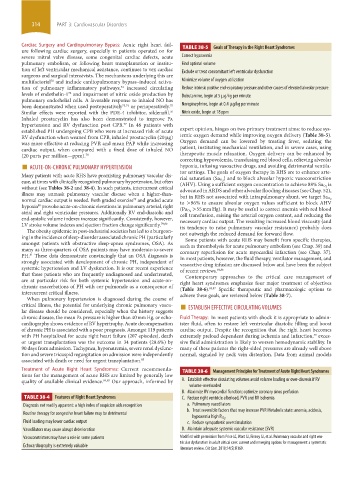
                 Cardiac Surgery and Cardiopulmonary Bypass:  Acute right heart fail-    TABLE 38-5    Goals of Therapy in the Right Heart Syndromes
                 ure following cardiac surgery, especially in patients operated on for
                 severe mitral valve disease, some congenital cardiac defects, acute   Correct hypoxemia
                 pulmonary embolism, or following heart transplantation or institu-  Find optimal volume
                 tion of left ventricular mechanical assistance, continues to vex cardiac   Exclude or treat concomitant left ventricular dysfunction
                 surgeons and surgical intensivists. The mechanisms underlying this are
                           70
                 multifactorial  and include cardiopulmonary bypass–induced activa-  Minimize volume of oxygen utilization
                 tion  of  pulmonary  inflammatory  pathways,   increased  circulating   Reduce intrinsic positive end-expiratory pressure and other causes of elevated alveolar pressure
                                                   71
                 levels of endothelin-1  and impairment of nitric oxide production by   Dobutamine, begin at 5 µg/kg per minute
                                 72
                 pulmonary endothelial cells. A favorable response to inhaled NO has
                                                                    75
                 been demonstrated when used postoperatively 73,74  or perioperatively.    Norepinephrine, begin at 0.4 µg/kg per minute
                 Similar effects were reported with the PDE-4 inhibitor, sildenafil.    Nitric oxide, begin at 18 ppm
                                                                    76
                 Inhaled prostacyclin has also been demonstrated to improve Pa
                 hypertension and RV dysfunction post CPB.  In 46 patients with
                                                    77
                 established PH undergoing CPB who were at increased risk of acute   expert opinion, hinges on two primary treatment aims: to reduce sys-
                 RV dysfunction when weaned from CPB, inhaled prostacyclin (20 µg)   temic oxygen demand while improving oxygen delivery (Table 38-5).
                 was more effective at reducing PVR and mean PAP while increasing   Oxygen demand can be lowered by treating fever, sedating the
                 cardiac output, when compared with a fixed dose of inhaled NO     patient, instituting mechanical ventilation, and in severe cases, using
                 (20 parts per million—ppm). 78                        therapeutic muscle relaxation. Oxygen delivery can be enhanced by
                     ■  ACUTE-ON-CHRONIC PULMONARY HYPERTENSION        hypoxia, infusing vasoactive drugs, and avoiding detrimental ventila-
                                                                       correcting hypovolemia, transfusing red blood cells, relieving alveolar
                 Many patients with acute RHS have preexisting pulmonary vascular dis-  tor settings. The goals of oxygen therapy in RHS are to enhance arte-
                                                                                      ) and to block alveolar hypoxic vasoconstriction
                 ease, at times with clinically recognized pulmonary hypertension, but often   rial saturation (Sa O 2    is
                 without (see Tables 38-2 and 38-4). In such patients, intercurrent critical   (AHV). Using a sufficient oxygen  concentration to achieve 88% Sa O 2
                                                                       advocated in ARDS and other alveolar flooding diseases (see Chap. 52),
                 illness may unmask pulmonary vascular disease when a higher-than-
                 normal cardiac output is needed. Both graded exercise  and graded acute   but in RHS not associated with intrapulmonary shunt, we target Sa O 2
                                                       79
                                                                       to >96% to ensure alveolar oxygen values sufficient to block AHV
                       80
                 hypoxia  provoke acute-on-chronic elevations in pulmonary arterial, right    >55 mm Hg). It may be useful to correct anemia with red blood
                 atrial and right ventricular pressures. Additionally RV end-diastolic and   (Pa O 2
                                                                       cell transfusion, raising the arterial oxygen content, and reducing the
                 end-systolic volume indexes increase significantly. Consistently, however,   necessary cardiac output. The resulting increased blood viscosity (and
                 LV stroke volume indexes and ejection fraction change significantly. 79,80  its tendency to raise pulmonary vascular resistance) probably does
                   The obesity epidemic in post-industrial societies has led to a burgeon-  not outweigh the reduced demand for forward flow.
                 ing in the incidence of sleep-disorder associated chronic PH (particularly   Some patients with acute RHS may benefit from specific therapies,
                 amongst patients with obstructive sleep-apnea syndromes, OSA). As     such as thrombolysis for acute pulmonary embolism (see Chap. 39) and
                 many as three-quarters of OSA patients may have moderate-to-severe   coronary reperfusion for acute myocardial infarction (see Chap. 37).
                 PH.  These data demonstrate convincingly that an OSA diagnosis is   In most patients, however, the fluid therapy, ventilator management, and
                    81
                 strongly associated with development of chronic PH, independent of   vasoactive drug infusion are discussed below and have been the subject
                 systemic hypertension and LV dysfunction. It is our recent experience   of recent reviews. 84,86
                 that these patients who are frequently undiagnosed and undertreated,   Contemporary  approaches  to  the  critical  care  management  of
                 are at particular risk for both systemic hypertension and acute-on-  right heart syndromes emphasize four major treatment of objectives
                 chronic exacerbations of PH with cor pulmonale as a consequence of   (Table 38-6). 85,87  Specific therapeutic and pharmacologic options to
                 intercurrent critical illness.                        achieve these goals, are reviewed below (Table 38-7).
                   When pulmonary hypertension is diagnosed during the course of
                 critical illness, the potential for underlying chronic pulmonary vascu-    ■  ESTABLISH EFFECTIVE CIRCULATING VOLUMES
                 lar disease should be considered, especially when the history suggests
                 chronic disease, the mean Pa pressure is higher than 40 mm Hg, or echo-  Fluid Therapy:  In most patients with shock it is appropriate to admin-
                 cardiography shows evidence of RV hypertrophy. Acute decompensation   ister fluid, often to restore left ventricular diastolic filling and boost
                 of chronic PH is associated with a poor prognosis. Amongst 119 patients   cardiac output. Despite the recognition that the right heart becomes
                 with PH hospitalized for acute right heart failure (207 episodes), death   extremely preload dependent during ischemia and infarction,  exces-
                                                                                                                     49
                 or urgent transplantation was the outcome in 34 patients (28.6%) by     sive fluid administration is likely to worsen hemodynamic stability. In
                 90 days from admission. Tachypnea, hyponatremia, severe renal dysfunc-  many of these patients the right-sided pressures are already well above
                 tion and severe tricuspid regurgitation on admission were independently   normal, signaled by neck vein distention. Data from animal models
                 associated with death or need for urgent transplantation. 83
                 Treatment of Acute Right Heart Syndromes:  Current recommenda-    TABLE 38-6    Management Principles for Treatment of Acute Right Heart Syndromes
                 tions for the management of acute RHS are limited by generally low
                 quality of available clinical evidence. 84,85  Our approach, informed by   A.  Establish effective circulating volumes avoid volume loading or over-diuresis if RV
                                                                          volume-overloaded
                                                                        B.  Maximize RV myocardial function; optimize coronary sinus perfusion
                   TABLE 38-4    Features of Right Heart Syndromes      C.  Reduce right ventricle afterload, PVR and RV ischemia
                  Diagnosis not readily apparent: a high index of suspicion aids recognition    a.  Pulmonary vasodilators
                                                                          b.  Treat reversible factors that may increase PVR Metabolic state: anemia, acidosis,
                  Routine therapy for congestive heart failure may be detrimental
                                                                           hypoxemia high P CO 2 ,
                  Fluid loading may lower cardiac output                  c.  Reduce sympathetic overstimulation
                  Vasodilators may cause abrupt deterioration           D.  Maintain adequate systemic vascular resistance (SVR)
                  Vasoconstrictors may have a role in some patients    Modified with permission from Price LC, Wort SJ, Finney SJ, et al. Pulmonary vascular and right ven-
                                                                       tricular  dysfunction in adult critical care: current and emerging options for management: a systematic
                  Echocardiography is extremely valuable
                                                                       literature review. Crit Care. 2010;14(5):R169.


            section03.indd   314                                                                                       1/23/2015   2:07:28 PM

