


Page 441 - Hall et al (2015) Principles of Critical Care-McGraw-Hill
P. 441
CHAPTER 38: Acute Right Heart Syndromes  311


                    treated currently or within the previous 6 months) and laboratory results,
                    especially serum D-dimer level, can be useful in excluding pulmonary
                    embolism as a likely cause.  The performance characteristics of clinical
                                       20
                    prediction rules (Wells score or revised Geneva score) in combination
                    with D-dimer assays  for the diagnosis of PE are discussed in Chap. 39.
                                  21
                    Electrocardiography:  Electrocardiographic (ECG) evidence of RV failure
                    in the context of pulmonary hypertension includes sinus tachycardia
                    or atrial fibrillation, right axis deviation or a rightward shift in axis, right
                    atrial enlargement, right ventricular hypertrophy, right bundle-branch
                    block (RBBB), right precordial T-wave inversions (leads III and aVF or in
                    leads V -V ), and the S Q T  pattern. Additional configurations include a
                                       3
                                      3
                           4
                         1
                                    1
                    Qr pattern in lead V , S waves in lead I and aVL >1.5 mm and Q waves in
                                  1
                    leads III and aVF, but not in lead II.  Reports of typical ECG changes vary
                                             5
                    significantly  suggesting relative insensitivity in the performance charac-
                            22
                    teristics of the 12-lead ECG in broad groups of mixed severity right heart
                    syndrome patients. However, in patients with hemodynamically significant
                    pulmonary embolism,  the  likelihood of  suggestive  electrocardiographic
                    findings is probably much higher. For example, among 49 patients with PE
                    (all of whom had RV dilation and tricuspid regurgitation by echocardiogra-
                    phy), 37 (76%) had electrocardiographic abnormalities strongly suggestive
                    of PE, including at least three of the following: incomplete or complete
                    RBBB; S waves greater than 1.5 mm in leads I and aVL; shift of the precor-
                    dial transition zone to V ; Q waves in leads III and aVF, but not lead II; right
                                    5
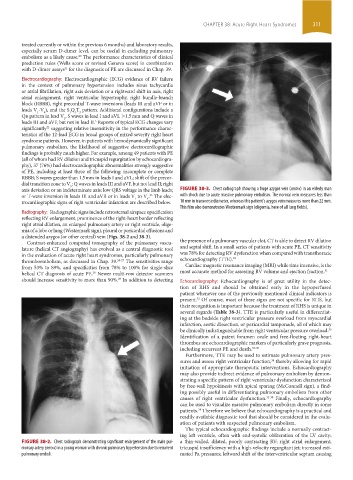
                    axis deviation or an indeterminate axis; low QRS voltage in the limb leads;   FIGURE 38-3.  Chest radiograph showing a huge azygos vein (arrow) in an elderly man
                    or T-wave inversion in leads III and aVR or in leads V  to V .  The elec-  with shock due to acute massive pulmonary embolism. The normal vein measures less than
                                                               23
                                                              4
                                                          1
                    trocardiographic signs of right ventricular infarction are described below.  10 mm in transverse diameter, whereas this patient’s azygos vein measures more than 22 mm.
                                                                          This film also demonstrates Westermark sign (oligemia, here of all lung fields).
                    Radiography:  Radiographic signs include retrosternal airspace opacification
                    reflecting RV enlargement, prominence of the right-heart border reflecting
                    right atrial dilation, an enlarged pulmonary artery or right ventricle, olige-
                    mia of a lobe or lung (Westermark sign), pleural or pericardial effusions and
                    a distended azygos (or other central) vein (Figs. 38-2 and 38-3).
                     Contrast-enhanced computed tomography of the pulmonary vascu-  the presence of a pulmonary vascular clot, CT is able to detect RV dilation
                    lature (helical CT angiography) has evolved as a central diagnostic tool   and septal shift. In a small series of patients with acute PE, CT sensitivity
                    in the evaluation of acute right heart syndromes, particularly pulmonary   was 78% for detecting RV dysfunction when compared with transthoracic
                    thromboembolism, as discussed in Chap. 39. 24-27  The sensitivities range   echocardiography (TTE). 30
                    from 53% to 89%, and specificities from 78% to 100% for single-slice   Cardiac magnetic resonance imaging (MRI) while time intensive, is the
                    helical CT diagnosis of acute PE.  Newer multi-row detector scanners   most accurate method for assessing RV volume and ejection fraction. 31
                                            28
                    should increase sensitivity to more than 90%.  In addition to detecting   Echocardiography:  Echocardiography  is  of  great  utility  in  the  detec-
                                                    29
                                                                          tion of RHS and should be obtained early in the hypoperfused
                                                                          patient whenever one of the previously mentioned clinical indicators is
                                                                          present.  Of course, most of these signs are not specific for RHS, but
                                                                               32
                                                                          their recognition is important because the treatment of RHS is unique in
                                                                          several regards (Table 38-3). TTE is particularly useful in differentiat-
                                                                          ing at the bedside right ventricular pressure overload from myocardial
                                                                          infarction, aortic dissection, or pericardial tamponade, all of which may
                                                                          be clinically indistinguishable from right ventricular pressure overload.
                                                                                                                            33
                                                                          Identification of a patent foramen ovale and free-floating right-heart
                                                                          thrombus are echocardiographic markers of particularly grave prognosis,
                                                                          including recurrent PE and death. 33-35
                                                                           Furthermore, TTE may be used to estimate pulmonary artery pres-
                                                                          sures and assess right ventricular function,  thereby allowing for rapid
                                                                                                         36
                                                                          initiation of appropriate therapeutic interventions. Echocardiography
                                                                          may also provide indirect evidence of pulmonary embolism by demon-
                                                                          strating a specific pattern of right ventricular dysfunction characterized
                                                                          by free-wall hypokinesis with apical sparing (McConnell sign), a find-
                                                                          ing possibly useful in differentiating pulmonary embolism from other
                                                                          causes of right ventricular dysfunction. 32-38  Finally, echocardiography
                                                                          can be used to visualize massive pulmonary embolism directly in some
                                                                                34
                                                                          patients.  Therefore we believe that echocardiography is a practical and
                                                                          readily available diagnostic tool that should be considered in the evalu-
                                                                          ation of patients with suspected pulmonary embolism.
                                                                           The typical echocardiographic findings include a normally contract-
                                                                          ing left ventricle, often with end-systolic obliteration of the LV cavity;
                    FIGURE 38-2.  Chest radiograph demonstrating significant enlargement of the main pul-  a thin-walled, dilated, poorly contracting RV; right atrial enlargement;
                    monary artery (arrow) in a young woman with chronic pulmonary hypertension due to recurrent   tricuspid insufficiency with a high-velocity regurgitant jet; increased esti-
                    pulmonary emboli.                                     mated Pa pressures; leftward shift of the interventricular septum causing


            section03.indd   311                                                                                       1/23/2015   2:07:26 PM

