


Page 469 - Hall et al (2015) Principles of Critical Care-McGraw-Hill
P. 469
CHAPTER 40: Pericardial Disease  339


                    or collapse of the right atrium and right ventricle, ventricular septal   intrapericardial pressure will be elevated and should be equal to the
                    shifting with respiration, and enlargement of the inferior vena cava.    intracardiac end-diastolic pressure.
                                                                       7
                    With Doppler echocardiography, respiratory variation in mitral inflow
                    can be detected early in the evolution of tamponade.  Moreover, the     ■  PERICARDIOCENTESIS
                                                            8
                    changes in mitral inflow are highly sensitive, and may precede changes   Pericardiocentesis historically was performed in a blinded or ECG-
                    in  cardiac  output,  blood  pressure,  and  other  echocardiographic  evi-  guided fashion, usually from the subxyphoid approach. Although these
                    dence of tamponade. Respiratory changes in mitral inflow resolve after   techniques may still be useful in some situations (eg, emergencies or car-
                      pericardiocentesis unless effusive-constrictive physiology is present.  diogenic shock), the incidence of complications is high and echocardio-
                        ■  INVASIVE HEMODYNAMICS                          graphic guidance is strongly preferred.  Of note, care should be taken to
                                                                                                     9
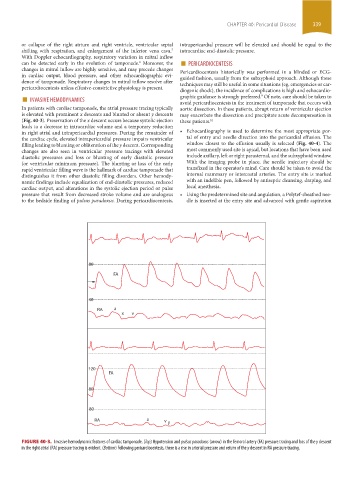
                    In patients with cardiac tamponade, the atrial pressure tracing typically   avoid pericardiocentesis in the treatment of tamponade that occurs with
                                                                          aortic dissection. In these patients, abrupt return of ventricular ejection
                    is elevated with prominent x descents and blunted or absent y descents   may exacerbate the dissection and precipitate acute decompensation in
                    (Fig. 40-3). Preservation of the x descent occurs because systolic ejection   these patients. 10
                    leads to a decrease in intracardiac volume and a temporary reduction
                    in right atrial and intrapericardial pressures. During the remainder of     • Echocardiography is used to determine the most appropriate por-
                    the cardiac cycle, elevated intrapericardial pressure impairs ventricular   tal of entry and needle direction into the pericardial effusion. The
                      filling leading to blunting or obliteration of the y descent. Corresponding   window closest to the effusion usually is selected (Fig. 40-4). The
                    changes are also seen in ventricular pressure tracings with elevated   most commonly used site is apical, but locations that have been used
                    diastolic pressures and loss or blunting of early diastolic pressure   include axillary, left or right parasternal, and the subxyphoid window.
                    (or ventricular minimum pressure). The blunting or loss of the early     With the  imaging probe  in place, the needle  trajectory should be
                    rapid ventricular filling wave is the hallmark of cardiac tamponade that   transfixed in the operator’s mind. Care should be taken to avoid the
                    distinguishes  it  from  other  diastolic  filling  disorders.  Other  hemody-  internal mammary or intercostal arteries. The entry site is marked
                    namic findings include equalization of end-diastolic pressures, reduced   with an indelible pen, followed by antiseptic cleansing, draping, and
                    cardiac output, and alterations in the systolic ejection period or pulse   local anesthesia.
                    pressure that result from decreased stroke volume and are analogous     • Using the predetermined site and angulation, a Polytef-sheathed nee-
                    to the bedside finding of pulsus paradoxus. During pericardiocentesis,   dle is inserted at the entry site and advanced with gentle aspiration


                                          80
                                                   FA


                                          40
                                             RA    a
                                                      x  v


                                          120
                                                 FA


                                          80


                                           80
                                            RA                a     v  y


                    FIGURE 40-3.  Invasive hemodynamic features of cardiac tamponade. (Top) Hypotension and pulsus paradoxus (arrow) in the femoral artery (FA) pressure tracing and loss of the y descent
                    in the right atrial (RA) pressure tracing is evident. (Bottom) Following pericardiocentesis, there is a rise in arterial pressure and return of the y descent in RA pressure tracing.


            section03.indd   339                                                                                       1/23/2015   2:07:42 PM

