


Page 482 - Hall et al (2015) Principles of Critical Care-McGraw-Hill
P. 482
352     PART 3: Cardiovascular Disorders


                                 A                        B                         C

                                            RV
                                                                                             RV     LV
                                        LV
                                                RA                                                 LA
                                                                                            RA


                                 D                        E                         F


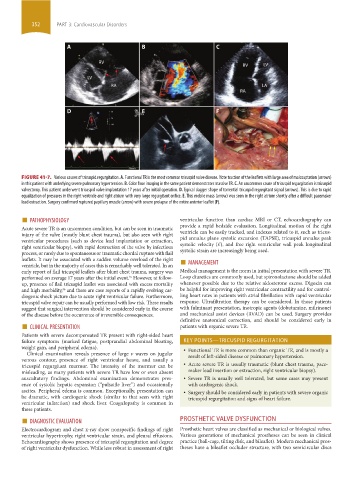
                 FIGURE 41-7.  Various causes of tricuspid regurgitation. A. Functional TR is the most common tricuspid valve disease. Note traction of the leaflets with large area of malcoaptation (arrows)
                 in this patient with underlying severe pulmonary hypertension. B. Color flow imaging in the same patient demonstrates massive TR. C. An uncommon cause of tricuspid regurgitation is tricuspid
                 valvectomy. This patient underwent tricuspid valve implantation 17 years after initial operation. D. Typical dagger shape of torrential tricuspid regurgitant signal (arrows). This is due to rapid
                 equalization of pressures in the right ventricle and right atrium with very large regurgitant orifice. E. This mobile mass (arrow) was seen in the right atrium shortly after a difficult pacemaker
                 lead extraction. Surgery confirmed ruptured papillary muscle (arrow) with severe prolapse of the entire anterior leaflet (F).
                     ■  PATHOPHYSIOLOGY                                ventricular function than cardiac MRI or CT, echocardiography can

                 Acute severe TR is an uncommon condition, but can be seen in traumatic   provide a rapid bedside evaluation. Longitudinal motion of the right
                 injury of the valve (mostly blunt chest trauma), but also seen with right   ventricle can be easily tracked, and indexes related to it, such as tricus-
                 ventricular procedures (such as device lead implantation or extraction,   pid annulus plane systolic excursion (TAPSE), tricuspid annulus peak
                 right ventricular biopsy), with rapid destruction of the valve by infectious   systolic  velocity (s’), and free right  ventricular wall  peak  longitudinal
                 process, or rarely due to spontaneous or traumatic chordal rupture with flail   systolic strain are increasingly being used.
                 ventricle, but in the majority of cases this is remarkably well tolerated. In an   ■  MANAGEMENT
                 leaflets. It may be associated with a sudden volume overload of the right
                 early report of flail tricuspid leaflets after blunt chest trauma, surgery was   Medical management is the norm in initial presentation with severe TR.
                 performed on average 17 years after the initial event.  However, at follow-  Loop diuretics are commonly used, but spironolactone should be added
                                                      35
                 up, presence of flail tricuspid leaflet was associated with excess mortality   whenever possible due to the relative aldosterone excess. Digoxin can
                 and high morbidity,  and there are case reports of a rapidly evolving car-  be helpful for improving right ventricular contractility and for control-
                               36
                 diogenic shock picture due to acute right ventricular failure. Furthermore,   ling heart rates in patients with atrial fibrillation with rapid ventricular
                 tricuspid valve repair can be usually performed with low risk. These results   response. Ultrafiltration therapy can be considered. In those patients
                 suggest that surgical intervention should be considered early in the course   with fulminant presentation, inotropic agents (dobutamine, milrinone)
                 of the disease before the occurrence of irreversible consequences.  and mechanical assist devices (RVAD) can be used. Surgery provides
                     ■  CLINICAL PRESENTATION                          definitive anatomical correction, and should be considered early in
                                                                       patients with organic severe TR.
                 Patients with severe decompensated TR present with right-sided heart
                 failure  symptoms  (marked  fatigue, postprandial  abdominal bloating,   KEY POINTS—TRICUSPID REGURGITATION
                 weight gain, and peripheral edema).                       • Functional TR is more common than organic TR, and is mostly a
                   Clinical examination reveals presence of large  v waves on jugular   result of left-sided disease or pulmonary hypertension.
                 venous contour, presence of right ventricular heave, and usually a
                 tricuspid  regurgitant  murmur.  The  intensity  of  the  murmur  can  be     • Acute severe TR is usually traumatic (blunt chest trauma, pace-
                 misleading, as many patients with severe TR have low or even absent   maker lead insertion or extraction, right ventricular biopsy).
                 auscultatory findings. Abdominal examination demonstrates pres-    • Severe TR is usually well tolerated, but some cases may present
                 ence of systolic hepatic expansion (“pulsatile liver”) and occasionally   with cardiogenic shock.
                 ascites. Peripheral edema is common. Exceptionally, presentation can     • Surgery should be considered early in patients with severe organic
                 be dramatic, with cardiogenic shock (similar to that seen with right     tricuspid regurgitation and signs of heart failure.
                 ventricular infarction) and shock liver. Coagulopathy is common in
                 these patients.
                     ■  DIAGNOSTIC EVALUATION                          PROSTHETIC VALVE DYSFUNCTION

                 Electrocardiogram and chest x-ray show nonspecific findings of right   Prosthetic heart valves are classified as mechanical or biological valves.
                 ventricular hypertrophy, right ventricular strain, and pleural effusions.   Various generations of mechanical prostheses can be seen in clinical
                 Echocardiography shows presence of tricuspid regurgitation and degree   practice (ball-cage, tilting disk, and bileaflet). Modern mechanical pros-
                 of right ventricular dysfunction. While less robust in assessment of right   theses have a bileaflet occluder structure, with two semicircular discs


            section03.indd   352                                                                                       1/23/2015   2:08:00 PM

