


Page 479 - Hall et al (2015) Principles of Critical Care-McGraw-Hill
P. 479
CHAPTER 41: Valvular Heart Disease  349


                                                                          right   ventricular function. Heavily calcified valves may obscure pres-
                                                                          ence of mitral regurgitation due to acoustic shadowing of the left atrium.
                                                                          Whenever in doubt, presence of concomitant mitral regurgitation
                                                                          should be assessed with TEE; this will also allow assessment of the left
                                                                          atrial appendage for the presence of left atrial thrombus.
                                                                           Given the reliability of echocardiographic techniques, cardiac cath-
                                                                          eterization is seldom used as a diagnostic tool. Mitral valve area can be
                                                                          calculated by the Gorlin formula, and right heart pressures are directly
                                                                          measured. Left atrial pressure can be directly measured by transseptal
                                                                          puncture, and is preferred to pulmonary capillary wedge pressure (the
                                                                          latter can overestimate left atrial pressure, and hence the severity of MS).
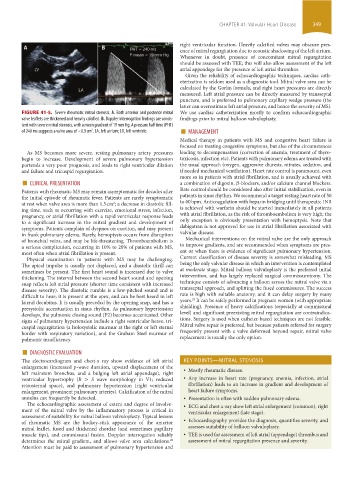
                    FIGURE 41-5.  Severe rheumatic mitral stenosis. A. Both anterior and posterior mitral   We use  cardiac catheterization mostly to confirm echocardiographic
                    valve leaflets are thickened and heavily calcified. B. Doppler interrogation findings are consis-  findings prior to mitral balloon valvuloplasty.
                    tent with severe mitral stenosis, with a mean gradient of 19 mm Hg. A pressure half time (PHT)
                    of 240 ms suggests a valve area of ~0.9 cm . LA, left atrium; LV, left ventricle.    ■  MANAGEMENT
                                           2
                                                                          Medical therapy in patients with MS  and congestive heart failure is
                                                                          focused on treating congestive symptoms, but also of the circumstances
                     As  MS  becomes  more  severe,  resting  pulmonary  artery  pressures   leading to decompensation (correction of anemia, treatment of thyro-
                    begin to increase. Development of severe pulmonary hypertension   toxicosis, infection etc). Patients with pulmonary edema are treated with
                      portends a very poor prognosis, and leads to right ventricular dilation   the usual approach (oxygen, aggressive diuresis, nitrates, sedation, and
                    and failure and tricuspid regurgitation.              if needed mechanical ventilation). Heart rate control is paramount, even
                        ■  CLINICAL PRESENTATION                          more so in patients with atrial fibrillation, and is usually achieved with
                                                                          a combination of digoxin, β-blockers, and/or calcium channel blockers.
                    Patients with rheumatic MS may remain asymptomatic for decades after   Rate control should be considered also after initial stabilization, even in
                    the initial episode of rheumatic fever. Patients are rarely symptomatic   patients in sinus rhythm. We recommend a target resting heart rate of 50
                                                   2
                    at rest when valve area is more than 1.5 cm ; a decrease in diastolic fill-  to 60 bpm. Anticoagulation with heparin bridging until therapeutic INR
                    ing time, such as occurring with exercise, emotional stress, infection,   is achieved with warfarin should be started immediately in all patients
                    pregnancy, or atrial fibrillation with a rapid ventricular response leads   with atrial fibrillation, as the risk of thromboembolism is very high; the
                    to a significant increase in the mitral gradient and development of   only exception is obviously presentation with hemoptysis. Note that
                    symptoms. Patients complain of dyspnea on exertion, and may present   dabigatran is not approved for use in atrial fibrillation associated with
                    in frank pulmonary edema. Rarely, hemoptysis occurs from disruption   valvular disease.
                    of bronchial veins, and may be life-threatening. Thromboembolism is   Mechanical interventions on the mitral valve are the only approach
                    a serious complication, occurring in 10% to 20% of patients with MS,   to improve gradients, and are recommended when symptoms are pres-
                    most often when atrial fibrillation is present.       ent or when there is evidence of significant pulmonary hypertension.
                     Physical  examination  in  patients  with  MS  may  be  challenging.   Current classification of disease severity is somewhat misleading, MS
                    The apical impulse is usually not displaced, and a diastolic thrill can   being the only valvular disease in which an intervention is contemplated
                    sometimes be present. The first heart sound is increased due to valve   at moderate stage. Mitral balloon valvuloplasty is the preferred initial
                    thickening. The interval between the second heart sound and opening   intervention, and has largely replaced surgical commissurotomy. The
                    snap reflects left atrial pressure (shorter time consistent with increased   technique consists of advancing a balloon across the mitral valve via a
                    disease severity).  The  diastolic  rumble  is  a  low-pitched  sound  and is   transseptal approach, and splitting the fused commissures. The success
                    difficult to hear; it is present at the apex, and can be best heard in left   rate is high with suitable anatomy, and it can delay surgery by many
                                                                              29
                    lateral decubitus. It is usually preceded by the opening snap, and has a   years.  It can be safely performed in pregnant women (with appropriate
                    presystolic accentuation in sinus rhythm. As pulmonary hypertension   shielding). Presence of heavy calcifications (especially at commissural
                    develops, the pulmonic closing sound (P2) becomes accentuated. Other   level) and significant preexisting mitral regurgitation are contraindica-
                    signs of pulmonary hypertension include a right ventricular heave, tri-  tions. Surgery is used when catheter-based techniques are not feasible.
                    cuspid regurgitation (a holosystolic murmur at the right or left sternal   Mitral valve repair is preferred, but because patients referred for surgery
                    border  with respiratory  variation),  and the  Graham Steel murmur of   frequently present with a valve deformed beyond repair, mitral valve
                    pulmonic insufficiency.                               replacement is usually the only option.
                        ■  DIAGNOSTIC EVALUATION


                    The  electrocardiogram  and  chest-x  ray  show  evidence  of  left  atrial   KEY POINTS—MITRAL STENOSIS
                    enlargement (increased  p-wave duration, upward displacement of the
                    left mainstem bronchus, and a bulging left atrial appendage), right     • Mostly rheumatic disease.
                      ventricular hypertrophy (R  >  S wave morphology in V1; reduced     • Any increase in  heart rate (pregnancy, anemia, infection, atrial
                    retrosternal space), and pulmonary hypertension (right ventricular   fibrillation) leads to an increase in gradient and development of
                    enlargement, prominent pulmonary arteries). Calcification of the mitral   heart failure symptoms.
                    annulus can frequently be detected.                       • Presentation is often with sudden pulmonary edema.
                     The echocardiographic assessment of extent and degree of involve-    • ECG and chest x-ray show left atrial enlargement (common), right
                    ment of the mitral valve by the inflammatory process is critical in     ventricular enlargement (late stage).
                    assessment of suitability for mitral balloon valvuloplasty. Typical lesions
                    of  rheumatic  MS  are  the  hockey-stick  appearance  of  the anterior     • Echocardiography provides the diagnosis, quantifies severity, and
                    mitral leaflet, fused and thickened chordae (and sometimes papillary   assesses suitability of balloon valvuloplasty.
                    muscle tips), and commissural fusion. Doppler interrogation reliably     • TEE is used for assessment of left atrial (appendage) thrombus and
                    determines the mitral gradient, and allows valve area calculations.    assessment of mitral regurgitation presence and severity.
                                                                      28
                    Attention must be paid to assessment of pulmonary hypertension and


            section03.indd   349                                                                                       1/23/2015   2:07:51 PM

