


Page 477 - Hall et al (2015) Principles of Critical Care-McGraw-Hill
P. 477
CHAPTER 41: Valvular Heart Disease  347


                                                                          (increased afterload due to increased wall stress and systolic pressure).
                        • Acute presentation is usually with dyspnea, less common with   The left ventricle dilates progressively, with both eccentric and concentric
                      syncope or angina.                                  hypertrophy. The increased diastolic volume allows for augmentation of
                        • Harsh, loud, midsystolic murmur and decreased S2 are typical of   stroke volume (Frank-Starling mechanism), and maintains cardiac out-
                      severe AS. This may be reduced or absent in patients with reduced   put in the normal range for many years despite presence of severe AR.
                      ejection fraction.                                  Once compensatory mechanisms are overwhelmed, the disease tends to
                        • Echocardiography is the cornerstone of diagnosis. Valve area   progress rapidly. Left ventricular volumes (left ventricular end-systolic
                                                                          diameter >50 mm, left ventricular end-diastolic diameter >70 mm) can
                      <1.0 cm  and gradient ≥40 mm Hg are diagnostic of severe AS.  be used to predict which patients are more likely to have progressive
                            2
                       • Low output/low gradient AS can be diagnosed with low-dose dobu-  disease  and  the  development  of  left  ventricular  failure.  Indexed  left
                      tamine stress. Presence of contractile reserve predicts good outcome.  ventricular dimensions are better predictors in patients of small body
                        • Cardiac catheterization verifies severity of AS in difficult cases and   size and in women. 21
                      provides preoperative coronary angiography.          In acute onset AR, the left ventricle has to accommodate suddenly a
                        • Medical management is only temporizing.         large regurgitant volume. Left ventricular dilation is limited by the com-
                                                                          pliance of the ventricle and by the constraining pericardium. As such,
                        • Temporizing aortic balloon valvuloplasty may be used.  small increase in regurgitant volume may lead to a dramatic increase
                        • Surgical or transcatheter aortic valve replacement  are the only   in left ventricular diastolic pressure. This leads to an increase in left
                      treatments with long-term success. Decision should be made by   atrial pressure, causing pulmonary congestion/edema. The combina-
                      the heart team (surgeon and cardiologist).          tion of decreased aortic diastolic pressure and increased left ventricular
                                                                          diastolic pressure leads to a dramatic decrease in coronary perfusion
                                                                          pressure. Acute AR is especially difficult to tolerate by patients with
                                                                          a very stiff left ventricle due to preexisting concentric hypertrophy;
                    AORTIC REGURGITATION                                  this entity is now more commonly present with a resurgence of aortic
                        ■  ETIOLOGY                                       balloon valvuloplasty (postdilatation AR) and increasing use of TAVR
                                                                          (periprosthetic AR).
                    The presentation and management of patients with severe aortic regur-
                    gitation (AR) depends on the nature of underlying disease. Acute severe     ■  CLINICAL PRESENTATION
                    AR is rare, but is a true medical and surgical emergency. It can be the   Patients with decompensation of chronic long-standing AR have the
                    result of endocarditis (leaflet or annular destruction), aortic dissec-  classical features of  AR  in addition to  the  signs  and symptoms of
                    tion (compromised leaflet coaptation), or traumatic (leaflet or annular   the acute decompensated state. The heart is enlarged, with displaced
                    tear/rupture from blunt chest trauma or aortic balloon valvuloplasty;   apical impulse. The heart sounds are usually normal (unless pulmonary
                    the  aortic valve is the most commonly involved valve in blunt chest   hypertension is present). There is a soft diastolic decrescendo murmur
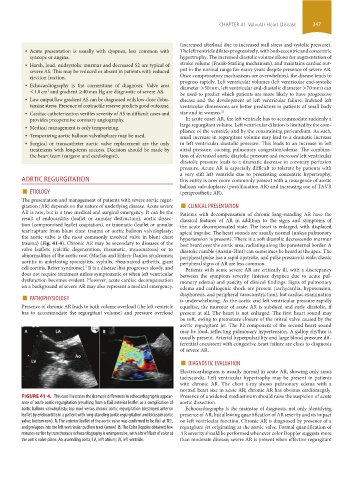
                    trauma) (Fig. 41-4). Chronic AR may be secondary to diseases of the   best heard over the aortic area, radiating along the parasternal border. A
                    valve leaflets (calcific degeneration, rheumatic, myxomatous) or to   diastolic rumble (Austin-Flint) can sometimes be heard at the apex. The
                    abnormalities of the aortic root (Marfan and Ehlers-Danlos syndromes;   peripheral pulse has a rapid upstroke, and pulse pressure is wide; classic
                    aortitis in ankylosing spondylitis, syphilis, rheumatoid arthritis, giant   peripheral signs of AR are less common.
                    cell aortitis, Reiter syndrome).  It is a disease that progresses slowly, and   Patients with acute severe AR are critically ill, with a discrepancy
                                         5
                    does not require treatment unless symptomatic or when left ventricular   between the symptom severity (intense dyspnea due to acute pul-
                    dysfunction becomes evident. However, acute cardiac decompensation   monary edema) and paucity of clinical findings. Signs of pulmonary
                    on a background of severe AR may also represent a medical emergency.  edema and cardiogenic shock are present (tachycardia, hypotension,
                        ■  PATHOPHYSIOLOGY                                diaphoresis, and peripheral vasoconstriction), but cardiac examination
                                                                          is underwhelming. As the aortic and left ventricular pressure rapidly
                    Presence of chronic AR leads to both volume overload (the left ventricle   equalize, the murmur of acute AR is subdued and early diastolic, if
                    has to accommodate the regurgitant volume) and pressure overload   present  at  all.  The  heart  is  not  enlarged.  The  first  heart  sound may
                                                                          be soft, owing to premature closure of the mitral valve caused by the
                                                                          aortic regurgitant jet. The P2 component of the second heart sound
                                                                          may be loud, reflecting pulmonary hypertension. A gallop rhythm is
                                                                          usually present. Arterial hyperpulsatility and large blood pressure dif-
                                                                          ferential coexistent with congestive heart failure are clues to diagnosis
                                                                          of severe AR.
                                                                              ■  DIAGNOSTIC EVALUATION


                                                                          Electrocardiogram is usually normal in acute AR, showing only sinus
                                                                          tachycardia. Left ventricular hypertrophy may be present in patients
                                                                          with chronic AR. The chest x-ray shows pulmonary edema with a
                                                                          normal heart size in acute AR; chronic AR has obvious cardiomegaly.
                    FIGURE 41-4.  This case illustrates the dramatic differences in echocardiographic appear-  Presence of a widened mediastinum should raise the suspicion of acute
                    ance of acute aortic regurgitation (resulting from a flail anterior leaflet as a complication of   aortic dissection.
                    aortic balloon valvuloplasty; top row) versus chronic aortic regurgitation (destroyed anterior   Echocardiography is the mainstay of diagnosis, not only identifying
                    leaflet by endocarditis in a patient with long-standing aortic regurgitation and bicuspid aortic   presence of AR, but allowing quantification of AR severity and its impact
                    valve; bottom row). A. The anterior leaflet of the aortic valve was confirmed to be flail at TEE,   on left ventricular function. Chronic AR is diagnosed by presence of a
                    and prolapses into the left ventricular outflow tract (arrow). B. The Color Doppler obtained few   regurgitant jet originating at the aortic valve. Formal quantification of
                    minutes earlier by transthoracic echocardiography is unimpressive, with a brief flash of color at   AR severity should be performed whenever color Doppler suggests more
                    the aortic valve plane. Ao, ascending aorta; LA, left atrium; LV, left ventricle.  than moderate disease; severe AR is present when effective regurgitant


            section03.indd   347                                                                                       1/23/2015   2:07:50 PM

