


Page 596 - Hall et al (2015) Principles of Critical Care-McGraw-Hill
P. 596
416     PART 4: Pulmonary Disorders


                       l/s                 Flow-time                     l/s                Flow-time                 s
                     1.1                                               1.1


                       0                                             6  0                                              6


                     −1.1                                             −1.1
                     cm H O               Pressure-time                cm H O              Pressure-time              s
                         2
                                                                          2
                      50                                               50


                       0                                             6  0                                              6

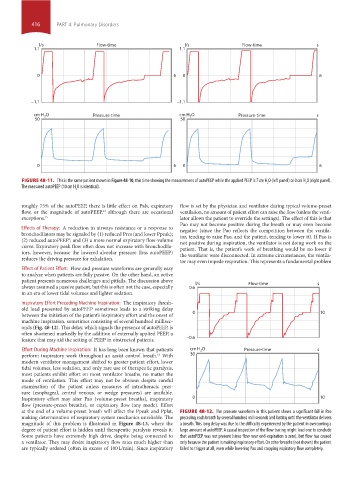
                 FIGURE 48-11.  This is the same patient shown in Figure 48-10, this time showing the measurement of autoPEEP while the applied PEEP is 7 cm H O (left panel) or 0 cm H O (right panel).
                                                                                                     2
                                                                                                                  2
                 The measured autoPEEP (10 cm H O is identical).
                                    2
                 roughly 75% of the autoPEEP, there is little effect on Palv, expiratory   flow is set by the physician and ventilator during typical volume-preset
                 flow, or the magnitude of autoPEEP,  although there are occasional   ventilation, no amount of patient effort can raise the flow (unless the venti-
                                             14
                 exceptions. 15                                        lator allows the patient to override the settings). The effect of this is that
                                                                       Pao may not become positive during the breath or may even become
                 Effects of Therapy:  A reduction in airways resistance or a response to   negative (since the Pao reflects the competition between the ventila-
                 bronchodilators may be signaled by (1) reduced Pres (and lower Ppeak);   tor, tending to raise Pao, and the patient, tending to lower it). If Pao is
                 (2) reduced autoPEEP ; and (3) a more normal expiratory flow-volume   not positive during inspiration, the ventilator is not doing work on the
                                 9
                 curve. Expiratory peak flow often does not increase with bronchodila-  patient. That is, the patient’s work of breathing would be no lower if
                 tors,  however,  because  the  lowered alveolar  pressure  (less  autoPEEP)   the ventilator were disconnected. In extreme circumstances, the ventila-
                 reduces the driving pressure for exhalation.          tor may even impede respiration. This represents a fundamental problem
                 Effect of Patient Effort:  Flow and pressure waveforms are generally easy
                 to analyze when patients are fully passive. On the other hand, an active
                 patient presents numerous challenges and pitfalls. The discussion above
                 always assumed a passive patient, but this is often not the case, especially   0.6 l/s  Flow-time    s
                 in an era of lower tidal volumes and lighter sedation.
                 Inspiratory Effort Preceding Machine Inspiration:  The inspiratory thresh-
                 old load presented by autoPEEP sometimes leads to a striking delay
                 between the initiation of the patient’s inspiratory effort and the onset of   0                       10
                 machine inspiration, sometimes consisting of several hundred millisec-
                 onds (Fig. 48-12). This delay, which signals the presence of autoPEEP, is
                 often shortened markedly by the addition of externally applied PEEP, a
                 feature that may aid the setting of PEEP in obstructed patients.  −0.6
                 Effort During Machine Inspiration:  It has long been known that patients   cm H O  Pressure-time     s
                                                                              2
                 perform inspiratory work throughout an assist control breath.  With   30
                                                               16
                 modern ventilator management shifted to greater patient effort, lower
                 tidal volumes, less sedation, and only rare use of therapeutic paralysis,
                 most patients exhibit effort on most ventilator breaths, no matter the
                 mode of ventilation. This effort may not be obvious despite careful
                 examination of the patient unless measures of intrathoracic pres-
                 sure  (esophageal,  central  venous,  or  wedge  pressures)  are  available.
                 Inspiratory effort may alter Pao (volume-preset breaths), inspiratory   0                             10
                 flow (pressure-preset breaths), or expiratory flow (any mode). Effort
                 at the end of a volume-preset breath will affect the Ppeak and Pplat,   FIGURE 48-12.  The pressure waveform in this patient shows a significant fall in Pao
                 making determination of respiratory system mechanics unreliable. The   preceding each breath by several hundred milliseconds and lasting until the ventilator delivers
                 magnitude of this problem is illustrated in  Figure 48-13, where the   a breath. This long delay was due to the difficulty experienced by the patient in overcoming a
                 degree of patient effort is hidden until therapeutic paralysis reveals it.   large amount of autoPEEP. A casual inspection of the flow tracing might lead one to conclude
                 Some patients have extremely high drive, despite being connected to    that autoPEEP was not present (since flow near end-expiration is zero), but flow has ceased
                 a ventilator. They may desire inspiratory flow rates much higher than     only because the patient is making inspiratory effort. On other breaths (not shown) the patient
                 are typically ordered (often in excess of 100 L/min). Since inspiratory   failed to trigger at all, even while lowering Pao and stopping expiratory flow completely.


            section04.indd   416                                                                                       1/23/2015   2:19:09 PM

