


Page 594 - Hall et al (2015) Principles of Critical Care-McGraw-Hill
P. 594
414     PART 4: Pulmonary Disorders

                     ■  EXPIRATORY PRESSURE                                 l/s                Flow-time               s

                 During either volume-preset or pressure-preset ventilation, analyzing   1.5
                 the expiratory pressure [Paw(ex)] is substantially less useful than the
                 inspiratory pressure, since Paw(ex) is largely determined by characteris-
                 tics of the mechanical ventilator, not the patient.
                                                                           0                                            8
                             Paw(ex) = PEEP + Flow  × Rexlimb
                                                E
                 where PEEP is the applied PEEP (not autoPEEP), Flow  is expiratory flow
                                                        E
                 rate, and Rexlimb is the resistance of the expiratory limb of the ventilator.
                 It is important to realize that Paw(ex) does not reflect expiratory alveo-  −1.5
                 lar pressure or autoPEEP, and relates to the patient’s res piratory system     cm H 2 O  Pressure-time  s
                 only indirectly through the expiratory flow. Although some ventilators   30
                 display inspiratory and expiratory pressure-volume plots, only the inspi-
                 ratory segment gives useful information about the patient.

                 FLOW WAVEFORMS
                     ■  EXPIRATORY FLOW

                 Expiratory flow depends largely on patient features, such as end-inspiratory   0                       8
                 lung volume, lung elastic recoil, and characteristics of the airways, rather
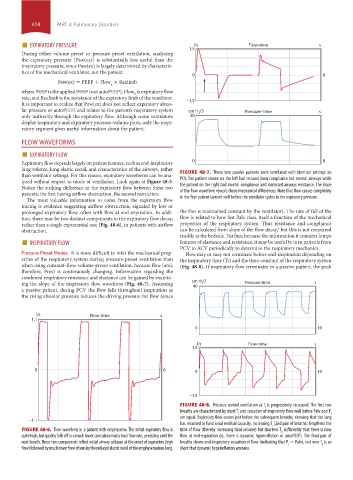
                 than ventilator settings. For this reason, expiratory waveforms can be ana-  FIGURE  48-7.  These two passive patients were ventilated with identical settings on
                 lyzed without respect to mode of ventilation. Look again at Figure 48-3.   PCV. The patient shown on the left had reduced lung compliance but normal airways while
                 Notice the striking difference in the expiratory flow between these two   the patient on the right had normal compliance and increased airways resistance. The slope
                 patients, the first having airflow obstruction, the second restriction.  of the flow waveform reveals these mechanical differences. Note that flow ceases completely
                   The most valuable information to come from the expiratory flow   in the first patient (arrow) well before the ventilator cycles to the expiratory pressure.
                 tracing is evidence suggesting airflow obstruction, signaled by low or
                 prolonged expiratory flow, often with flow at end-expiration. In addi-  the Pao is maintained constant by the ventilator). The rate of fall of the
                 tion, there may be two distinct components to the expiratory flow decay,   flow is related to how fast Palv rises, itself a function of the mechanical
                 rather than a single exponential one (Fig. 48-6), in patients with airflow   properties of the respiratory system. Thus resistance and compliance
                                                                                                         4
                 obstruction.                                          can be calculated from slope of the flow decay,  but this is not measured
                     ■  INSPIRATORY FLOW                               readily at the bedside. Further, because the information it contains lumps
                                                                       features of elastance and resistance, it may be useful to turn patients from
                 Pressure-Preset Modes:  It is more difficult to infer the mechanical prop-  PCV to ACV periodically to determine the respiratory mechanics.
                                                                         Flow may or may not terminate before end-inspiration depending on
                 erties of the respiratory system during pressure-preset ventilation than   the inspiratory time (Ti) and the time-constant of the respiratory system
                 when using constant-flow, volume-preset ventilation, because flow (and,   (Fig. 48-8). If inspiratory flow terminates in a passive patient, the peak
                 therefore, Pres) is continuously changing. Information regarding the
                 combined respiratory resistance and elastance can be gained by examin-
                 ing the slope of the inspiratory flow waveform (Fig. 48-7). Assuming   cm H 2 O  Pressure-time      s
                 a passive patient, during PCV the flow falls throughout inspiration as   40
                 the rising alveolar pressure reduces the driving pressure for flow (since


                      l/s                Flow-time              s
                     1.1
                                                                            0                                         10

                                                                             l/s              Flow-time              s
                                                                           1.5


                      0                                          6          0                                         10


                                                                          −1.5
                                                                       FIGURE 48-8.  Pressure control ventilation as T is progressively increased. The first two
                                                                                                    I
                                                                       breaths are characterized by short T and cessation of inspiratory flow well before Palv and P  I
                                                                                           I
                                                                       are equal. Expiratory flow ceases just before the subsequent breaths, showing that the lung
                    −1.1
                                                                       has returned to functional residual capacity. Increasing T (2nd pair of breaths) lengthens the
                                                                                                       I
                 FIGURE 48-6.  Flow waveform in a patient with emphysema. The initial expiratory flow is   time of flow (thereby increasing tidal volume) but shortens T  sufficiently that there is now
                                                                                                          E
                 quite high, but quickly falls off to a much lower (and abnormally low) flow rate, persisting until the   flow at end-expiration (ie, there is dynamic hyperinflation or autoPEEP). The final pair of
                 next breath. These two components reflect initial airway collapse at the onset of expiration (high   breaths shows end-inspiratory cessation of flow (indicating that P = Palv), but now T  is so
                                                                                                                        E
                                                                                                            I
                 flow)  followed by much lower flow driven by the reduced elastic recoil of the emphysematous lung.  short that dynamic hyperinflation worsens.


            section04.indd   414                                                                                       1/23/2015   2:19:07 PM

