


Page 597 - Hall et al (2015) Principles of Critical Care-McGraw-Hill
P. 597
CHAPTER 48: Ventilator Waveforms: Clinical Interpretation  417


                        l/s                 Flow-time                         l/s                Flow-time               s
                      1.2                                                    1.1


                       0
                                                                              0                                           8


                     −1.2
                                                                            −1.1
                      cm H 2 O
                      40                                                     cm H O             Pressure-time            s
                                                                                2
                                                                             30


                       0
                                                                              0                                           8
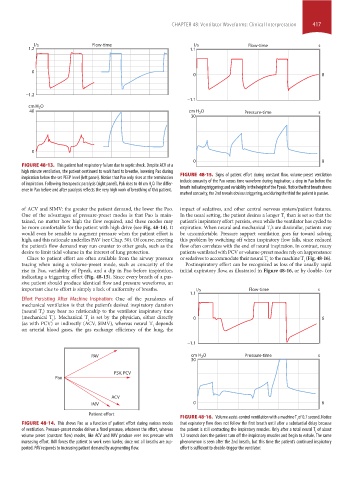
                    FIGURE 48-13.  This patient had respiratory failure due to septic shock. Despite ACV at a
                    high minute ventilation, the patient continued to work hard to breathe, lowering Pao during
                    inspiration below the set PEEP level (left panel). Notice that Pao only rises at the termination   FIGURE 48-15.  Signs  of  patient effort  during constant flow,  volume-preset ventilation
                    of inspiration. Following therapeutic paralysis (right panel), Ppk rises to 40 cm H O. The differ-  include concavity of the Pao versus time waveform during inspiration; a drop in Pao before the
                                                                2
                    ence in Pao before and after paralysis reflects the very high work of breathing of this patient.  breath indicating triggering; and variability in the height of the Ppeak. Notice the first breath shows
                                                                          marked concavity, the 2nd reveals obvious triggering, and during the third the patient is passive.
                    of ACV and SIMV: the greater the patient demand, the lower the Pao.   impact of sedatives, and other central nervous system/patient features.
                    One of the advantages of pressure-preset modes is that Pao is main-  In the usual setting, the patient desires a longer T  than is set so that the
                                                                                                             I
                    tained, no matter how high the flow required, and these modes may   patient’s inspiratory effort persists, even while the ventilator has cycled to
                    be more comfortable for the patient with high drive (see Fig. 48-14). It   expiration. When neural and mechanical T ’s are dissimilar, patients may
                                                                                                        I
                    would even be sensible to augment pressure when the patient effort is   be   uncomfortable. Pressure support ventilation goes far toward solving
                    high, and this rationale underlies PAV (see Chap. 50). Of course, meeting   this problem by switching off when inspiratory flow falls, since reduced
                    the patient’s flow demand may run counter to other goals, such as the   flow often correlates with the end of neural inspiration. In contrast, many
                    desire to limit tidal volume in the interest of lung protection.  patients ventilated with PCV or volume-preset modes rely on happenstance
                     Clues to patient effort are often available from the airway pressure   or sedatives to accommodate their neural T  to the machine T  (Fig. 48-16).
                                                                                                                    I
                                                                                                       I
                    tracing when using a volume-preset mode, such as concavity of the   Postinspiratory effort can be recognized as loss of the usually rapid
                    rise in Pao, variability of Ppeak, and a dip in Pao before inspiration,   initial expiratory flow, as illustrated in Figure 48-16, or by double- (or
                    indicating a triggering effort (Fig. 48-15). Since every breath of a pas-
                    sive patient should produce identical flow and pressure waveforms, an
                    important clue to effort is simply a lack of uniformity of breaths.  l/s     Flow-time               s
                                                                             1.1
                    Effort Persisting After Machine Inspiration:  One of the paradoxes of
                    mechanical ventilation is that the patient’s desired inspiratory duration
                    (neural T ) may bear no relationship to the ventilator inspiratory time
                           I
                    (mechanical T ). Mechanical T  is set by the physician, either directly   0                           6
                                          I
                              I
                    (as with PCV) or indirectly (ACV, SIMV), whereas neural T  depends
                                                                I
                    on  arterial  blood  gases,  the  gas  exchange  efficiency  of  the  lung,  the
                                                                            −1.1
                                           PAV                               cm H O             Pressure-time            s
                                                                                 2
                                                                             30
                                                   PSV, PCV
                               Pao


                                                  ACV
                                           IMV                                0                                           6
                                          Patient effort
                                                                          FIGURE 48-16.  Volume assist-control ventilation with a machine T of 0.7 second. Notice
                                                                                                                 I
                    FIGURE 48-14.  This shows Pao as a function of patient effort during various modes   that expiratory flow does not follow the first breath until after a substantial delay because
                    of ventilation. Pressure-preset modes deliver a fixed pressure, whatever the effort, whereas   the patient is still contracting the inspiratory muscles. Only after a total neural T of about
                                                                                                                        I
                      volume preset (constant flow) modes, like ACV and IMV produce ever less pressure with   1.2 seconds does the patient turn off the inspiratory muscles and begin to exhale. The same
                    increasing effort. IMV forces the patient to work even harder, since not all breaths are sup-  phenomenon is seen after the 2nd breath, but this time the patient’s continued inspiratory
                    ported. PAV responds to increasing patient demand by augmenting flow.  effort is sufficient to double-trigger the ventilator.


            section04.indd   417                                                                                       1/23/2015   2:19:10 PM

