


Page 595 - Hall et al (2015) Principles of Critical Care-McGraw-Hill
P. 595
CHAPTER 48: Ventilator Waveforms: Clinical Interpretation  415


                    alveolar pressure equals the ventilator P . Flow waveform displays facili-  impede venous return, heighten the risk of barotrauma, and improve
                                                I
                    tate adjustments of T  and respiratory rate as discussed below.  oxygenation. In addition, autoPEEP increases the work of breathing
                                   I
                     When patients are breathing spontaneously on PSV, thereby deter-  and impairs the patient’s ability to trigger the ventilator. For these rea-
                    mining their own T  and rate, waveform analysis aids the identification   sons, it is imperative to monitor routinely the presence and amount of
                                  I
                    of  patient-ventilator  asynchrony.  This  may  be  especially  important   autoPEEP in mechanically ventilated patients.
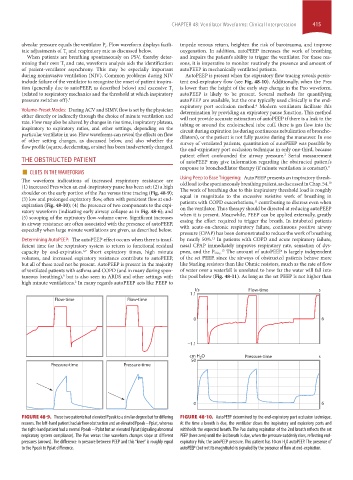
                    during noninvasive ventilation (NIV). Common problems during NIV   AutoPEEP is present when the expiratory flow tracing reveals persis-
                    include failure of the ventilator to recognize the onset of patient inspira-  tent end-expiratory flow (see Fig. 48-10). Additionally, when the Pres
                    tion (generally due to autoPEEP, as described below) and excessive T   I  is lower than the height of the early step change in the Pao waveform,
                    (related to respiratory mechanics and the threshold at which inspiratory   autoPEEP  is  likely  to  be  present.  Several  methods  for  quantifying
                    pressure switches off). 5                             autoPEEP are available, but the one typically used clinically is the end-
                                                                          expiratory port occlusion method.  Modern ventilators facilitate this
                                                                                                   6
                    Volume-Preset Modes:  During ACV and SIMV, flow is set by the physician   determination by providing an expiratory pause function. This method
                    either directly or indirectly through the choice of minute ventilation and   will not provide accurate estimation of autoPEEP if there is a leak in the
                    rate. Flow may also be altered by changes in rise time, inspiratory  plateau,   tubing or around the endotracheal tube cuff, there is gas flow into the
                    inspiratory to expiratory ratios, and other settings, depending on the   circuit during expiration (as during continuous nebulization of broncho-
                    particular ventilator in use. Flow waveforms can reveal the effects on flow     dilators), or the patient is not fully passive during the maneuver. In one
                    of other setting changes, as discussed below, and also whether the    survey of ventilated patients, quantitation of autoPEEP was possible by
                    flow profile (square, decelerating, or sine) has been inadvertently changed.
                                                                          the end-expiratory port occlusion technique in only one-third, because
                                                                          patient effort confounded the airway pressure.  Serial measurement
                                                                                                             2
                    THE OBSTRUCTED PATIENT                                of autoPEEP may give information regarding the obstructed patient’s
                        ■  CLUES IN THE WAVEFORMS                         response to bronchodilator therapy (if minute ventilation is constant). 9
                    The waveform indications of increased respiratory resistance are    Using Peep to Ease Triggering:  AutoPEEP presents an inspiratory thresh-
                                                                          old load to the spontaneously breathing patient, as discussed in Chap. 54.
                                                                                                                            10
                    (1) increased Pres when an end-inspiratory pause has been set; (2) a high
                    shoulder on the early portion of the Pao versus time tracing (Fig. 48-9);   The work of breathing due to this inspiratory threshold load is roughly
                                                                          equal in magnitude to the excessive resistive work of breathing in
                    (3) low and prolonged expiratory flow, often with persistent flow at end-      11
                    expiration (Fig. 48-10); (4) the presence of two components to the expi-  patients with COPD exacerbations,  contributing to distress even when
                                                                          on the ventilator. Thus therapy should be directed at reducing autoPEEP
                    ratory waveform (indicating early airway collapse as in Fig. 48-6); and
                    (5) scooping of the expiratory flow-volume curve. Significant increases   when it is present. Meanwhile, PEEP can be applied externally, greatly
                                                                          easing the effort required to trigger the breath. In intubated patients
                    in airway resistance are often associated with the presence of autoPEEP,
                    especially when large minute ventilations are given, as described below.  with acute-on-chronic respiratory failure, continuous positive airway
                                                                          pressure (CPAP) has been demonstrated to reduce the work of breathing
                    Determining AutoPEEP:  The autoPEEP effect occurs when there is insuf-  by nearly 50%.  In patients with COPD and acute respiratory failure,
                                                                                     12
                    ficient time for the respiratory system to return to functional residual   nasal  CPAP  immediately  improves  respiratory  rate,  sensation  of  dys-
                    capacity by end-expiration.  Short expiratory times, high minute    pnea, and the P CO 2 .  The amount of autoPEEP is largely independent
                                                                                        13
                                         6,7
                    volumes, and increased expiratory resistance contribute to autoPEEP,   of the set PEEP, since the airways of obstructed patients behave more
                    but all of these need not be present. AutoPEEP is present in the majority   like Starling resistors than like Ohmic resistors, much as the rate of flow
                    of ventilated patients with asthma and COPD (and in many during spon-  of water over a waterfall is unrelated to how far the water will fall into
                    taneous breathing),  but is also seen in ARDS and other settings with     the pool below (Fig. 48-11). As long as the set PEEP is not higher than
                                  8
                    high minute ventilations.  In many regards autoPEEP acts like PEEP to
                                      2
                                                                               l/s               Flow-time               s
                                                                             1.1
                               Flow-time                Flow-time
                                                                              0                                           6


                                                                            −1.1

                                                                             cm H O             Pressure-time            s
                                                                                2
                                                                             50
                              Pressure-time           Pressure-time


                                                                              0                                           6

                    FIGURE 48-9.  These two patients had elevated Ppeak to a similar degree but for differing   FIGURE 48-10.  AutoPEEP determined by the end-expiratory port occlusion technique.
                    reasons. The left-hand patient had airflow obstruction and an elevated Ppeak – Pplat, whereas   At the time a breath is due, the ventilator closes the inspiratory and expiratory ports and
                    the right-hand patient had a normal Ppeak – Pplat but an elevated Pplat (signaling abnormal   withholds the expected breath. The Pao during expiration of the 2nd breath reflects the set
                    respiratory system  compliance). The Pao versus time waveform changes slope at different   PEEP (here zero) until the 3rd breath is due, when the pressure suddenly rises, reflecting end-
                    pressures (arrows). The difference in pressure between PEEP and this “knee” is roughly equal   expiratory Palv, the  autoPEEP pressure. This patient has 10 cm H O autoPEEP. The presence of
                                                                                                             2
                    to the Ppeak to Pplat difference.                     autoPEEP (but not its magnitude) is signaled by the presence of flow at end-expiration.


            section04.indd   415                                                                                       1/23/2015   2:19:08 PM

