


Page 616 - Hall et al (2015) Principles of Critical Care-McGraw-Hill
P. 616
436     PART 4: Pulmonary Disorders


                   Good gas exchange, often with lower maximal airway pressures than   They analyzed eight clinical trials of HFOV in patients with ARDS.
                 control ventilation, has been demonstrated with APRV in several small   This population included some pediatric patients who met the criteria
                 observational clinical trials. 28-31,34  However, the end inspiratory lung dis-  for ARDS. In this analysis, six of the eight studies applied HFOV within
                 tention in APRV may not be necessarily less than that provided during   48 hours of intubation and in five of the eight studies the ARDS Network
                 other forms of support (and, indeed, it could be substantially higher)   low tidal volume strategy was used as the control group. Four hundred
                 since spontaneous tidal volumes added to lung volume occur while the   nineteen patients were included in these studies. The resulting meta-
                 lung is inflated with the APRV set pressure.          analysis showed that HFOV produced a significant reduction in mortality
                   Several randomized controlled trials have been done with APRV. The   with a risk ratio of 0.77 and a 95% confidence interval range from 0.61 to
                 first of these appeared to show an outcome benefit to APRV but is dif-  0.98. This certainly suggests that there may be a role for HFOV in severe
                 ficult to interpret as the control strategy required three days of paralysis   respiratory failure from ARDS. While these results were encouraging,
                 and it seemed to markedly worsen gas exchange.  A later trial compared   both Canadian and British trials were recently completed and reported.
                                                    29
                 APRV to a more conventional SIMV strategy and showed no difference   These trials had randomized patients with ARDS to either HFOV or a
                 in outcome.  The most recent trial compared APRV to ARDS Network   standard approach. Neither trial showed a benefit with HFOV and one
                          30
                 low tidal volume ventilation in 64 patients with trauma induced ALI   was terminated early because of harm related to HFOV (see Chap. 52).
                 ARDS.  In this study, there were no significant differences in any of the   A variation on high-frequency ventilation is high-frequency per-
                      34
                 clinical outcomes. Specifically ventilator days, ICU length of stay, and   cussive ventilation (HFPV)—a technique that uses high-frequency
                 mortality were all comparable regardless of mode. Finally, an interesting   pressure pulses superimposed on a conventional ventilation pattern.
                 reanalysis of the data base of a very large ventilator usage survey was   This technique is thought to do two things: First, the high-frequency
                 recently published.  In this data base, 234 subjects were identified who   pulsations may enhance gas mixing and thus gas exchange. Second,
                               35
                 were receiving APRV. A case control group of matched patients based on   the high- frequency pulses may enhance secretion clearance. Indeed,
                 a propensity score and who were receiving assist-control ventilation were   it is this latter application that has driven its popularity in burn units
                 also  identified.  Comparing  the  APRV  group  with  this  matched  assist   where supporters claim improved pulmonary toilet in patients with
                 control group found no differences in mortality, ventilator free days, or   airway burns. One of the few randomized trials with this technique was
                 length of stay. Taken together these studies would suggest that APRV,   reported in 2010.  This study was conducted in a military burn unit
                                                                                    44
                 while a physiologically interesting mode, has not been shown as yet to   where 62 patients were randomized to HFPV or a conventional lung
                 improve meaningful clinical outcomes in patients with severe ARDS.  protective ventilator strategy. Approximately one-third of the patients
                     ■  HIGH-FREQUENCY OSCILLATORY VENTILATION         had significant inhalational injuries. Although the HFPV group met gas
                                                                       exchange goals more readily, the ultimate outcomes in terms of survival,
                 High-frequency oscillatory ventilation (HFOV) uses very high breath-  ventilator free days and hospital length of stay were not statistically dif-
                 ing frequencies (120-900 breaths per minute [bpm] in the adult) coupled   ferent. HFPV thus remains an attractive theoretical adjunct in patients,
                 with very small tidal volumes (usually less than anatomic dead space   especially those with severe airway injuries, but evidence supporting
                 and often <1 mL/kg at the alveolar level) to provide gas exchange in the   improved outcomes from its use remains minimal.
                 these seemingly unphysiologic conditions involves such mechanisms as   ■  ADAPTIVE SUPPORT VENTILATION
                         Gas transport up and down the tracheobronchial tree under
                 lungs.
                     36,37
                 Taylor dispersion, coaxial flows and augmented diffusion.  The actual   Adaptive support ventilation (ASV) is an assist-control, pressure-targeted,
                                                            37
                 device to deliver HFOV in adults uses a to-and-fro piston mechanism   time-cycled mode of ventilation that automatically sets the  frequency-tidal
                 to literally vibrate a fresh bias flow of gas delivered at or near the tip of   volume pattern according to respiratory system  mechanics in order to
                 the endotracheal tube. Indeed, because HFOV supplies substantial mean   minimize the ventilator work. 45-52  Conceptually, this  minimal ventilator
                 airway pressures but applies very little pressure or volume fluctuations in   work may translate into minimal stretching forces on the lungs, which
                 the alveolus, it is sometimes termed “CPAP with a wiggle.”  may, in turn, reduce VILI.
                   The putative advantages to HFOV are twofold. First, the very small   ASV calculates minimal work settings by first measuring respiratory
                 alveolar tidal pressure swings minimize cyclical overdistension and   system mechanics using several “test breaths.” It then uses a measure-
                 derecruitment.  Second, a high mean airway pressure can also pre-  ment of the expiratory time constants (RCe = resistance × compliance)
                            36
                 vent derecruitment. Interestingly, mean pressures used during HFOV   to ensure an inspiratory time of at least one RCe and an expiratory time
                 are often reported to exceed the 30 to 35 cm H O threshold employed   of at least three RCes. These data are then inserted into the following
                                                    2
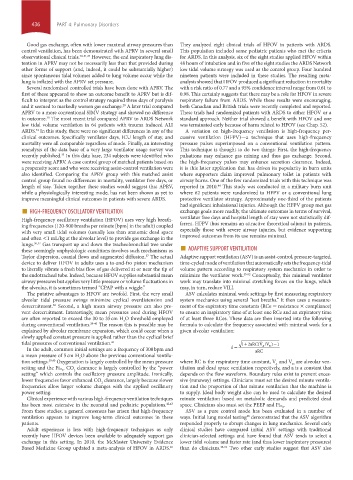
                 during conventional ventilation. 38-40  The reason this is possible may be   formula to calculate the frequency associated with minimal work for a
                 explained by alveolar membrane expansion, which could occur when a   given alveolar ventilation:
                 slowly applied constant pressure is applied rather than the cyclical brief
                 tidal pressures of conventional ventilation. 41                            12 aRC(V/V) 1

                                                                                             +
                                                                                                       -
                   In the adult, common initial settings are a frequency of 300 bpm and   f =    aRC A  D
                 a mean pressure of 5 cm H O above the previous conventional ventila-
                                     2
                 tion settings. 39,40  Oxygenation is largely controlled by the mean pressure   where RC is the respiratory time constant, V  and V  are alveolar ven-
                                                                                                        A
                                                                                                             D
                               . CO  clearance is largely controlled by the “power   tilation and dead space ventilation respectively, and a is a constant that
                 setting and the Fi O 2  2
                 setting” which controls the oscillatory pressure amplitude. Ironically,   depends on the flow waveform. Boundary rules exist to prevent exces-
                 lower frequencies favor enhanced CO  clearance, largely because slower   sive (runaway) settings. Clinicians must set the desired minute ventila-
                                            2
                 frequencies allow larger volume changes with the applied oscillatory   tion and the proportion of that minute ventilation that the machine is
                 power setting.                                        to supply. Ideal body weight also can be used to calculate the desired
                   Clinical experience with various high-frequency ventilation techniques   minute ventilation based on metabolic demands and predicted dead
                 has been most extensive in the neonatal and pediatric populations. 42,43    space. Clinicians also must set the PEEP and Fi O 2 .
                 From these studies, a general consensus has arisen that high-frequency   ASV as a pure control mode has been evaluated in a number of
                 ventilation appears to improve long-term clinical outcomes in these   ways. Initial lung model testing  demonstrated that the ASV algorithm
                                                                                              48
                 patients.                                             responded properly to abrupt changes in lung mechanics. Several early
                   Adult experience is less with high-frequency techniques as only   clinical studies have compared initial ASV settings with traditional
                 recently have HFOV devices been available to adequately support gas   clinician-selected settings and have found that ASV tends to select a
                 exchange  in  this  setting.  In  2010,  the  McMaster  University  Evidence   lower tidal volume and faster rate (and thus lower inspiratory pressures)
                 Based Medicine Group updated a meta-analysis of HFOV in ARDS.    than do clinicians. 48-51  Two other early studies suggest that ASV also
                                                                    40


            section04.indd   436                                                                                       1/23/2015   2:19:25 PM

