


Page 638 - Hall et al (2015) Principles of Critical Care-McGraw-Hill
P. 638
CHAPTER 52: Acute Lung Injury and the Acute Respiratory Distress Syndrome  457


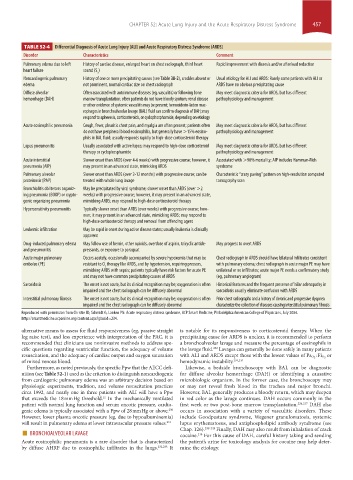
                      TABLE 52-4    Differential Diagnosis of Acute Lung Injury (ALI) and Acute Respiratory Distress Syndrome (ARDS)
                    Disorder             Characteristics                              Comment
                    Pulmonary edema due to left   History of cardiac disease, enlarged heart on chest radiograph, third heart   Rapid improvement with diuresis and/or afterload reduction
                    heart failure        sound (S )
                                             3
                    Noncardiogenic pulmonary   History of one or more precipitating causes (see Table 38-2), crackles absent or  Usual etiology for ALI and ARDS: Rarely some patients with ALI or
                    edema                not prominent, normal cardiac size on chest radiograph  ARDS have no obvious precipitating cause
                    Diffuse alveolar     Often associated with autoimmune diseases (eg, vasculitis) or following bone   May meet diagnostic criteria for ARDS, but has different
                      hemorrhage (DAH)   marrow transplantation; often patients do not have bloody sputum; renal disease     pathophysiology and management
                                         or other evidence of systemic vasculitis may be present; hemosiderin-laden mac-
                                         rophages in bronchoalveolar lavage (BAL) fluid can confirm diagnosis of DAH; may
                                         respond to apheresis, corticosteroids, or cyclophosphamide, depending on etiology
                    Acute eosinophilic pneumonia  Cough, fever, pleuritic chest pain, and myalgia are often present; patients often   May meet diagnostic criteria for ARDS, but has different
                                         do not have peripheral blood eosinophilia, but generally have >15% eosino-    pathophysiology and management
                                         phils in BAL fluid; usually responds rapidly to high-dose corticosteroid therapy
                    Lupus pneumonitis    Usually associated with active lupus; may respond to high-dose corticosteroid   May meet diagnostic criteria for ARDS, but has different
                                         therapy or cyclophosphamide                    pathophysiology and management
                    Acute interstitial   Slower onset than ARDS (over 4-6 weeks) with progressive course; however, it   Associated with >90% mortality; AIP includes Hamman-Rich
                      pneumonia (AIP)    may present in an advanced state, mimicking ARDS    syndrome
                    Pulmonary alveolar    Slower onset than ARDS (over 2-12 months) with progressive course; can be   Characteristic “crazy paving” pattern on high-resolution computed
                    proteinosis (PAP)    treated with whole lung lavage               tomography scan
                    Bronchiolitis obliterans organiz-  May be precipitated by viral syndrome; slower onset than ARDS (over >2
                    ing pneumonia (BOOP) or crypto-  weeks) with progressive course; however, it may present in an advanced state,
                    genic organizing pneumonia  mimicking ARDS; may respond to high-dose corticosteroid therapy
                    Hypersensitivity pneumonitis  Typically slower onset than ARDS (over weeks) with progressive course; how-
                                         ever, it may present in an advanced state, mimicking ARDS; may respond to
                                         high-dose corticosteroid therapy and removal from offending agent
                    Leukemic infiltration  May be rapid in onset during active disease states; usually leukemia is clinically
                                         apparent
                    Drug-induced pulmonary edema   May follow use of heroin, other opioids, overdose of aspirin, tricyclic antide-  May progress to overt ARDS
                    and pneumonitis      pressants, or exposure to paraquat
                    Acute major pulmonary    Occurs acutely, occasionally accompanied by severe hypoxemia that may be   Chest radiograph in ARDS should have bilateral infiltrates consistent
                    embolus (PE)         resistant to O  therapy like ARDS, and by hypotension, requiring pressors,   with pulmonary edema; chest radiograph in acute major PE may have
                                                2
                                         mimicking ARDS with sepsis; patients typically have risk factors for acute PE   unilateral or no infiltrates; acute major PE needs a confirmatory study
                                         and may not have common precipitating causes of ARDS  (eg, pulmonary angiogram)
                    Sarcoidosis          The onset is not acute, but its clinical recognition may be; oxygenation is often  Historical features and the frequent presence of hilar adenopathy in
                                         impaired and the chest radiograph can be diffusely abnormal  sarcoidosis usually eliminate confusion with ARDS
                    Interstitial pulmonary fibrosis  The onset is not acute, but its clinical recognition may be; oxygenation is often  Prior chest radiographs and a history of chronic and progressive dyspnea
                                         impaired and the chest radiograph can be diffusely abnormal  characterize the collection of diseases causing interstitial pulmonary fibrosis
                    Reproduced with permission from Christie JD, Schmidt G, Lanken PN: Acute respiratory distress syndrome, ACP Smart Medicine, Philadelphia:American College of Physicians, July 2004.
                    http://smartmedicine.acponline.org/content.aspx?gbosid=234.
                    alternative means to assess for fluid responsiveness (eg, passive straight   is notable for its responsiveness to corticosteroid therapy. When the
                    leg raise test), and less experience with interpretation of the PAC, it is   precipitating cause for ARDS is unclear, it is recommended to perform
                    recommended that clinicians use noninvasive methods to address spe-  a bronchoalveolar lavage and measure the percentage of eosinophils in
                    cific questions regarding ventricular function, the adequacy of volume   the lavage fluid.  Lavages can generally be done safely in many patients
                                                                                     232
                    resuscitation, and the adequacy of cardiac output and oxygen saturation   with ALI and ARDS except those with the lowest values of Pa O 2  : Fi O 2  or
                    of mixed venous blood.                                hemodynamic instability. 234,235
                     Furthermore, as noted previously, the specific Ppw that the AECC defi-  Likewise, a bedside bronchoscopy with BAL can be diagnostic
                    nition (see Table 52-1) used as the criterion to distinguish noncardiogenic   for  diffuse  alveolar  hemorrhage  (DAH)  or  identifying  a  causative
                    from cardiogenic pulmonary edema was an arbitrary decision based on   microbiologic organism. In the former case, the bronchoscopy may
                    physiologic experiments, tradition, and volume resuscitation practices   or may not reveal fresh blood in the trachea and major bronchi.
                    circa 1992, and nearly one in three patients with ALI will have a Ppw   However, BAL generally produces a bloody return, which may deepen
                    that exceeds the 18 mm Hg threshold.  In the mechanically  ventilated   in red color as the lavage continues. DAH occurs commonly in the
                                               22
                    patient with normal lung function and serum oncotic pressure, cardio-  first week or two post-bone marrow transplantation. 236,237  DAH also
                    genic edema is typically associated with a Ppw of 28 mm Hg or above.    occurs in association with a variety of vasculitic disorders. These
                                                                      230
                    However, lower plasma oncotic pressure (eg, due to hypoalbuminemia)   include Goodpasture syndrome, Wegener granulomatosis, systemic
                    will result in pulmonary edema at lower intravascular pressure values. 231  lupus erythematosus, and antiphospholipid antibody syndrome (see
                        ■  BRONCHOALVEOLAR LAVAGE                         Chap. 126). 238-243  Finally, DAH may also result from inhalation of crack
                                                                          cocaine.  For this cause of DAH, careful history taking and sending
                                                                                238
                    Acute eosinophilic pneumonia is a rare disorder that is characterized   the patient’s urine for toxicology analysis for cocaine may help deter-
                    by diffuse AHRF due to eosinophilic infiltrates in the lungs. 232,233  It   mine the etiology.


            section04.indd   457                                                                                       1/23/2015   2:19:40 PM

