


Page 655 - Hall et al (2015) Principles of Critical Care-McGraw-Hill
P. 655
474     PART 4: Pulmonary Disorders


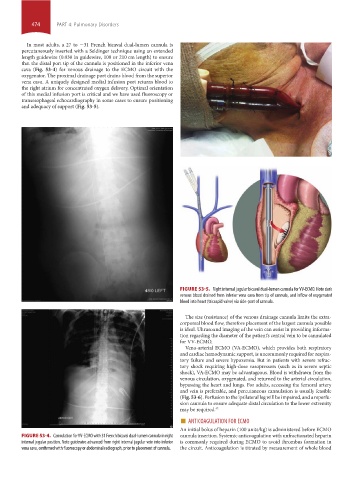
                   In  most adults,  a 27  to  −31  French  bicaval  dual-lumen cannula is
                 percutaneously inserted with a Seldinger technique using an extended
                 length guidewire (0.038 in guidewire, 100 or 210  cm length) to ensure
                 that the distal port tip of the cannula is positioned in the inferior vena
                 cava (Fig. 53-4) for venous drainage to the ECMO circuit with the
                 oxygenator. The proximal drainage port drains blood from the superior
                 vena cava. A uniquely designed medial infusion port returns blood to
                 the right atrium for concentrated oxygen delivery. Optimal orientation
                 of this medial infusion port is critical and we have used fluoroscopy or
                 transesophageal echocardiography in some cases to ensure positioning
                 and adequacy of support (Fig. 53-5).


                                                                       FIGURE 53-5.  Right internal jugular bicaval dual-lumen cannula for VV-ECMO. Note dark
                                                                       venous blood drained from inferior vena cava from tip of cannula, and inflow of oxygenated
                                                                       blood into heart (tricuspid valve) via side-port of cannula.

                                                                         The size (resistance) of the venous drainage cannula limits the extra-
                                                                       corporeal blood flow, therefore placement of the largest cannula possible
                                                                       is ideal. Ultrasound imaging of the vein can assist in providing informa-
                                                                       tion regarding the diameter of the patient’s central vein to be cannulated
                                                                       for VV-ECMO.
                                                                         Veno-arterial ECMO (VA-ECMO), which provides both respiratory
                                                                       and cardiac hemodynamic support, is uncommonly required for respira-
                                                                       tory failure and severe hypoxemia. But in patients with severe refrac-
                                                                       tory shock requiring high-dose vasopressors (such as in severe septic
                                                                       shock), VA-ECMO may be advantageous. Blood is withdrawn from the
                                                                       venous circulation, oxygenated, and returned to the arterial circulation,
                                                                         bypassing the heart and lungs. For adults, accessing the femoral artery
                                                                       and vein is preferable, and percutaneous cannulation is usually feasible
                                                                       (Fig. 53-6). Perfusion to the ipsilateral leg will be impaired, and a reperfu-
                                                                       sion cannula to ensure adequate distal circulation to the lower extremity
                                                                       may be required. 42
                                                                           ■  ANTICOAGULATION FOR ECMO

                                                                       An initial bolus of heparin (100 units/kg) is administered before ECMO
                 FIGURE 53-4.  Cannulation for VV-ECMO with 31 French bicaval dual-lumen cannula in right   cannula insertion. Systemic anticoagulation with unfractionated heparin
                 internal jugular position. Note guidewire advanced from right internal jugular vein into inferior   is commonly required during ECMO to avoid thrombus formation in
                 vena cava, confirmed with fluoroscopy or abdominal radiograph, prior to placement of cannula.  the circuit. Anticoagulation is titrated by measurement of whole blood


            section04.indd   474                                                                                       1/23/2015   2:19:56 PM

