


Page 656 - Hall et al (2015) Principles of Critical Care-McGraw-Hill
P. 656
CHAPTER 53: Extracorporeal Lung Support  475


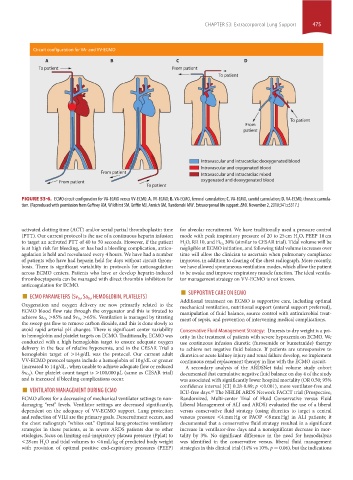
                        Circuit configuration for VA- and VV-ECMO
                            A                     B                     C                      D
                         To patient                                    From patient
                                                                                       To patient


                                                                                                               To patient
                                                                                                From
                                                                                               patient


                                                                                 Intravascular and intracardiac deoxygenated blood
                                                                                 Intravascular and oxygenated blood
                                               From patient
                                                                                 Intravascular and intracardiac mixed
                                From patient                                     oxygenated and deoxygenated blood
                                                              To patient
                    FIGURE 53-6.  ECMO circuit configuration for VA-ECMO versus VV-ECMO. A. VV-ECMO; B. VA-ECMO, femoral cannulation; C. VA-ECMO, carotid cannulation; D. VA-ECMO, thoracic cannula-
                    tion. (Reproduced with permission from Gaffney AM, Wildhirst SM, Griffin MJ, Annich GM, Randomski MW. Extracorporeal life support. BMJ. November 2, 2010;341:c5317.)


                    activated clotting time (ACT) and/or serial partial thromboplastin time   for alveolar recruitment. We have traditionally used a pressure control
                    (PTT). Our current protocol is the use of a continuous heparin infusion   mode with peak inspiratory pressure of 20 to 25 cm H O, PEEP 10 cm
                                                                                                                  2
                    to target an activated PTT of 40 to 50 seconds. However, if the patient   H O, RR 10, and Fi O 2  30% (similar to CESAR trial). Tidal volume will be
                                                                           2
                    is at high risk for bleeding, or has had a bleeding complication, antico-  negligible at ECMO initiation, and following tidal volume increases over
                    agulation is held and reevaluated every 4 hours. We have had a number   time will allow the clinician to ascertain when pulmonary compliance
                    of patients who have had heparin held for days without circuit throm-  improves, in addition to clearing of the chest radiograph. More recently,
                    bosis. There is significant variability in protocols for anticoagulation   we have allowed spontaneous ventilation modes, which allow the patient
                    across ECMO centers. Patients who have or develop heparin-induced   to be awake and improve respiratory muscle function. The ideal ventila-
                    thrombocytopenia can be managed with direct thrombin inhibitors for   tor management strategy on VV-ECMO is not known.
                    anticoagulation for ECMO.
                        ■                  , HEMOGLOBIN, PLATELETS)           ■  SUPPORTIVE CARE ON ECMO

                                        , Sa O2
                      ECMO PARAMETERS (Sv O2
                    Oxygenation and oxygen delivery are now primarily related to the   Additional treatment on ECMO is supportive care, including optimal
                                                                          mechanical ventilation, nutritional support (enteral support preferred),
                    ECMO blood flow rate through the oxygenator and this is titrated to   manipulation of fluid balance, source control with antimicrobial treat-
                                         >65%. Ventilation is managed by titrating
                    achieve Sa O 2  >85% and Sv O 2                       ment of sepsis, and prevention of intervening medical complications.
                    the sweep gas flow to remove carbon dioxide, and this is done slowly to
                    avoid rapid arterial pH changes. There is significant center variability   Conservative Fluid Management Strategy:  Diuresis to dry weight is a pri-
                    in hemoglobin and platelet targets on ECMO. Traditionally, ECMO was   ority in the treatment of patients with severe hypoxemia on ECMO. We
                    conducted with a high hemoglobin target to ensure adequate oxygen   use continuous infusion diuretic (furosemide or bumetanide) therapy
                    delivery in the face of relative hypoxemia, and in the CESAR Trial a   to  achieve  net  negative  fluid  balance.  If  patients  are  unresponsive  to
                    hemoglobin  target  of  >14 g/dL  was  the  protocol.  Our  current  adult   diuretics or acute kidney injury and renal failure develop, we implement
                    VV-ECMO protocol targets include a hemoglobin of 10 g/dL or greater   continuous renal replacement therapy in line with the ECMO circuit.
                    (increased to 14 g/dL , when unable to achieve adequate flow or reduced   A secondary analysis of the ARDSNet tidal volume study cohort
                      ). Our platelet count target is >100,000 μL (same as CESAR trial)
                    Sv O 2                                                documented that cumulative negative fluid balance on day 4 of the study
                    and is increased if bleeding complications occur.     was associated with significantly lower hospital mortality (OR 0.50; 95%
                        ■  VENTILATOR MANAGEMENT DURING ECMO              confidence interval [CI] 0.28-0.89; p <0.001), more ventilator-free and
                                                                          ICU-free days.  The NHLBI ARDS Network FACCT trial (Prospective,
                                                                                    43
                    ECMO allows for a decreasing of mechanical ventilator settings to non-  Randomized, Multi-center Trial of Fluid Conservative versus Fluid
                    damaging  “rest”  levels.  Ventilator  settings  are  decreased  significantly,   Liberal Management of ALI and ARDS) evaluated the use of a liberal
                    dependent on the adequacy of VV-ECMO support. Lung protection   versus  conservative  fluid strategy (using diuretics  to target  a central
                    and reduction of VILI are the primary goals. Derecruitment occurs, and   venous pressure  <4 mm Hg  or  PAOP  <8 mm Hg)  in  ALI  patients;  it
                    the chest radiograph “whites out.” Optimal lung-protective ventilatory   documented that a conservative fluid strategy resulted in a significant
                    strategies in these patients, as in severe ARDS patients due to other   increase in ventilator-free days and a nonsignificant decrease in mor-
                    etiologies, focus on limiting end-inspiratory plateau pressure (Pplat) to   tality  by  3%.  No  significant  difference  in  the  need  for  hemodialysis
                    <28 cm H O and tidal volumes to <6 mL/kg of predicted body weight   was identified in the conservative versus. liberal fluid management
                           2
                    with provision of optimal positive end-expiratory pressures (PEEP)     strategies in this clinical trial (14% vs 10%, p = 0.06), but the indications


            section04.indd   475                                                                                       1/23/2015   2:19:57 PM

