


Page 654 - Hall et al (2015) Principles of Critical Care-McGraw-Hill
P. 654
CHAPTER 53: Extracorporeal Lung Support  473


                      membrane oxygenator to temporarily take over the functions of the lung.   When severe ARDS patients are transferred to us for possible ECMO
                    While on ECMO, mechanical ventilator settings are adjusted to minimize   evaluation, we place a right internal jugular and right femoral venous
                    VILI and to maximize the recruitment to functional residual capacity   catheter in the event that ECMO is required, so that VV-ECMO can-
                    with an algorithm that aims to normalize body physiology and minimize   nulation can proceed expeditiously. The ECMO charge specialist is
                    barotrauma. This algorithm used in 141 patients with respiratory failure   contacted, and an ECMO circuit and ECMO blood pack is prepared.
                    referred for consideration of ECMO yielded a survival rate of 62% in     ■
                                                         ratio of 66). 41   CANNULATION
                    patients with severe ARDS (median initial Pa O 2 /Fi O 2
                     The primary indication for use of ECMO in patients with severe   The majority of patients with severe hypoxemia are managed with
                    respiratory failure is when the risk of dying from ARDS is considered   VV-ECMO. Adult patients are typically cannulated percutaneously
                    greater than 80% despite optimal ventilator and medical management.   with 21 to 23 French catheters for drainage and infusion of blood.
                                         ratio of less than 70 on 100% oxygen.  Percutaneous venous ECMO cannula insertion is the standard, but
                    This translates to a Pa O 2 /Fi O 2
                                                                          surgical cutdown is required in some circumstances. Traditional can-
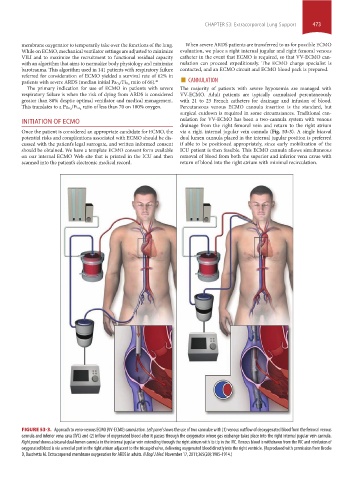
                    INITIATION OF ECMO                                    nulation for VV-ECMO has been a two-cannula system with venous
                                                                          drainage from the right femoral vein and return to the right atrium
                    Once the patient is considered an appropriate candidate for ECMO, the   via a right internal jugular vein cannula (Fig. 53-3). A single bicaval
                    potential risks and complications associated with ECMO should be dis-  dual lumen cannula placed in the internal jugular position is preferred
                    cussed with the patient’s legal surrogate, and written informed consent   if  able  to  be positioned  appropriately,  since  early  mobilization  of  the
                    should be obtained. We have a template ECMO consent form available   ICU patient is then feasible. This ECMO cannula allows simultaneous
                    on our internal ECMO Web site that is printed in the ICU and then   removal of blood from both the superior and inferior vena cavae with
                    scanned into the patient’s electronic medical record.  return of blood into the right atrium with minimal recirculation.


                    FIGURE 53-3.  Approach to veno-venous ECMO (VV-ECMO) cannulation. Left panel shows the use of two cannulae with (1) venous outflow of deoxygenated blood from the femoral venous
                    cannula and inferior vena cava (IVC) and (2) inflow of oxygenated blood after it passes through the oxygenator where gas exchange takes place into the right internal jugular vein cannula.
                    Right panel shows a bicaval dual-lumen cannula in the internal jugular vein extending through the right atrium with its tip in the IVC. Venous blood is withdrawn from the IVC and reinfusion of
                    oxygenated blood is via a medial port in the right atrium adjacent to the tricuspid valve, delivering oxygenated blood directly into the right ventricle. (Reproduced with permission from Brodie
                    D, Bacchetta M. Extracorporeal membrane oxygenation for ARDS in adults. N Engl J Med. November 17, 2011;365(20):1905-1914.)


            section04.indd   473                                                                                       1/23/2015   2:19:54 PM

