


Page 657 - Hall et al (2015) Principles of Critical Care-McGraw-Hill
P. 657
476     PART 4: Pulmonary Disorders


                 for initiation of hemodialysis were not controlled in this study mak-
                 ing comparison difficult. A post hoc subgroup analysis of 244 surgical
                 patients enrolled in the FACTT trial documented that a conservative
                 fluid strategy resulted in more ventilator-free and ICU-free days, and no
                 difference in mortality or renal failure. 44
                   A  small  (n  =  40)  RCT  randomized  patients  with  ALI/ARDS  and
                 hypoproteinemia (serum total protein concentrations <6 g/dL) to receive
                 furosemide  with  albumin  or  furosemide  with  placebo  for  72  hours,
                 titrated to fluid loss and normalization of serum total protein concentra-
                 tion. Albumin-treated patients had greater increase in oxygenation (mean
                              : +43 vs −24 mm Hg at 24 hours and +49 vs −13 mm Hg
                 change in Pa O 2 /Fi O 2
                 at day 3) with greater net negative fluid balance (−5480 vs −1490 mL at
                 day  3)  and  better  maintenance  of  hemodynamic  stability.   Additional
                                                           45
                 trials are underway (comparative evaluation of albumin and starch effects
                 in acute lung injury, CEASE, NCT00796419) and larger definitive clinical
                 trials are warranted to confirm these preliminary findings.
                     ■  WEANING OFF ECMO

                 Once the patient’s native lung function has improved, with documenta-  FIGURE 53-7.  Use of prone positioning in ECMO for lung recruitment.
                 tion of improved pulmonary compliance and oxygenation, the patient
                 is ready to wean off ECMO. This requires a slow reduction of ECMO     cannula in place, as IVC thrombus is common, and the patient is at risk
                 sweep, and increase in mechanical ventilation to achieve adequate ven-  for pulmonary embolus.
                 pressure and recruitment maneuvers to improve oxygenation. The opti-  ■  COMPLICATIONS RELATED TO ECMO
                 tilation. We initiate recruitment with increased PEEP and mean airway
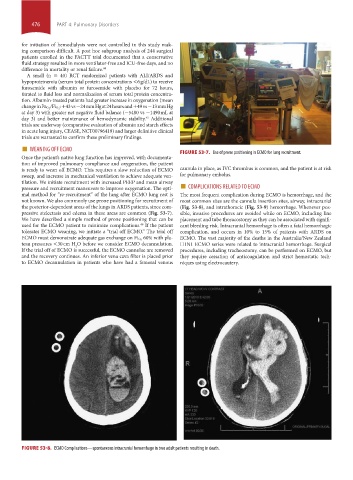
                 mal method for “re-recruitment” of the lung after ECMO lung rest is   The most frequent complication during ECMO is hemorrhage, and the
                 not known. We also commonly use prone positioning for recruitment of   most common sites are the cannula insertion sites, airway, intracranial
                 the posterior-dependent areas of the lungs in ARDS patients, since com-  (Fig. 53-8), and intrathoracic (Fig. 53-9) hemorrhage. Whenever pos-
                 pressive atelectasis and edema in these areas are common (Fig. 53-7).   sible, invasive procedures are avoided while on ECMO, including line
                 We have described a simple method of prone positioning that can be   placement and tube thoracostomy as they can be associated with signifi-
                 used for the ECMO patient to minimize complications.  If the patient   cant bleeding risk. Intracranial hemorrhage is often a fatal hemorrhagic
                                                          46
                 tolerates ECMO weaning, we initiate a “trial off ECMO.” The trial off   complication, and occurs in 10% to 15% of patients with ARDS on
                                                           60% with pla-  ECMO. The vast majority of the deaths in the Australia/New Zealand
                 ECMO must demonstrate adequate gas exchange on Fi O 2
                 teau pressures <30 cm H O before we consider ECMO decannulation.   H1N1 ECMO series were related to intracranial hemorrhage. Surgical
                                    2
                 If the trial off of ECMO is successful, the ECMO cannulae are removed   procedures, including tracheostomy, can be performed on ECMO, but
                 and the recovery continues. An inferior vena cava filter is placed prior   they require cessation of anticoagulation and strict hemostatic tech-
                 to ECMO decannulation in patients who have had a femoral venous   niques using electrocautery.


                 FIGURE 53-8.  ECMO Complications—spontaneous intracranial hemorrhage in two adult patients resulting in death.


            section04.indd   476                                                                                       1/23/2015   2:19:59 PM

