


Page 659 - Hall et al (2015) Principles of Critical Care-McGraw-Hill
P. 659
478     PART 4: Pulmonary Disorders


                                                                       180 patients. Of the 90 conventional  treatment patients, 41 survived.
                   TABLE 53-5     ECMO Outcomes From the Extracorporeal Life Support
                             Organization (ELSO) Registry              Of the 90 ECMO patients, 5 died before or during transport to the
                                                                       ECMO center, 17 improved on the  management algorithm, and 68
                             Total Patients  Survived ECLS  Survived to DC or Transfer  patients (75%) received ECMO. Six-month survival without disability
                  Neonatal                                             was 63% (57/90) of patients in the ECMO group compared to 47%
                                                                       (41/90) in the conventional management group (relative risk [RR] 0.69;
                    Respiratory  27,007  22,782  84%   20,093  74%
                                                                       95% CI 0.05-0.97, p = 0.03). The authors concluded that management
                    Cardiac    5,425      3,339  62%    2,206  41%     of ARDS with a standardized algorithm including ECMO in an expert
                    ECPR        980        626  64%      388   40%     center resulted in better survival than the best care in other centers in
                                                                       the United Kingdom.
                  Pediatric
                    Respiratory  6,149    4,034  66%    3,496  57%         ■  META-ANALYSIS OF ECMO TRIALS FOR ARDS
                    Cardiac    6,784      4,443  65%    3,388  50%     A recent systematic review and meta-analysis examined studies of
                    ECPR       2,071      1,123  54%     840   41%     ECMO in adult acute respiratory failure reporting mortality rates for
                  Adult                                                at least 10 patients in ECMO and non-ECMO groups. Three RCTs
                                                                       (including the CESAR trial) and three cohort studies were identified.
                    Respiratory  5,146    3,317  64%    2,905  56%     Meta-analysis  of  the  three  RCTs  revealed  significant  heterogeneity in
                    Cardiac    4,042      2,255  56%    1,636  40%     risk of mortality, with a summary risk ratio of 0.93 (95% CI, 0.71-1.22). 53
                                                                         The authors of this meta-analysis concluded that: “There is insuf-
                    ECPR       1,238       476  38%      355   29%
                                                                       ficient evidence to provide a recommendation for ECMO among
                  Total        58,842    42,395  72%   35,307  60%     patients with respiratory failure resulting from influenza. However,
                                                                       clinicians should consider ECMO within the context of other sal-
                                                                       vage therapies for acute respiratory failure.” They recommended the
                     ■  ECMO OUTCOMES IN ARDS                          following:

                 In a review and quantitative analysis, Chalwin and colleagues  exam-    • For clinicians at hospitals that do not have an ECMO program, it
                                                               51
                 ined the role of ECMO for ARDS. An electronic search revealed two   would be advisable
                 randomized controlled trials (RCTs) and three noncontrolled trials.     • To establish institutional guidelines  to identify ECMO-eligible
                 Bayesian analysis on the two RCTs produced an odds ratio mortality of   patients in a timely manner
                 1.28 (CI 0.24-6.55) showing no significant harm or benefit. Pooling was     • To establish a relationship with an ECMO-capable institution to
                 not possible for the noncontrolled studies because of differing admission   facilitate safe interhospital transport of these potentially salvage-
                 status and ECMO selection criteria and an inability to control for these   able patients
                 differences in the absence of individual patient data. A large number       • To be familiar with the general guidelines for extracorporeal
                 (n = 35) of case series have been published with generally more positive   life support cases and H1N1 cases in particular provided by
                 results. The authors concluded that ECMO, as rescue therapy for ARDS,   the ELSO
                 appears to be an unvalidated rescue treatment option. Analysis and     • Future studies are needed to define the optimal use of this potentially
                 review of trial data did not support its application; however, the body of   life-saving intervention.
                 reported cases suggests otherwise.
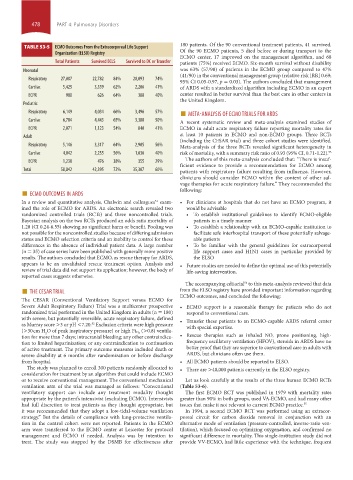
                     ■  THE CESAR TRIAL                                from the ELSO registry have provided important information regarding
                                                                         The accompanying editorial  to this meta-analysis reviewed that data
                                                                                             54
                 The CESAR (Conventional Ventilatory Support versus ECMO for   ECMO outcomes, and concluded the following:
                 Severe Adult Respiratory Failure) Trial was a multicenter prospective     • ECMO support is a reasonable therapy for patients who do not
                 randomized trial performed in the United Kingdom in adults (n = 180)   respond to conventional care.
                 with severe, but potentially reversible, acute respiratory failure, defined     • Transfer these patients to an ECMO-capable ARDS referral center
                 as Murray score >3 or pH <7.20.  Exclusion criteria were high pressure   with special expertise.
                                         52
                                                           (>0.8) ventila-
                         2
                 (>30 cm H O of peak inspiratory pressure) or high Fi O 2
                 tion for more than 7 days; intracranial bleeding; any other contraindica-    • Rescue therapies such as inhaled NO, prone positioning, high-
                 tion to limited heparinization; or any contraindication to continuation   frequency oscillatory ventilation (HFOV), steroids in ARDS have no
                 of active treatment. The primary outcome measures included death or   better proof that they are superior to conventional care in adults with
                 severe disability at 6 months after randomization or before discharge   ARDS, but clinicians often use them.
                 from hospital.                                           • All ECMO patients should be reported to ELSO.
                   The study was planned to enroll 300 patients randomly allocated to     • There are >40,000 patients currently in the ELSO registry.
                 consideration for treatment by an algorithm that could include ECMO
                 or to receive conventional management. The conventional mechanical   Let us look carefully at the results of the three human ECMO RCTs
                 ventilation arm of the trial was managed as follows: “Conventional   (Table 53-6).
                 ventilatory support can include any treatment modality thought   The first ECMO RCT was published in 1979 with mortality rates
                 appropriate by the patient’s intensivist (excluding ECMO). Intensivists   greater than 90% in both groups, used VA-ECMO, and had many other
                 had full discretion to treat patients as they thought appropriate, but   issues that make it not relevant to current ECMO practice. 55
                 it  was  recommended  that  they  adopt  a  low-tidal-volume  ventilation   In 1994, a second ECMO RCT was performed using an extracor-
                 strategy.” But the details of compliance with lung-protective ventila-  poreal circuit for carbon dioxide removal in conjunction with an
                 tion in the control cohort were not reported. Patients in the ECMO     alternative mode of ventilation (pressure-controlled, inverse-ratio ven-
                 arm were transferred to the ECMO center at Leicester for protocol   tilation), which focused on optimizing oxygenation, and confirmed no
                 management and ECMO if needed. Analysis was by intention to   significant difference in mortality. This single-institution study did not
                 treat. The study was stopped by the DSMB for effectiveness after   provide VV-ECMO, had little experience with the technique, frequent


            section04.indd   478                                                                                       1/23/2015   2:20:01 PM

