


Page 658 - Hall et al (2015) Principles of Critical Care-McGraw-Hill
P. 658
CHAPTER 53: Extracorporeal Lung Support  477


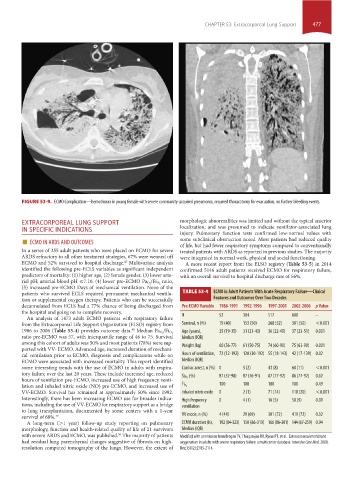
                    FIGURE 53-9.  ECMO Complication—hemothorax in young female with severe community-acquired pneumonia, required thoracotomy for evacuation, no further bleeding events.


                    EXTRACORPOREAL LUNG SUPPORT                           morphologic abnormalities was limited and without the typical anterior
                    IN SPECIFIC INDICATIONS                               localization, and was presumed to indicate ventilator-associated lung
                                                                          injury. Pulmonary function tests confirmed low-normal values with
                        ■  ECMO IN ARDS AND OUTCOMES                      some subclinical obstruction noted. Most patients had reduced quality
                    In a series of 255 adult patients who were placed on ECMO for severe   of life, but had fewer respiratory symptoms compared to conventionally
                                                                          treated patients with ARDS as reported in previous studies. The majority
                    ARDS refractory to all other treatment strategies, 67% were weaned off   were integrated in normal work, physical and social functioning.
                    ECMO and 52% survived to hospital discharge.  Multivariate analysis   A more recent report from the ELSO registry (Table 53-5) in 2014
                                                       47
                    identified the following pre-ECLS variables as significant independent   confirmed 5146 adult patients received ECMO for respiratory failure,
                    predictors of mortality: (1) higher age, (2) female gender, (3) lower arte-  with an overall survival to hospital discharge rate of 56%.
                                                                    ratio,
                    rial pH; arterial blood pH ≤7.10, (4) lower pre-ECMO Pa O 2 /Fi O 2
                    (5) increased pre-ECMO Days of mechanical ventilation. None of the
                    patients who survived ECLS required permanent mechanical ventila-    TABLE 53-4     ECMO in Adult Patients With Acute Respiratory Failure—Clinical
                    tion or supplemental oxygen therapy. Patients who can be successfully   Features and Outcomes Over Two Decades
                    decannulated from ECLS had a 77% chance of being discharged from   Pre-ECMO Variable 1986-1991 1992-1996  1997-2001 2002-2006 p Value
                    the hospital and going on to complete recovery.
                     An  analysis of  1473 adult ECMO patients with respiratory failure     N  52  304  517     600     –
                    from the Extracorporeal Life Support Organization (ELSO) registry from    Survival, n (%)  19 (40)  153 (50)  268 (52)  301 (50)  <0.001
                                                         48
                    1986 to 2006 (Table 53-4) provides outcome data.  Median Pa O 2 /Fi O 2  Age (years),   25 (19-35)  31 (21-43)  36 (22-49)  37 (23-51)  0.001
                    ratio pre-ECMO was 57, with interquartile range of 46 to 75. Survival   Median (IQR)
                    among this cohort of adults was 50% and most patients (78%) were sup-  Weight (kg)  60 (56-77)  61 (50-75)  74 (60-90)  75 (63-90)  0.001
                    ported with VV- ECMO. Advanced age, increased duration of mechani-
                    cal ventilation prior to ECMO, diagnosis and complications while on   Hours of ventilation,  72 (12-192) 120 (30-192) 55 (18-143) 42 (17-139) 0.02
                    ECMO were associated with increased mortality. This report identified   Median (IQR)
                    some interesting trends with the use of ECMO in adults with respira-  Cardiac arrest, n (%) 0  5 (2)  43 (8)  60 (11)  <0.001
                    tory failure over the last 20 years. These include increased age, reduced    (%)  87 (52-98)  87 (76-91)  87 (77-92)  86 (77-92)  0.62
                    hours of ventilation pre-ECMO, increased use of high frequency venti-  Sa O 2
                    lation and inhaled nitric oxide (NO) pre-ECMO, and increased use of   Fi O 2  100  100  100  100    0.49
                    VV-ECMO. Survival has remained at approximately 50% since 1992.   Inhaled nitric oxide  0  2 (1)  71 (14)  118 (20)  <0.001
                    Interestingly, there has been increasing ECMO use for broader indica-  High frequency   0  4 (1)  16 (5)  50 (9)  0.09
                    tions, including the use of VV-ECMO for respiratory support as a bridge     ventilation
                    to lung transplantation, documented by some centers with a 1-year
                    survival of 68%. 49                                   VV mode, n (%)  4 (44)  29 (69)  301 (72)  419 (72)  0.32
                     A long-term (>1 year) follow-up study reporting on pulmonary   ECMO duration (h),   192 (84-323) 150 (86-319) 166 (86-301) 144 (67-259) 0.94
                    morphology, function and health-related quality of life of 21 survivors   Median (IQR)
                    with severe ARDS and ECMO, was published.  The majority of patients   Modified with permission from Brogan TV, Thiagarajan RR, Rycus PT, et al.  Extracorporeal membrane
                                                     50
                    had residual lung parenchymal changes suggestive of fibrosis on high-   oxygenation in adults with severe respiratory failure: a multicenter database. Intensive Care Med. 2009,
                    resolution computed tomography of the lungs. However, the extent of   Dec;35(12):2105-2114.


            section04.indd   477                                                                                       1/23/2015   2:20:00 PM

