


Page 691 - Hall et al (2015) Principles of Critical Care-McGraw-Hill
P. 691
510     PART 4: Pulmonary Disorders


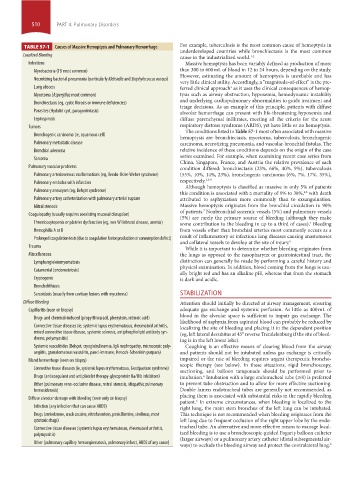
                   TABLE 57-1    Causes of Massive Hemoptysis and Pulmonary Hemorrhage  For example, tuberculosis is the most common cause of hemoptysis in
                                                                       underdeveloped countries while bronchiectasis is the most common
                  Localized Bleeding                                   cause in the industrialized world. 1-2
                    Infections                                           Massive hemoptysis has been variably defined as production of more
                      Mycobacteria (TB most common)                    than 300 to 600 mL of blood in 12 to 24 hours, depending on the study.
                                                                       However, estimating the amount of hemoptysis is unreliable and has
                      Necrotizing bacterial pneumonia (particularly Klebsiella and Staphylococcus aureus)
                                                                       very little clinical utility. Accordingly, a “magnitude-of-effect” is the pre-
                     Lung abscess                                      ferred clinical approach  as it uses the clinical consequences of hemop-
                                                                                        3
                     Mycetoma (Aspergillus most common)                tysis such as airway obstruction, hypoxemia, hemodynamic instability
                                                                       and underlying cardiopulmonary abnormalities to guide treatment and
                      Bronchiectasis (eg, cystic fibrosis or immune deficiencies)
                                                                       triage decisions. As an example of this principle, patients with diffuse
                      Parasites (Hydatid cyst, paragonimiasis)         alveolar hemorrhage can present with life-threatening hypoxemia and
                     Leptospirosis                                     diffuse parenchymal infiltrates, meeting all the criteria for the acute
                    Tumors                                             respiratory distress syndrome (ARDS), yet have little or no hemoptysis.
                      Bronchogenic carcinoma (ie, squamous cell)         The conditions listed in Table 57-1 most often associated with massive
                                                                       hemoptysis are: bronchiectasis, mycetoma, tuberculosis, bronchogenic
                      Pulmonary metastatic disease                     carcinoma, necrotizing pneumonia, and vascular-bronchial fistulas. The
                     Bronchial adenoma                                 relative incidence of these conditions depends on the origin of the case
                                                                       series examined. For example, when examining recent case series from
                     Sarcoma
                                                                       China, Singapore, France, and Austria the relative prevalence of each
                    Pulmonary vascular problems                        condition differed: bronchiectasis (23%, 66%, 40%, 9%), tuberculosis
                      Pulmonary arteriovenous malformations (eg, Rendu-Osler-Weber syndrome)  (55%, 10%, 14%, 23%), bronchogenic carcinoma (6%, 7%, 17%, 35%),
                      Pulmonary embolus with infarction                respectively. 1,3-5
                                                                         Although hemoptysis is classified as massive in only 5% of patients
                      Pulmonary aneurysm (eg, Behçet syndrome)
                                                                       this condition is associated with a mortality of 9% to 38%,  with death
                                                                                                                 4,6
                      Pulmonary artery catheterization with pulmonary arterial rupture  attributed to asphyxiation more commonly than to exsanguination.
                     Mitral stenosis                                   Massive hemoptysis originates from the bronchial circulation in 90%
                                                                       of patients.  Nonbronchial systemic vessels (5%) and pulmonary vessels
                                                                               7
                    Coagulopathy (usually requires coexisting mucosal disruption)
                                                                       (5%)  are  rarely  the  primary  source  of  bleeding  (although  they  make
                      Thrombocytopenia or platelet dysfunction (eg, von Willebrand disease, uremia)  some contribution to the bleeding in up to a third of cases).  Bleeding
                                                                                                                   7
                      Hemophilia A or B                                from vessels other than bronchial arteries most commonly occurs as a
                                                                       result of inflammatory or infectious lung diseases causing anastomoses
                       Prolonged coagulation tests (due to coagulation factor production or consumption defect)
                                                                       and collateral vessels to develop at the site of injury. 6
                    Trauma                                               While it is important to determine whether bleeding originates from
                    Miscellaneous                                      the lungs as opposed to the nasopharynx or gastrointestinal tract, the
                     Lymphangioleiomyomatosis                          distinction can generally be made by performing a careful history and
                                                                       physical examination. In addition, blood coming from the lungs is usu-
                     Catamenial (endometriosis)                        ally bright red and has an alkaline pH, whereas that from the stomach
                     Cryptogenic                                       is dark and acidic.
                     Broncholithiasis
                      Sarcoidosis (usually from cavitary lesions with mycetoma)  STABILIZATION
                  Diffuse Bleeding                                     Attention should initially be directed at airway management, ensuring
                    Capillaritis (seen on biopsy)                      adequate gas exchange and systemic perfusion. As little as 400 mL of
                                                                       blood in the alveolar space is sufficient to impair gas exchange. The
                      Drug- and chemical-induced (propylthiouracil, phenytoin, retinoic acid)
                                                                       likelihood of asphyxia from aspirated blood can probably be reduced by
                       Connective tissue diseases (ie, systemic lupus erythematosus, rheumatoid arthritis,   localizing the site of bleeding and placing it in the dependent position
                     mixed  connective tissue disease, systemic sclerosis, antiphospholipid antibody syn-  (eg, left lateral decubitus at 45° reverse Trendelenburg if the site of bleed-
                     drome, polymyositis)                              ing is in the left lower lobe).
                       Systemic vasculitides (Behçet, cryoglobulinemia, IgA nephropathy, microscopic poly-  Coughing is an  effective  means of clearing blood from the airway
                     angiitis, granulomatous vasculitis, pauci-immune, Henoch-Schonlein purpura)   and patients should not be intubated unless gas exchange is critically
                    Bland hemorrhage (seen on biopsy)                  impaired or the rate of bleeding requires urgent therapeutic broncho-
                                                                       scopic therapy (see below). In these situations, rigid bronchoscopy,
                      Connective tissue diseases (ie, systemic lupus erythematosus, Goodpasture syndrome)  suctioning, and balloon tamponade should be performed prior to
                      Drugs (anticoagulant and antiplatelet therapy-glycoprotein IIa/IIIb inhibitors)  intubation.  Intubation with a large endotracheal tube (≥8) is preferred
                                                                               6
                       Other (pulmonary veno-occlusive disease, mitral stenosis, idiopathic pulmonary   to prevent tube obstruction and to allow for more effective suctioning.
                     hemosiderosis)                                    Double lumen endotracheal tubes are generally not recommended, as
                                                                       placing them is associated with substantial risks in the rapidly bleeding
                    Diffuse alveolar damage with bleeding (seen only on biopsy)
                                                                       patient.  In extreme circumstances, when bleeding is localized to the
                                                                             6
                      Infection (any infection that can cause ARDS)    right lung, the main stem bronchus of the left lung can be intubated.
                       Drugs (amiodarone, crack cocaine, nitrofurantoin, penicillamine, sirolimus, most    This technique is not recommended when bleeding originates from the
                     cytotoxic drugs)                                  left lung due to frequent occlusion of the right upper lobe by the endo-
                       Connective tissue diseases (systemic lupus erythematosus, rheumatoid arthritis,   tracheal tube. An alternative and more effective means to manage local-
                     polymyositis)                                     ized bleeding is to use a bronchoscopic-guided Fogarty balloon catheter
                                                                       (larger airways) or a pulmonary artery catheter (distal subsegmental air-
                      Other (pulmonary capillary hemangiomatosis, pulmonary infarct, ARDS of any cause)
                                                                       ways) to occlude the bleeding airway and protect the contralateral lung. 6


            section04.indd   510                                                                                       1/23/2015   2:20:23 PM

