


Page 717 - Hall et al (2015) Principles of Critical Care-McGraw-Hill
P. 717
536     PART 4: Pulmonary Disorders


                                                                       LIBERATION STRATEGIES
                    Gradual  reduction of mechanical support, termed weaning, is frequently
                    unnecessary and can prolong the duration of mechanical ventilation.  Many intensivists have reasoned that by gradually reducing ventilatory
                     •  Once a patient has been liberated from the ventilator, extuba-  support, the respiratory muscles exercise at subfatiguing loads, leading
                                                                       to gradual improvement of function. Some studies have suggested that
                    tion should follow if mechanisms of airway maintenance (cough,   respiratory exercises  (repetitions of low-load  resistive breathing) can
                    gag, swallow) are sufficient to protect the airway from secretions.   lead to successful extubation in patients who have previously failed.
                                                                                                                          1
                    Whether to extubate is a decision which follows successful libera-  However, no studies have established that respiratory muscle training,
                    tion from the ventilator.                          through the use of graded withdrawal of ventilatory support, hastens the
                     •  In patients who fail their first trial of spontaneous breathing, atten-  recovery to unassisted breathing.
                    tion should turn to defining and treating the pathophysiologic   Two large studies assessed the role of weaning strategies once clini-
                    processes underlying failure.                      cians judge that weaning can proceed. Brochard and colleagues  studied
                                                                                                                     2
                     •  One weaning regimen, the gradual reduction of intermittent man-  456 medical-surgical patients being considered for weaning, of whom
                    datory breaths, prolongs patients’ time on mechanical ventilation.  347 (76%) were successfully extubated on the first day. One hundred
                     •  Liberation from mechanical ventilation is achieved most expedi-  and nine patients who failed an initial spontaneous breathing trial (SBT)
                    tiously if patients are given a trial of spontaneous breathing (T-Piece   were randomized to be weaned by one of three strategies: (1) T-piece
                    or pressure support ≤7 cm H O) each day. Patients remain on ventila-  trials of increasing length until 2 hours could be tolerated; (2) synchro-
                                        2
                    tors unnecessarily when clinicians do not put this simple plan in place.  nized intermittent mandatory ventilation (SIMV) with attempted reduc-
                                                                       tions of 2 to 4 breaths/min twice a day, until 4 breaths/min could be
                     •  Patients who have had most correctable factors addressed and   tolerated; (3) pressure support ventilation (PSV) with attempted reduc-
                    remain marginal with regard to ventilatory capacity should in most   tions of 2 to 4 cm H O twice a day until 8 cm H O could be tolerated.
                                                                                      2
                                                                                                           2
                    circumstances undergo a trial of extubation rather than remain   Patients randomized to the three strategies were similar with regard to
                    intubated for  protracted  periods of  time.  Noninvasive  positive   disease severity and duration of ventilation before weaning. There was
                    pressure ventilation may be useful in these patients to transition   no difference in the duration of weaning between the T-piece and SIMV
                    them to fully spontaneous breathing following extubation.  groups, but PSV led to significantly shorter weaning compared to the
                                                                       combined T-piece and SIMV cohorts.
                                                                         Esteban and colleagues  performed a similar study of 546 medical-
                                                                                          3
                 Positive pressure ventilation can be lifesaving, but is also associated   surgical patients, 416 (76%) of whom were successfully extubated on
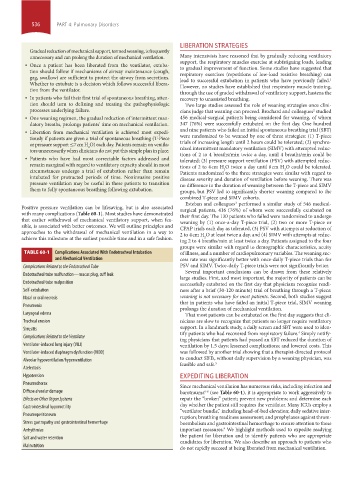
                 with many complications (Table 60-1). Most studies have demonstrated   their first day. The 130 patients who failed were randomized to undergo
                 that earlier withdrawal of mechanical ventilatory support, when fea-  weaning  by  (1)  once-a-day  T-piece  trial,  (2)  two  or  more  T-piece  or
                 sible, is associated with better outcomes. We will outline principles and   CPAP trials each day as tolerated, (3) PSV with attempts at reduction of
                 approaches to the withdrawal of mechanical ventilation in a way to   2 to 4 cm H O at least twice a day, and (4) SIMV with attempts at reduc-
                 achieve this milestone at the earliest possible time and in a safe fashion.  ing 2 to 4 breaths/min at least twice a day. Patients assigned to the four
                                                                               2
                                                                       groups were similar with regard to demographic characteristics, acuity
                   TABLE 60-1     Complications Associated With Endotracheal Intubation    of illness, and a number of cardiopulmonary variables. The weaning suc-
                             and Mechanical Ventilation                cess rate was significantly better with once-daily T-piece trials than for
                  Complications Related to the Endotracheal Tube       PSV and SIMV. Twice-daily T-piece trials were not significantly better.
                                                                         Several important conclusions can be drawn from these relatively
                  Endotracheal tube malfunction—mucus plug, cuff leak  large studies. First, and most important, the majority of patients can be
                  Endotracheal tube malposition                        successfully extubated on the first day that physicians recognize readi-
                  Self-extubation                                      ness after a brief (30-120 minute) trial of breathing through a T-piece:
                  Nasal or oral necrosis                               weaning is not necessary for most patients. Second, both studies suggest
                  Pneumonia                                            that in patients who have failed an initial T-piece trial, SIMV weaning
                                                                       prolongs the duration of mechanical ventilation.
                  Laryngeal edema                                        That most patients can be extubated on the first day suggests that cli-
                  Tracheal erosion                                     nicians are slow to recognize that patients no longer require ventilatory
                  Sinusitis                                            support. In a landmark study, a daily screen and SBT were used to iden-
                                                                                                                4
                  Complications Related to the Ventilator              tify patients who had recovered from respiratory failure.  Simply notify-
                                                                       ing physicians that patients had passed an SBT reduced the duration of
                  Ventilator-induced lung injury (VILI)                ventilation by 1.5 days; lessened complications; and lowered costs. This
                  Ventilator-induced diaphragm dysfunction (VIDD)      was followed by another trial showing that a therapist-directed protocol
                  Alveolar hypoventilation/hyperventilation            to conduct SBTs, without daily supervision by a weaning physician, was
                                                                       feasible and safe.
                                                                                   5
                  Atelectasis
                  Hypotension                                          EXPEDITING LIBERATION
                  Pneumothorax
                                                                       Since mechanical ventilation has numerous risks, including infection and
                  Diffuse alveolar damage                              barotrauma  (see Table 60-1), it is appropriate to work aggressively to
                                                                                6-8
                  Effects on Other Organ Systems                       repair the “broken” patient; prevent new problems; and determine each
                  Gastrointestinal hypomotility                        day whether the patient still requires the ventilator. Many ICUs employ a
                                                                       “ventilator bundle,” including head-of-bed elevation; daily sedative inter-
                  Pneumoperitoneum
                                                                       ruption; breathing readiness assessment; and prophylaxes against throm-
                  Stress gastropathy and gastrointestinal hemorrhage   boembolism and gastrointestinal hemorrhage to ensure attention to these
                                                                                      9
                  Arrhythmias                                          important measures.  We highlight methods used to expedite readying
                  Salt and water retention                             the  patient  for  liberation and  to  identify  patients  who  are  appropriate
                                                                       candidates for liberation. We also describe an approach to patients who
                  Malnutrition
                                                                       do not rapidly succeed at being liberated from mechanical ventilation.


            section04.indd   536                                                                                       1/23/2015   2:20:40 PM

