


Page 720 - Hall et al (2015) Principles of Critical Care-McGraw-Hill
P. 720
CHAPTER 60: Liberation From Mechanical Ventilation  539


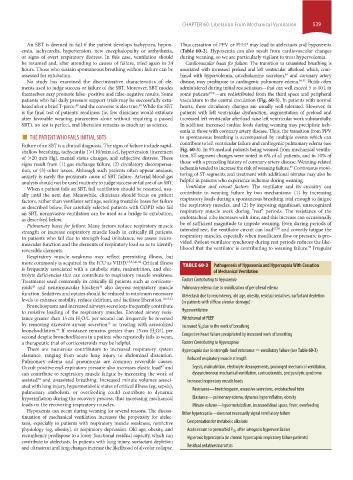
                     An SBT is deemed to fail if the patient develops tachypnea, hypox-  Thus cessation of PPV or PEEP may lead to atelectasis and hypoxemia
                    emia, tachycardia, hypertension, new encephalopathy or arrhythmia,   (Table 60-2). Hypoxemia can also result from cardiovascular changes
                    or signs of overt respiratory distress. In this case, ventilation should   during weaning, so we are particularly vigilant to treat hypervolemia.
                    be resumed and, after attending to causes of failure, tried again in 24   Cardiovascular bases for failure: The transition to unassisted breathing is
                    hours. Those who sustain spontaneous breathing without failure can be   associated with increased preload and left ventricular afterload which, com-
                    assessed for extubation.                              bined with hypervolemia, catecholamine secretion,  and coronary artery
                                                                                                             49
                     No  study  has  examined  the  discriminative characteristics  of  ele-  disease, may predispose to cardiogenic pulmonary edema. 50-55  Fluids often
                    ments used to judge success or failure of the SBT. Moreover, SBT modes   administered during initial resuscitation—that can well exceed 5 to 10 L in
                    themselves may promote false- positive and false-negative results. Some   some patients 29,56 —are redistributed from the third space and peripheral
                    patients who fail daily pressure support trials may be successfully extu-  vasculature to the central circulation (Fig. 60-3). In patients with normal
                    bated after a brief T-piece,  and the converse is also true.  While the SBT   hearts,  these  circulatory  changes  are  usually  well  tolerated.  However,  in
                                      40
                                                            38
                    is the final test of patients’ readiness (ie, few clinicians would extubate   patients with left ventricular dysfunction, augmentation of preload and
                    after favorable weaning parameters alone without requiring a passed   increased left ventricular afterload raise left ventricular work substantially.
                    SBT), no test is perfect, and liberation remains as much art as science.  In addition, increased cardiac loads during weaning may precipitate isch-
                        ■  THE PATIENT WHO FAILS INITIAL SBTS             emia in those with coronary artery disease. Thus, the transition from PPV
                                                                          to spontaneous breathing is accompanied by multiple events which can
                    Failure of an SBT is a clinical diagnosis. The signs of failure include rapid-  contribute to left ventricular failure and cardiogenic pulmonary edema (see
                    shallow breathing, tachycardia (>110/minute), hypertension (increment   Fig. 60-3). In 93 medical patients being weaned from mechanical ventila-
                    of >20 mm Hg), mental status changes, and subjective distress. These   tion, ST-segment changes were noted in 6% of all patients, and in 10% of
                    signs result from (1) gas exchange failure, (2) circulatory decompensa-  those with a preceding history of coronary artery disease. Weaning-related
                                                                                                               55
                    tion, or (3) other issues. Although such patients often appear anxious,   ischemia tended to increase the risk of weaning failure.  Continuous moni-
                    anxiety is rarely the proximate cause of SBT failure. Arterial blood gas   toring of ST-segments and treatment with additional nitrates may also be
                    analysis should not be used routinely to judge success or failure of an SBT.  helpful in patients who experience ischemia during weaning.
                     When a patient fails an SBT, full ventilation should be resumed, usu-  Ventilator and circuit factors: The ventilator and its circuitry can
                    ally until the next day. Meanwhile, clinicians should focus on patient   contribute to weaning failure by two mechanisms: (1) by increasing
                    factors, rather than ventilator settings, seeking treatable bases for failure   respiratory loads during a spontaneous breathing trial enough to fatigue
                    as described below. For carefully selected patients with COPD who fail   the respiratory muscles, and (2) by imposing significant, unrecognized
                    an SBT, noninvasive ventilation can be used as a bridge to extubation,   respiratory muscle work during “rest” periods. The resistance of the
                    as described below.                                   endotracheal tube increases with time, and this increase can occasionally
                     Pulmonary bases for failure: Many factors reduce respiratory muscle   be of sufficient magnitude to impede weaning. Even during periods of
                    strength or increase respiratory muscle loads in critically ill patients.   intended rest, the ventilator circuit can load 57,58  and covertly fatigue the
                    In patients who fail due to strength-load imbalance, we assess neuro-  respiratory muscles, especially when insufficient flow or pressure is pro-
                    muscular function and the elements of respiratory load so as to identify   vided. Patient-ventilator synchrony during rest periods reduces the like-
                                                                                                                     59
                    reversible elements.                                  lihood that the ventilator is contributing to weaning failure.  Irregular
                     Respiratory muscle weakness may reflect preexisting illness, but
                    more commonly is acquired in the ICU as VIDD. 13,32,41,42  Critical illness     TABLE 60-2     Pathogenesis of Hypoxemia and Hypercapnia With Cessation
                    is frequently  associated with a  catabolic state, malnutrition,  and elec-
                    trolyte deficiencies that can contribute to respiratory muscle weakness.   of Mechanical Ventilation
                    Treatments used commonly in critically ill patients such as corticoste-  Factors Contributing to Hypoxemia
                    roids  and neuromuscular blockers  also depress respiratory muscle   Pulmonary edema due to mobilization of peripheral edema
                                              44
                       43
                    function. Sedatives and opiates should be reduced to minimum necessary   Atelectasis due to recumbency, old age, obesity, residual sedatives, surfactant depletion
                    levels to enhance mobility, reduce delirium, and facilitate liberation. 18,19,21  (in patients with diffuse alveolar damage)
                     Bronchospasm and increased airways secretions frequently contribute
                    to resistive loading of the respiratory muscles. Elevated airway resis-  Hypoventilation
                    tance greater than 15 cm H O/L per second can frequently be reversed   Withdrawal of PEEP
                                       2
                    by  removing  excessive  airway  secretion   or treating with aerosolized   Increased V ˙ due to the work of breathing
                                                 45
                    bronchodilators.  If resistance remains greater than 15 cm H O/L per   O 2
                               46
                                                                 2
                    second despite bronchodilators in a patient who repeatedly fails to wean,   Congestive heart failure precipitated by increased work of breathing
                    a therapeutic trial of corticosteroids may be helpful.  Factors Contributing to Hypercapnia
                     There  are numerous  contributors  to increased respiratory system   Hypercapnia due to strength-load imbalance = ventilatory failure (see Table 60-3)
                    elastance, ranging from acute lung injury to abdominal distention.
                    Pulmonary edema and pneumonia are common reversible causes.     Reduced respiratory muscle strength
                    Occult positive end-expiratory pressure also increases elastic load  and        Sepsis, malnutrition, electrolyte derangements, prolonged mechanical ventilation,
                                                                   47
                    can contribute to respiratory muscle fatigue by increasing the work of     dyssynchronous mechanical ventilation, corticosteroids, postparalytic syndrome
                    assisted  and unassisted breathing. Increased minute volumes associ-    Increased respiratory muscle loads
                         48
                    ated with lung injury, hypermetabolic states of critical illness (eg, sepsis),
                    pulmonary embolism, or overfeeding could contribute to dynamic       Resistance—bronchospasm, excessive secretions, endotracheal tube
                    hyperinflation during the recovery process, thus increasing mechanical       Elastance—pulmonary edema, dynamic hyperinflation, obesity
                    loads on the recovering respiratory muscles.              Minute volume—hypermetabolism, increased dead space, fever, overfeeding
                     Hypoxemia can occur during weaning for several reasons. The discon-
                    tinuation of mechanical ventilation increases the propensity for atelec-  Other hypercapnia—does not necessarily signal ventilatory failure
                    tasis, especially in patients with respiratory muscle weakness, restrictive     Compensation for metabolic alkalosis
                    physiology (eg, obesity), or respiratory depression. Old age, obesity, and     Acute return to premorbid P CO 2  after iatrogenic hyperventilation
                    recumbency predispose to a lower functional residual capacity, which can     Hyperoxic hypercapnia (in chronic hypercapnic respiratory failure patients)
                    contribute to atelectasis. In patients with lung injury, surfactant depletion
                    and ultrastructural lung changes increase the  likelihood of alveolar collapse.     Residual sedatives/narcotics


            section04.indd   539                                                                                       1/23/2015   2:20:44 PM

