


Page 718 - Hall et al (2015) Principles of Critical Care-McGraw-Hill
P. 718
CHAPTER 60: Liberation From Mechanical Ventilation  537


                     In order to minimize the duration of ventilator dependence, the clini-  in Chaps. 29 and 48. By discerning the causes of respiratory failure, the
                    cian must:                                            clinician can initiate appropriate treatments early and understand which
                                                                          parameters best reflect disease resolution.
                      1.  Identify the pathogenesis of respiratory failure in each patient, and
                       institute appropriate treatment.                       ■  STEP TWO: PREVENT IATROGENIC COMPLICATIONS
                      2.  Prevent iatrogenic complications.               Although  not emphasized in  most  discussions  of  “weaning”  from
                      3.  Detect when the patient is ready to breathe.    mechanical ventilation, strategies that avoid further injury during
                        ■  STEP ONE: TREAT THE CAUSES OF RESPIRATORY FAILURE  mechanical support are extremely important to ultimately returning the
                                                                          patient to spontaneous breathing. Such injuries can be characterized as
                    Although it may seem intuitive that an organized, systematic approach   those wrought directly by the ventilator, and those associated with being
                                                                          in the ICU. Ventilator-induced lung injury (VILI) (see Chap. 51) refers to
                    aimed at remedying the pathogenesis of disease should expedite lib-  a number of mechanisms by which lung injury is amplified in ARDS but
                    eration from mechanical ventilation, this has been examined rarely.  A   can be produced in otherwise healthy lungs as well. 11,12  Ventilator-induced
                                                                    10
                    protocol that combined identifying and repairing causes of failure with   diaphragm dysfunction (VIDD) describes the loss of respiratory muscle
                    recognizing readiness to breathe, reduced ventilator days and costs.   function related to mechanical ventilation and acute illness, and is dis-
                    From this study it is not possible to determine the relative importance of   cussed more fully in Chap. 49.  Patients with severe airflow obstruction
                                                                                               13
                    disease reversal and readiness assessment, but both are likely important.   are at risk for dynamic hyperinflation and adverse consequences such as
                    Accordingly, from the very first day a patient requires intubation it is   hypotension and diminished venous return (see Chap. 54). 14
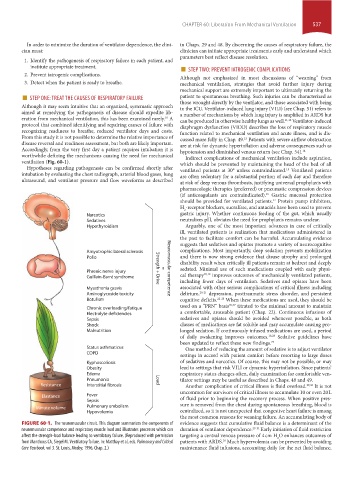
                    worthwhile defining the mechanisms causing the need for mechanical   Indirect complications of mechanical ventilation include aspiration,
                    ventilation (Fig. 60-1).                              which should be prevented by maintaining the head of the bed of all
                     Hypotheses regarding pathogenesis can be confirmed shortly after   ventilated patients at 30° unless contraindicated.  Ventilated patients
                                                                                                              15
                    intubation by evaluating the chest radiograph, arterial blood gases, lung   are often sedentary for a substantial portion of each day and therefore
                    ultrasound, and ventilator pressure and flow waveforms as described   at risk of deep venous thrombosis, justifying universal prophylaxis with
                                                                          pharmacologic therapies (preferred) or pneumatic compression devices
                                                                          (if anticoagulants are contraindicated).  Gastric mucosal protection
                                                                                                       16
                                                                          should be provided for ventilated patients.  Protein pump inhibitors,
                                                                                                         17
                                                                          H -receptor blockers, sucralfate, and antacids have been used to prevent
                                                                           2
                                          Narcotics                       gastric injury. Whether continuous feeding of the gut, which usually
                                          Sedatives                       neutralizes pH, obviates the need for prophylaxis remains unclear.
                                          Hypothyroidism                   Arguably, one of the most important advances in care of critically
                                                                          ill, ventilated patients is realization that medications administered in
                                                                          the past to facilitate comfort can be harmful. Accumulating evidence
                                                                          suggests that sedatives and opiates promote a variety of neurocognitive
                                          Amyotrophic lateral sclerosis   complications. Most importantly, deep sedation prevents mobilization
                                          Polio                           and there is now strong evidence that disuse atrophy and prolonged
                                                                          disability result when critically ill patients remain at bedrest and deeply
                                                                          sedated.  Minimal  use  of  such  medications  coupled  with  early  physi-
                                          Phrenic nerve injury                    18,19
                                                                    =
                                          Guillain-Barré syndrome         cal therapy   improves outcomes of mechanically ventilated patients,
                                                                          including fewer days of ventilation. Sedatives and opiates have been
                                                                  Strength + Drive
                                          Myasthenia gravis               associated with other serious complications of critical illness including
                                          Aminoglycoside toxicity         delirium, 20-21  depression, posttraumatic stress disorder, and persistent
                                          Botulism                        cognitive deficits. 22-25  When these medications are used, they should be
                                                                     Neuromuscular competence
                                                                          used on a “PRN” basis 26,27  titrated to the minimal amount to maintain
                                          Chronic overloading/fatique
                                          Electrolyte deficiencies        a comfortable, arousable patient (Chap. 22). Continuous infusions of
                                          Sepsis                          sedatives  and  opiates  should  be  avoided  whenever  possible,  as  both
                                          Shock                           classes of medications are fat soluble and may accumulate causing pro-
                                          Malnutrition                    longed sedation. If continuously infused medications are used, a period
                                                                          of daily awakening improves outcomes. 18,28  Sedative guidelines have
                                                                          been updated to reflect these new findings. 27
                                          Status asthmaticus               One method of reducing the amount of sedative is to adjust ventilator
                                          COPD                            settings in accord with patient comfort before resorting to large doses
                                          Kyphoscoliosis                  of sedatives and narcotics. Of course, this may not be possible, or may
                                          Obesity                         lead to settings that risk VILI or dynamic hyperinflation. Since patients’
                                          Edema                           respiratory status changes often, daily examination for comfortable ven-
                                          Pneumonia               Load    tilator settings may be useful as described in Chaps. 48 and 49.
                          Resistance      Interstitial fibrosis            Another complication of critical illness is fluid overload. 29,30  It is not
                                                                          uncommon for survivors of critical illness to accumulate 10 or even 20 L
                          Elastance       Fever                           of fluid prior to beginning the recovery process. When positive pres-
                                          Sepsis                          sure is removed from the chest during spontaneous breathing, blood is
                        Minute volume     Pulmonary embolism
                                          Hypovolemia                     centralized, so it is not unexpected that congestive heart failure is among
                                                                          the most common reasons for weaning failure. An accumulating body of
                    FIGURE 60-1.  The neuromuscular circuit. This diagram summarizes the components of   evidence suggests that cumulative fluid balance is a determinant of the
                    neuromuscular competence and respiratory muscle load and illustrates processes which can   duration of ventilator dependence. 29-31  Early initiation of fluid restriction
                    affect the strength-load balance leading to ventilatory failure. (Reproduced with permission   targeting a central venous pressure of 4 cm H O enhances outcomes of
                                                                                                           2
                    from Manthous CA, Siegel M. Ventilatory failure. In: Matthay et al, eds. Pulmonary and Critical   patients with ARDS.  Much hypervolemia can be prevented by avoiding
                                                                                        30
                    Care Yearbook, vol 3. St. Louis, Mosby; 1996, Chap. 2.)  maintenance fluid infusions, accounting daily for the net fluid balance,


            section04.indd   537                                                                                       1/23/2015   2:20:42 PM

