


Page 719 - Hall et al (2015) Principles of Critical Care-McGraw-Hill
P. 719
538     PART 4: Pulmonary Disorders


                 limiting fluid boluses to patients likely to benefit from it (see Chap. 34),   variation occurring in unstructured care systems. Whether achieved by
                 and using diuretics and renal replacement therapy before hypervolemia   protocol or by individual clinician perseverance, we believe that patients
                 is excessive.                                         can be liberated from mechanical ventilation more expeditiously if they
                   Inspiratory muscles suffer atrophy and contractile dysfunction dur-  are screened on a daily basis.
                 ing critical illness and mechanical ventilation. 13,32  This VIDD is seen
                 early, progresses quickly, and is associated with prolonged ventilation     ■  THE SPONTANEOUS BREATHING TRIAL (SBT)
                 and  death.  In  animal  models,  ventilator  modes  that  maintain  active   Pressure support, continuous positive airway pressure (CPAP), and
                 contraction (assisted, rather than controlled, modes) largely prevent   T-piece trials are the most common methods used to test readiness for
                 VIDD. These findings suggest that controlled modes should be avoided,   liberation from mechanical ventilation. Strong evidence is lacking to
                 when possible.                                        support one approach over the others. An advantage of T-piece trials is
                     ■  STEP THREE: RECOGNIZE READINESS TO BREATHE     simplicity, but some patients failing T-piece can safely be extubated.
                                                                                                                          38
                                                                       Most intensivists prefer 5 to 7 cm H O pressure-support because this
                                                                                                  2
                 Weaning implies gradual, rather than rapid, withdrawal of ventilatory   maintains the monitoring and alarming functions of the ventilator; this
                 assistance. This word suggests that the ventilator is beneficial or nurtur-  degree of ventilator assistance does not generally produce false nega-
                 ing and that the mechanism for successfully separating the patient is to   tives (ie, passing the SBT does not lead to excessive extubation failures;
                 gradually adjust the machine. Liberation more accurately describes the   although patients with primary neuromuscular disease may be an
                 process by which most patients are freed from the ventilator. For many,   exception); PEEP can be continued; and most large mechanical ventila-
                 this is as simple as recognizing that the ventilator is no longer needed.   tion trials have employed this approach.
                 In patients who cannot breathe independently, liberation will only be   In preparation for the SBT, sedatives and narcotics should be discon-
                 possible after the patient is treated and recovers.   tinued several hours beforehand to reduce the likelihood of inadequate
                                                                       drive to breathe. Coordinating the sedative interruption and SBT
                 CAN THE PATIENT BREATHE WITHOUT                       improves success, reducing time on the ventilator and even long-term
                                                                       mortality.  Especially when SBTs are conducted by protocol, a safety
                                                                              28
                 THE VENTILATOR?                                       screen is necessary to reduce risk and select patients most likely to
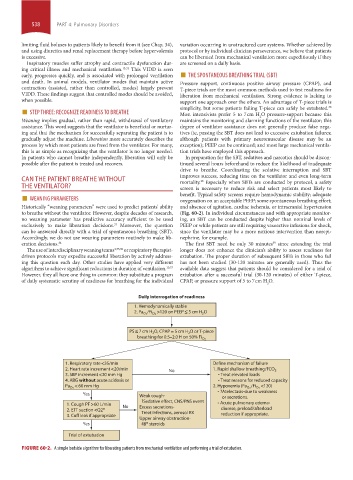
                     ■  WEANING PARAMETERS                             benefit. Typical safety screens require hemodynamic stability; adequate
                                                                       oxygenation on an acceptable PEEP; some spontaneous breathing effort;
                 Historically “weaning parameters” were used to predict patients’ ability   and absence of agitation, cardiac ischemia, or intracranial hypertension
                 to breathe without the ventilator. However, despite decades of research,   (Fig. 60-2). In individual circumstances and with appropriate monitor-
                 no weaning parameter has  predictive  accuracy sufficient to  be used   ing, an SBT can be conducted despite higher than nominal levels of
                 exclusively to make liberation decisions.  Moreover, the question   PEEP or while patients are still requiring vasoactive infusions for shock,
                                                 33
                 can be answered directly with a trial of spontaneous breathing (SBT).   since the ventilator may be a more noxious intervention than norepi-
                 Accordingly, we do not use weaning parameters routinely to make lib-  nephrine, for example.
                 eration decisions. 34                                   The first SBT need be only 30 minutes  since extending the trial
                                                                                                       39
                   The use of interdisciplinary weaning teams 4,35,36  or respiratory therapist-   longer does not enhance the clinician’s ability to assess readiness for
                 driven protocols may expedite successful liberation by actively address-  extubation. The proper duration of subsequent SBTs in those who fail
                 ing this question each day. Other studies have applied very different   has not been studied (30-120 minutes are  generally used). Thus the
                 algorithms to achieve significant reductions in duration of ventilation. 10,37    available data suggest that patients should be considered for a trial of
                 However, they all have one thing in common: they substitute a program   extubation  after  a  successful  trial  (30-120  minutes)  of  either  T-piece,
                 of daily systematic scrutiny of readiness for breathing for the individual   CPAP, or pressure support of 5 to 7 cm H O.
                                                                                                     2
                                                         Daily interrogation of readiness
                                                        1. Hemodynamically stable
                                                        2. Pa /Fi  >120 on PEEP   5 cm H O
                                                                               2
                                                           O 2
                                                              O 2
                                                      PS   7 cm H O, CPAP = 5 cm H O or T-piece
                                                                          2
                                                              2
                                                         breathing for 0.5–2.0 H on 50% Fi
                                                                               O 2

                                1. Respiratory rate <35/min                       Define mechanism of failure
                                2. Heart rate increment <20/min    No             1. Rapid shallow breathing/ CO 2
                                3. SBP increment <20 mm Hg                             - Treat elevated loads
                                4. ABG without acute acidosis or                       - Treat reasons for reduced capacity
                                Pa O 2   < 60 mm Hg                               2. Hypoxemia (Pa /Fi  <120)
                                                                                              O 2
                                                                                                 O 2
                                                                                      - ?Atelectasis-due to weakness
                                      Yes                Weak cough-                       or secretions.
                                                           ?Sedative effect, CNS/PNS event      - Acute pulmonary edema-
                                 1. Cough PF >60 L/min  No
                                 2. ETT suction <Q2°     Excess secretions-               diurese, preload/afterload
                                                           Treat infections, aerosol RX
                                 3. Cuff leak if appropriate                              reduction if appropriate.
                                                         Upper airway obstruction-
                                      Yes                  48° steroids
                                 Trial of extubation
                 FIGURE 60-2.  A simple bedside algorithm for liberating patients from mechanical ventilation and performing a trial of extubation.


            section04.indd   538                                                                                       1/23/2015   2:20:44 PM

