


Page 851 - Hall et al (2015) Principles of Critical Care-McGraw-Hill
P. 851
582     PART 5: Infectious Disorders


                 Biomarkers:  Physicians  have  used  biological  markers  of  infection,     studies.  Subsequently, several other scoring systems, including
                                                                             69
                 such as the white blood cell count, to help guide clinical decisions   CURXO,  SMART-COP,  REA-ICU,  and CAP-PIRO,  were devel-
                                                                                                                71
                                                                                          66
                                                                              70
                                                                                                   65
                 for a long time, so biomarkers are hardly a new concept. The last   oped to specifically address the need for ICU care. The CURXO and
                 decade has seen an explosion of interest in the potential for the levels   SMART-COP criteria were developed with multivariate techniques but
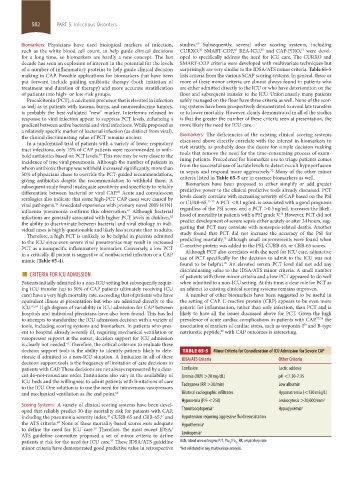
                 of a number of inflammatory proteins to help guide clinical decision   surprisingly are very similar to the IDSA/ATS minor criteria. Table 65-5
                 making in CAP. Possible applications for biomarkers that have been   lists criteria from the various SCAP scoring systems. In general, three or
                 put forward include guiding antibiotic therapy (both initiation of   more of these minor criteria are almost always found in patients who
                 treatment and duration of therapy) and more accurate stratification   are either admitted directly to the ICU or who have deterioration on the
                 of patients into high- or low-risk groups.            floor and subsequent transfer to the ICU. Unfortunately many patients
                   Procalcitonin (PCT), a calcitonin precursor that is elevated in infection     safely managed on the floor have three criteria as well. None of the scor-
                 as well as in patients with trauma, burns, and neuroendocrine tumors,   ing systems have been prospectively demonstrated to avoid late transfers
                 is  probably  the best-validated “new” marker. Interferons released in   or to lower mortality. However, clearly demonstrated in all of the studies
                 response to viral infection appear to suppress PCT levels, enhancing a   is that the greater the number of these criteria seen at presentation, the
                 gradient between active bacterial and viral infections. While proposed as   more likely the need for ICU care.
                 a relatively specific marker of bacterial infection (as distinct from viral),   Biomarkers:  The deficiencies of the existing clinical scoring systems
                 the clinical discriminating value of PCT remains unclear.
                   In a randomized trial of patients with a variety of lower respiratory   discussed above directly correlate with the interest in biomarkers to
                 tract infections, only 15% of CAP patients were recommended to with-  risk stratify, as probably does the desire for simple decision making
                 hold antibiotics based on PCT levels.  This rate may be very close to the   tools that remove the need for the time-consuming process of exam-
                                            59
                                                                       ining patients. Precedence for biomarker use to triage patients comes
                 incidence of true viral pneumonia. Although the number of patients in
                 whom antibiotic therapy was withheld increased significantly, more than   from the successful use of lactate levels to detect occult hypoperfusion
                                                                       in sepsis and respond more aggressively.  Many of the other minor
                                                                                                      72
                 50% of physicians chose to override the PCT-guided recommendations,
                 giving antibiotics despite the recommendation to withhold them. A   criteria listed in Table 65-5 are in essence biomarkers as well.
                                                                         Biomarkers have been proposed to either simplify or add greater
                 subsequent study found inadequate sensitivity and specificity to reliably
                                                  60
                 differentiate between bacterial or viral CAP.  Acute and convalescent   predictive power to the clinical predictive tools already discussed. PCT
                                                                       levels clearly correlate with increasing severity of CAP based on the PSI
                 serologies also indicate that some high-PCT CAP cases were caused by   73-75
                             59
                 viral pathogens.  Anecdotal experience with primary novel 2009 H1N1   or CURB-65.   A PCT <0.1 ng/mL is associated with a good prognosis
                                                                       regardless of the PSI score, and a PCT >0.5 ng/mL increases the likeli-
                 influenza pneumonia confirms this observation.  Although bacterial                      74
                                                     61
                 infections are generally associated with higher PCT levels in children,    hood of mortality in patients with a PSI grade V.  However, PCT did not
                                                                    62
                                                                       predict development of severe sepsis either acutely or after 24 hours, sug-
                 the ability to discriminate between bacterial and viral etiology in indi-
                 vidual cases is highly questionable and likely less accurate than in adults.  gesting that PCT may correlate with nonsepsis-related deaths. Another
                                                                       study found that PCT did not increase the accuracy of the PSI for
                   Therefore, a high PCT is unlikely to be helpful in patients admitted   75
                 to the ICU since even severe viral pneumonias may result in increased   predicting mortality,  although small improvements were found when
                                                                       C-reactive protein was added to the PSI, CURB-65, or CRB-65 scores.
                 PCT as a nonspecific inflammatory biomarker. Conversely, a low PCT
                                                                         Although PCT also correlates with the need for ICU care, adjunctive
                 in a critically ill patient is suggestive of nonbacterial infection or a CAP   use of PCT specifically for the decision to admit to the ICU was not
                 mimic (Table 65-4).                                   found to be helpful.  An elevated serum PCT level did not add any
                                                                                      76
                     ■  CRITERIA FOR ICU ADMISSION                     discriminating value to the IDSA/ATS minor criteria. A small number
                                                                       of patients with three minor criteria and a low PCT appeared to do well
                 Patients initially admitted to a non-ICU setting but subsequently requir-  when admitted to a non-ICU setting. At this time, a clear role for PCT as
                 ing ICU transfer (up to 50% of CAP patients ultimately receiving ICU   an adjunct to existing clinical scoring systems remains unproven.
                 care) have a very high mortality rate, exceeding that of patients who have   A number of other biomarkers have been suggested to be useful in
                 equivalent illness at presentation but who are admitted directly to the   the setting of CAP. C-reactive protein (CRP) appears to be even more
                 ICU. 63,64  High degrees of variability in ICU admission for CAP between   generic for inflammation, rather than only infection, than PCT and is
                 hospitals and individual physicians have also been found. This has led   likely to have all the issues discussed above for PCT. Given the high
                 to attempts to standardize the ICU admission decision with a variety of   prevalence of acute cardiac complications in patients with CAP, 77,78  the
                 tools, including scoring systems and biomarkers. In patients who pres-  association of markers of cardiac stress, such as troponin-I  and B-type
                                                                                                                 79
                 ent to hospital already severely ill, requiring mechanical ventilation or   natriuretic peptide,  with CAP outcomes is interesting.
                                                                                     80
                 vasopressor support at the outset, decision support for ICU admission
                                65
                 is clearly not needed.  Therefore, the critical criterion to evaluate these
                 decision support tools is the ability to identify patients likely to dete-    TABLE 65-5    Minor Criteria for Consideration of ICU Admission for Severe CAP
                 riorate if admitted to a non-ICU situation. A limitation in all of these   IDSA/ATS Criteria  Other Criteria
                 decision support tools is the frequency of limitation of care decisions in
                 patients with CAP. These decisions are not always represented by a clear-  Confusion    Lactic acidosis
                 cut do-not-resuscitate order. Institutions also vary in the availability of   Uremia (BUN >20 mg/dL)  pH <7.30-7.35
                 ICU beds and the willingness to admit patients with limitations of care   Tachypnea (RR >30/min)  Low albumin
                 to the ICU. One solution is to use the need for intravenous vasopressors
                 and mechanical ventilation as the end point. 66        Bilateral radiographic infiltrates  Hyponatremia (<130 mEq/L)
                                                                        Hypoxemia (P/F <250)             Leukocytosis >20,000/mm 3
                 Scoring Systems:  A variety of clinical scoring systems have been devel-
                 oped that reliably predict 30-day mortality risk for patients with CAP,   Thrombocytopenia a  Hypoglycemia a
                 including the pneumonia severity index,  CURB-65 and CRB-65,  and   Hypotension requiring aggressive fluid resuscitation
                                                                 67
                                              43
                 the ATS criteria.  None of these mortality-based scores were adequate   Hypothermia a
                             68
                 to define the need for ICU care.  Therefore, the most recent IDSA/  a
                                          40
                 ATS guideline committee proposed a set of minor criteria to define   Leukopenia
                 patients at risk for the need for ICU care.  These IDSA/ATS guideline   BUN, blood urea nitrogen; P/F, PaO 2 /FiO 2 ; RR, respiratory rate.
                                                55
                 minor criteria have demonstrated good predictive value in retrospective     a Not validated in any multivariate analysis.
            section05_c61-73.indd   582                                                                                1/23/2015   12:47:56 PM

