


Page 850 - Hall et al (2015) Principles of Critical Care-McGraw-Hill
P. 850
CHAPTER 65: Pneumonia   581


                                                                          CAP, clear-cut cases of pneumonia have occurred in the absence of all
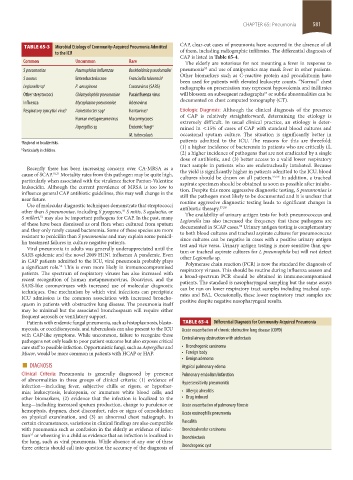
                      TABLE 65-3     Microbial Etiology of Community-Acquired Pneumonia Admitted
                               to the ICU                                 of them, including radiographic infiltrates. The differential diagnosis of
                                                                          CAP is listed in Table 65-4.
                    Common            Uncommon          Rare               The  elderly  are  notorious  for  not  mounting  a  fever  in  response  to
                                                                                  53
                    S pneumoniae      Haemophilus influenzae  Burkholderia pseudomallei  pneumonia  and use of antipyretics may mask fever in other patients.
                                                                          Other biomarkers such as C-reactive protein and procalcitonin have
                    S aureus          Enterobacteriaceae  Francisella tularensis a
                                                                          been used for patients with elevated leukocyte counts. “Normal” chest
                    Legionella sp a   P. aeruginosa     Coronavirus (SARS)  radiographs on presentation may represent hypovolemia and infiltrates
                                                                                                      54
                    Other streptococci  Chlamydophila pneumoniae  Parainfluenza virus  will blossom on subsequent radiographs  or subtle abnormalities can be
                                                                          documented on chest computed tomography (CT).
                    Influenza         Mycoplasma pneumoniae  Adenovirus
                    Respiratory syncytial virus b  Acinetobacter spp a  Hantavirus a  Etiologic Diagnosis:  Although the clinical diagnosis of the presence
                                                                          of CAP is relatively straightforward, determining the etiology is
                                      Human metapneumovirus  Mucormycoses
                                                                          extremely difficult. In usual clinical practice, an etiology is deter-
                                      Aspergillus sp    Endemic fungi a   mined in  <15% of cases of CAP with standard blood cultures and
                                                        M. tuberculosis   occasional sputum culture. The situation is significantly better in
                                                                          patients admitted to the ICU. The reasons for this are threefold:
                    a Regional or localize risks.
                                                                          (1) a higher incidence of bacteremia in patients who are critically ill,
                    b Particularly in children.
                                                                          (2) a higher incidence of pathogens that are not eradicated by a single
                                                                          dose of antibiotic, and (3) better access to a valid lower respiratory
                                                                          tract sample in patients who are endotracheally intubated. Because
                     Recently there has been increasing concern over CA-MRSA as a   the yield is significantly higher in patients admitted to the ICU, blood
                    cause of SCAP. 18,21  Mortality rates from this pathogen may be quite high,   cultures should be drawn on all patients. 55,56  In addition, a tracheal
                    particularly when associated with the virulence factor Panton-Valentine   aspirate specimen should be obtained as soon as possible after intuba-
                    leukocidin. Although the current prevalence of MRSA is too low to   tion. Despite this more aggressive diagnostic testing, S pneumoniae is
                    influence general CAP antibiotic guidelines, this may well change in the   still the pathogen most likely to be documented and it is unclear that
                    near future.                                          routine aggressive diagnostic testing leads to significant changes in
                     Use of molecular diagnostic techniques demonstrate that streptococci   antibiotic therapy. 57,58
                    other than S pneumoniae, including S pyogenes,  S mitis, S agalactia, or   The availability of urinary antigen tests for both pneumococcus and
                                                      50
                    S milleri,  may also be important pathogens for CAP. In the past, many   Legionella has also increased the frequency that these pathogens are
                          51
                    of these have been dismissed as oral flora when cultured from sputum   documented in SCAP cases.  Urinary antigen testing is complementary
                                                                                              58
                    and they only rarely caused bacteremia. Some of these species are more   to both blood cultures and tracheal aspirate cultures for pneumococcus
                    resistant to penicillin than S pneumoniae and may explain some penicil-  since cultures can be negative in cases with a positive urinary antigen
                    lin treatment failures in culture negative patients.  test and vice versa. Urinary antigen testing is more sensitive than spu-
                     Viral pneumonia in adults was generally underappreciated until the
                    SARS epidemic and the novel 2009 H1N1 influenza A pandemic. Even   tum or tracheal aspirate cultures for L pneumophila but will not detect
                                                                          other Legionella sp.
                    in CAP patients admitted to the ICU, viral pneumonia probably plays   Polymerase chain reaction (PCR) is now the standard for diagnosis of
                    a significant role.  This is even more likely in immunocompromised   respiratory viruses. This should be routine during influenza season and
                                52
                    patients. The spectrum of respiratory viruses has also increased with   a broad-spectrum PCR should be obtained in immunocompromised
                    recent recognition of human metapneumovirus, Bocavirus, and the   patients. The standard is nasopharyngeal sampling but the same assays
                    SARS-like coronaviruses with increased use of molecular diagnostic   can be run on lower respiratory tract samples including tracheal aspi-
                    techniques. One mechanism by which viral infections can precipitate   rates and BAL. Occasionally, these lower respiratory tract samples are
                    ICU  admission  is  the  common  association  with  increased  broncho-  positive despite negative nasopharyngeal results.
                    spasm in patients with obstructive lung disease. The pneumonia itself
                    may be minimal but the associated bronchospasm will require either
                    frequent aerosols or ventilatory support.
                     Patients with endemic fungal pneumonia, such as histoplasmosis, blasto-    TABLE 65-4    Differential Diagnosis for Community-Acquired Pneumonia
                    mycosis, or coccidiomycosis, and tuberculosis can also present to the ICU   Acute exacerbation of chronic obstructive lung disease (COPD)
                    with CAP-like symptoms. While uncommon, failure to recognize these
                    pathogens not only leads to poor patient outcome but also exposes critical   Central airway obstruction with atelectasis
                    care staff to possible infection. Opportunistic fungi, such as Aspergillus and   •  Bronchogenic carcinoma
                    Mucor, would be more common in patients with HCAP or HAP.  •  Foreign body
                        ■  DIAGNOSIS                                      •  Benign adenoma
                                                                          Atypical pulmonary edema
                    Clinical Criteria:  Pneumonia is generally diagnosed by presence    Pulmonary embolism/infarction
                    of  abnormalities  in  three  groups  of  clinical  criteria:  (1)  evidence  of
                    infection—including  fever,  subjective  chills  or  rigors,  or  hypother-  Hypersensitivity pneumonitis
                    mia; leukocytosis, leukopenia, or immature white blood cells; and    •  Allergic alveolitis
                    other biomarkers, (2) evidence that the infection is localized to the   •  Drug induced
                    lung—including increased sputum production, change to purulence or   Acute exacerbation of pulmonary fibrosis
                    hemoptysis, dyspnea, chest discomfort, rales or signs of consolidation   Acute eosinophilic pneumonia
                    on physical examination, and (3) an abnormal chest radiograph. In
                    certain circumstances, variations in clinical findings are also compatible   Vasculitis
                    with pneumonia such as confusion in the elderly as evidence of infec-  Bronchoalveolar carcinoma
                    tion  or wheezing in a child as evidence that an infection is localized in   Bronchiectasis
                       53
                    the lung, such as viral pneumonia. While absence of any one of these
                    three criteria should call into question the accuracy of the diagnosis of   Bronchogenic cyst


            section05_c61-73.indd   581                                                                                1/23/2015   12:47:55 PM

