


Page 852 - Hall et al (2015) Principles of Critical Care-McGraw-Hill
P. 852
CHAPTER 65: Pneumonia   583

                        ■  TREATMENT                                      This is particularly true when the circulating strain is very virulent, such

                    Empirical antibiotic therapy of CAP patients who do not have risk fac-  as with the novel 2009 H1N1 influenza A pandemic where early antiviral
                                                                          treatment was associated with lower mortality.  The class of antiviral is
                                                                                                           88
                    tors  for MDR  pathogens (Table 65-6)  is fairly straightforward.  Most
                                                                  55
                    guidelines recommend cephalosporin-based combination therapy. Either a   dictated by resistance patterns in the known circulating strains.
                    macrolide or a respiratory fluoroquinolone should be used in combination.  Duration of Treatment:  An RCT showed that more than 5 days of anti-
                     Despite the fairly consistent guideline recommendations, only one   biotic therapy is not associated with better outcomes than 5 days in
                    RCT has ever addressed combination versus monotherapy in critically   mild to moderate pneumonia. 89,90  Even shorter therapy is possible
                    ill patients. Quinolone monotherapy in patients who were mechanically   in mild cases. However, duration of treatment in severely ill patients
                    ventilated had a trend toward inferior results compared to a cephalo-  with CAP has not been studied. Traditionally, 7 to 10 days have been
                    sporin/quinolone combination.  Hypotensive patients were specifically   used for most cases. Duration of therapy in CA-MRSA CAP is also
                                          81
                    excluded from this study. Therefore, the recommendation for combina-  unclear. Prolonged fever is common, particularly in patients with
                    tion therapy is based almost exclusively on retrospective analyses. These   cavitary pneumonia. 21
                    retrospective studies show a remarkably consistent pattern of worse   PCT has also been studied in an attempt to decrease the duration of
                    outcome with monotherapy in the critically ill patient. 82-84  However,   antibiotic therapy. An RCT of usual care or a PCT-assisted therapy arm
                    the studies are dominated by empirical therapy in patients without an   where physicians were given a recommendation to discontinue antibiot-
                    etiologic diagnosis. Therefore, monotherapy with an appropriate agent   ics based on a PCT-based algorithm demonstrated a substantial decrease
                    can potentially be given in SCAP patients with an etiologic diagnosis,   in length of antibiotic therapy in the PCT group (median 5 vs 12 days),
                                                                                                                            60
                    with the possible exception of bacteremic pneumococcal pneumonia.    suggesting that a fall in PCT level may be a useful indicator of adequate
                    For documented severe Legionella pneumonia, fluoroquinolones appear   therapy. However, PCT can remain elevated above the 0.25 ng/mL
                    to induce more rapid resolution than macrolides. 85   threshold for over a week in patients with severe or bacteremic CAP,
                     Because atypical pathogens play a smaller role in CAP patients admit-  suggesting that the value of PCT may be limited to those with mild
                    ted to the ICU, the benefit of combination therapy is unlikely due to   to moderate disease. PCT has also been used to shorten duration of
                    coverage of additional pathogens except where  Legionella is common.   therapy in patients with severe sepsis  and, despite a substantial group
                                                                                                     91
                    Several studies of bacteremic pneumococcal pneumonia have suggested   of patients with very prolonged PCT elevations, antibiotics could be
                    a beneficial effect of macrolide combination therapy, particularly when   stopped within 7 to 10 days in the majority of patients. PCT therefore
                    the patient is more severely ill. 82,84  The likely explanation is an immu-  does not appear to have routine benefit in patients treated with standard
                    nomodulatory effect of macrolides since fluoroquinolone combinations   courses of antibiotics (7-10 days in the ICU, 5-7 days for less severely ill).
                                        86
                    have less consistent benefit.  For this reason, macrolides are preferred   However, it may be valuable in complicated cases and to exclude drug
                    unless the patient has risk factors for gram-negative pathogens (active   fever and other noninfectious causes of persistent SIRS.
                    alcohol abuse, severe obstructive lung disease, and bronchiectasis) or has
                    received recent macrolide therapy. Macrolide combination therapy is also     ■  COMPLICATIONS
                    recommended for patients documented to have bacteremic pneumococ-
                    cal pneumonia. The data for nonbacteremic cases are less clear but given   A variety of complications are more likely to occur in patients with CAP
                    the minimal cost and toxicity, continuing macrolides appears reasonable.  admitted to the ICU. This not only reflects a greater severity of illness
                     A subtle preference for cephalosporins, such as ceftriaxone, over peni-  but also a shift in the etiologic spectrum.
                                                       87
                    cillins is seen in the literature of mortality for CAP.  In addition to its ease   Empyema  and  Parapneumonic  Effusions:  Empyema is  more  common
                    of use, resistance to cephalosporins is less than to penicillins. However,   in severely ill patients because of the shift in spectrum to include
                    this is unlikely the sole reason since a trend toward lower mortality    CA-MRSA and Pseudomonas, as well as the traditional pneumococcus
                    with cephalosporins antedates the time of high penicillin resistance.  and anaerobic pleuropneumonia. Molecular diagnostics have demon-
                     The major therapeutic dilemma is whether to add or substitute   strated that  S milleri is actually more common than  S pneumonia,
                                                                                                                            51
                    broader spectrum antibiotics. Most of the Enterobacteriaceae and classic   although patients requiring ICU admission have not been studied
                    CAP organisms are usually sensitive to cephalosporins and/or respira-  separately. The determinates of empyema in pneumococcal and other
                    tory fluoroquinolones. Therefore, in patients with no HCAP risk factors,   streptococcal infections are unclear and not all patients are critically ill.
                    the greatest question is addition of anti-MRSA drugs. The frequency of   Empyema or parapneumonic effusion should be considered in
                    CA-MRSA is still so low that routine coverage is not needed. A fairly   patients who are persistently febrile or have increasing pleural effusions.
                    distinct syndrome that includes neutropenia, gross hemoptysis, ery-  Unfortunately,  aggressive  fluid  resuscitation  in  critically  ill  patients
                    thematous skin rash, cavitary infiltrates, and rapidly progressive pleural   results in transudative pleural effusions in a large fraction of patients.
                    effusions can raise suspicion that CA-MRSA is the causative pathogen. 18,21     Accordingly, pleural effusion development and/or progression in size is
                    In addition, a characteristic Gram stain and/or positive cultures are     not necessarily related to infection and therefore requires sampling. In
                    easily found from multiple sites.                     children, appearance of a pleural effusion in CAP without underlying
                     During influenza season, empirical antivirals may be indicated in   congenital heart disease or nephropathy is almost always infectious.
                    patients with influenza-like symptoms prior to the onset of pneumonia.   Adequate drainage is critical for management. This may be accom-
                                                                          plished with simple tube thoracostomy or even complete drainage at the
                                                                          time of thoracentesis for parapneumonic effusions or empyema caused
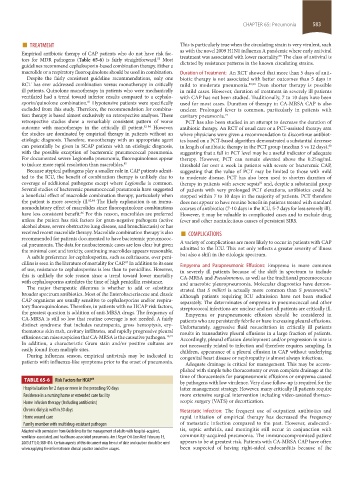
                      TABLE 65-6    Risk Factors for HCAP 94
                                                                          by pathogens with low virulence. Very close follow-up is required for the
                    Hospitalization for 2 days or more in the preceding 90 days  latter management strategy. However, many critically ill patients require
                    Residence in a nursing home or extended care facility  more extensive surgical intervention including video-assisted thoraco-
                    Home infusion therapy (Including antibiotics)         scopic surgery (VATS) or decortication.
                    Chronic dialysis within 30 days                       Metastatic  Infection:  The frequent use of outpatient antibiotics and
                    Home wound care                                       rapid initiation of empirical therapy has decreased the frequency
                    Family member with multidrug-resistant pathogen       of metastatic infection compared to the past. However, endocardi-
                    Adapted with permission from Guidelines for the management of adults with hospital-acquired,   tis, septic arthritis, and meningitis still occur in conjunction with
                    ventilator-associated, and healthcare-associated pneumonia. Am J Respir Crit Care Med. February 15,   community-acquired pneumonia. The immunocompromised patient
                    2005;171(4):388-416. Certain aspects of this document may be out of date and caution should be used   appears to be at greatest risk. Patients with CA-MRSA CAP have often
                    when applying the information in clinical practice and other usages.  been suspected of having right-sided endocarditis because of the


            section05_c61-73.indd   583                                                                                1/23/2015   12:47:56 PM

