


Page 918 - Hall et al (2015) Principles of Critical Care-McGraw-Hill
P. 918
CHAPTER 70: Fungal Infections  649


                    Management of Central Venous Catheters:  Both the guidelines for the     TABLE 70-6    Characteristics of Azoles Used in the ICU
                    management of candidiasis and those for the management of central
                    venous catheters recommend removing a central venous catheter          Fluconazole    Voriconazole
                    when a patient develops candidemia. 15,82  These recommendations are   Formulation  IV and oral  IV and oral
                    based on data showing faster clearance of candidemia and better out-
                    comes when the catheter is removed. 86,93,94  However, there is a school   Dosage  12 mg/kg loading dose,   6 mg/kg bid on first day, then
                    of thought that believes that for many patients, especially those who   then 6 mg/kg once daily  3-4 mg/kg bid
                    are neutropenic, the source of candidemia is the gut, and the catheter   Bioavailability (%)   >90  >90
                    should remain in place. 95,96  It is further argued that removal of cath-  Effect of food  No effect  Decreases absorption; give on
                    eters, many of which are tunneled catheters, in neutropenic patients                  empty stomach
                    is not without risk. At the crux of this debate  is the problem that
                    there are no sensitive and specific tests that will unequivocally reveal   Protein binding (%)  11-12  58
                    the source of candidemia to be either the catheter or the gut and   Distribution (L/kg)  0.7-1  4.6
                    there have been no controlled trials aimed specifically at addressing   Half-life (h)  22-31  6
                    the issue of catheter retention. After consideration of these data, the
                    IDSA Guidelines Panel strongly recommended removal of catheters   Substrate/inhibitor of   Inhibitor of CYP 2C9,   Substrate and inhibitor of CYP
                    in nonneutropenic patients and suggested that catheter removal be   CYP450  2C19, and 3A4  2C9, 2C19, and CYP 3A4
                    considered for those who are neutropenic. 82          Metabolism       Minimal        Hepatic CYP 450 2C19, 2C9, 3A4
                        ■  INTRA-ABDOMINAL CANDIDIASIS                    CSF penetration (%serum) 50-94  42-67
                                                                          Elimination
                                                                                           Urine as active drug
                                                                                                          Urine and feces after metabolized,
                    Treatment is similar to that of candidemia in regard to the antifungal                <1% active drug in urine
                    agent selected. Except for cases of peritonitis and phlegmon without a   Dosage adjustment in   Cr Cl >50 mL/min: none  None; cannot use IV formulation
                    discrete abscess, drainage of purulent material is necessary and can be   renal impairment  if Cr Cl <50 mL/min
                    accomplished by either interventional radiologic or surgical procedures.
                    Longer therapy is often required than that needed for candidemia in    Cr Cl <50 mL/min: reduce
                    order to ensure complete resolution of the intra-abdominal infection.  by 50%
                        ■  URINARY TRACT INFECTIONS                       Dosage adjustment in   None     Child-Pugh <7: none
                                                                          hepatic impairment
                    The most important steps in treating candiduria are to remove indwell-                Child-Pugh >7: 6 mg/kg bid
                    ing bladder catheters, stop broad-spectrum antibiotics, and be sure there             loading dose, then 2 mg/kg bid
                    is no obstruction to urine flow. For many patients in the ICU, catheters   CSF, cerebrospinal fluid; IV, intravenous.
                    must remain in place and antibiotics must continue. It is important to   Adapted from references 99 and 100.
                    not treat every patient who has asymptomatic candiduria, but to treat
                    only those in whom there is some proof of infection.
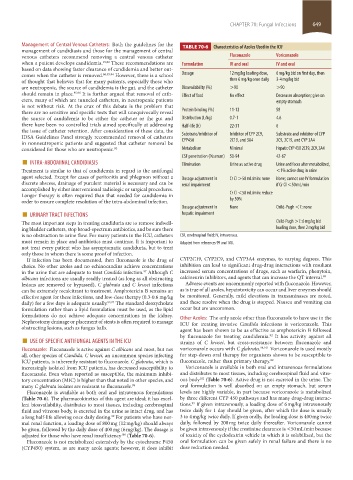
                     If infection has been documented, then fluconazole is the drug of   CYP2C19, CYP2C9, and CYP3A4 enzymes, to varying degrees. This
                    choice. No other azoles and no echinocandins achieve concentrations   inhibition can lead to significant drug-drug interactions with resultant
                    in the urine that are adequate to treat Candida infection.  Although C   increased serum concentrations of drugs, such as warfarin, phenytoin,
                                                             97
                    albicans infections are usually readily treated (as long as all obstructing   calcineurin inhibitors, and agents that can increase the QT interval. 99
                    lesions are removed or bypassed),  C glabrata and  C krusei infections   Adverse events are uncommonly reported with fluconazole. However,
                    can be extremely recalcitrant to treatment. Amphotericin B remains an   as is true of all azoles, hepatotoxicity can occur and liver enzymes should
                    effective agent for these infections, and low-dose therapy (0.3-0.6 mg/kg   be monitored. Generally, mild elevations in transaminases are noted,
                    daily) for a few days is adequate usually. 82,97  The standard deoxycholate   and these resolve when the drug is stopped. Nausea and vomiting can
                    formulation rather than a lipid formulation must be used, as the lipid   occur but are uncommon.
                    formulations do not achieve adequate concentrations in the kidney.   Other Azoles:  The only azole other than fluconazole to have use in the
                    Nephrostomy drainage or placement of stents is often required to manage    ICU for treating invasive  Candida infections is voriconazole. This
                    obstructing lesions, such as fungus balls.            agent has been shown to be as effective as amphotericin B followed
                        ■  USE OF SPECIFIC ANTIFUNGAL AGENTS IN THE ICU   by fluconazole for treating candidemia.  It has activity against all
                                                                                                        92
                                                                          strains  of  C krusei,  but  cross-resistance  between  fluconazole  and
                    Fluconazole:  Fluconazole is active against C albicans and most, but not   voriconazole occurs with C glabrata. 98,101  Voriconazole is used mostly
                    all, other species of Candida. C krusei, an uncommon species infecting   for step-down oral therapy for organisms shown to be susceptible to
                    ICU patients, is inherently resistant to fluconazole. C glabrata, which is   fluconazole, rather than primary therapy. 82
                    increasingly isolated from ICU patients, has decreased susceptibility to   Voriconazole is available in both oral and intravenous formulations
                    fluconazole. Even when reported as susceptible, the minimum inhibi-  and distributes to most tissues, including cerebrospinal fluid and vitre-
                                                                                102
                    tory concentration (MIC) is higher than that noted in other species, and   ous body  (Table 70-6). Active drug is not excreted in the urine. The
                    many C glabrata isolates are resistant to fluconazole. 98  oral formulation is well absorbed on an empty stomach, but serum
                     Fluconazole is available as both oral and intravenous formulations   levels are highly variable, in part because voriconazole is metabolized
                    (Table 70-6). The pharmacokinetics of this agent are ideal; it has excel-  by three different CYP 450 pathways and has many drug-drug interac-
                                                                              99
                    lent bioavailability, distributes to most tissues, including cerebrospinal   tions.  If given intravenously, a loading dose of 6 mg/kg intravenously
                    fluid and vitreous body, is excreted in the urine as intact drug, and has   twice daily for 1 day should be given, after which the dose is usually
                    a long half-life allowing once daily dosing.  For patients who have nor-  3 to 4 mg/kg twice daily. If given orally, the loading dose is 400 mg twice
                                                  99
                    mal renal function, a loading dose of 800 mg (12 mg/kg) should always   daily, followed by 200 mg twice daily thereafter. Voriconazole cannot
                    be given, followed by the daily dose of 400 mg (6 mg/kg). The dosage is   be given intravenously if the creatinine clearance is <50 mL/min because
                    adjusted for those who have renal insufficiency  (Table 70-6).  of toxicity of the cyclodextrin vehicle in which it is solubilized, but the
                                                      100
                     Fluconazole is not metabolized extensively by the cytochrome P450   oral formulation can be given safely in renal failure and there is no
                    (CYP450) system, as are many azole agents; however, it does inhibit   dose reduction needed.


            section05_c61-73.indd   649                                                                                1/23/2015   12:48:32 PM

