


Page 919 - Hall et al (2015) Principles of Critical Care-McGraw-Hill
P. 919
650     PART 5: Infectious Disorders


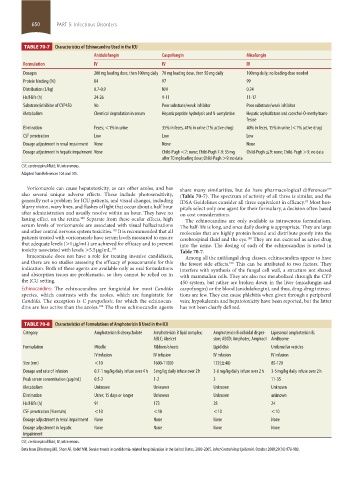
                   TABLE 70-7    Characteristics of Echinocandins Used in the ICU
                                          Anidulafungin          Caspofungin                  Micafungin
                  Formulation             IV                     IV                           IV
                  Dosages                 200 mg loading dose, then 100 mg daily 70 mg loading dose, then 50 mg daily  100 mg daily; no loading dose needed
                  Protein binding (%)     84                     97                           99
                  Distribution (L/kg)     0.7-0.9                N/A                          0.24
                  Half-life (h)           24-26                  9-11                         11-17
                  Substrate/inhibitor of CYP450  No              Poor substrate/weak inhibitor  Poor substrate/weak inhibitor
                  Metabolism              Chemical degradation in serum   Hepatic peptide hydrolysis and N-acetylation  Hepatic arylsulfatase and catechol-O-methyltrans-
                                                                                              ferase
                  Elimination             Feces; <1% in urine    35% in feces, 41% in urine (1% active drug)  40% in feces, 15% in urine (<1% active drug)
                  CSF penetration         Low                    Low                          Low
                  Dosage adjustment in renal impairment  None    None                         None
                  Dosage adjustment in hepatic impairment None   Child-Pugh <7: none; Child-Pugh 7-9: 35 mg   Child-Pugh ≤9: none; Child-Pugh >9: no data
                                                                 after 70 mg loading dose; Child-Pugh >9: no data
                 CSF, cerebrospinal fluid; IV, intravenous.
                 Adapted from References 104 and 105.

                   Voriconazole can cause hepatotoxicity, as can other azoles, and has   share many similarities, but do have pharmacological differences
                                                                                                                         105
                 also several unique adverse effects. These  include photosensitivity,   (Table 70-7). The spectrum of activity of all three is similar, and the
                 generally not a problem for ICU patients, and visual changes, including   IDSA Guidelines consider all three equivalent in efficacy.  Most hos-
                                                                                                                  82
                 blurry vision, wavy lines, and flashes of light that occur about a half hour   pitals select only one agent for their formulary, a decision often based
                 after administration and usually resolve within an hour. They have no   on cost considerations.
                 lasting effect on the retina.  Separate from these ocular effects, high   The echinocandins are only available as intravenous formulations.
                                     102
                 serum levels of voriconazole are associated with visual hallucinations   The half-life is long, and once daily dosing is appropriate. They are large
                 and other central nervous system toxicities.  It is recommended that all   molecules that are highly protein bound and distribute poorly into the
                                                103
                 patients treated with voriconazole have serum levels measured to ensure   cerebrospinal fluid and the eye.  They are not excreted as active drug
                                                                                              105
                 that adequate levels (>1 µg/mL) are achieved for efficacy and to prevent   into the urine. The dosing of each of the echinocandins is noted in
                 toxicity associated with levels >5.5 µg/mL. 103       Table 70-7.
                   Itraconazole does not have a role for treating invasive candidiasis,   Among all the antifungal drug classes, echinocandins appear to have
                 and there are no studies assessing the efficacy of posaconazole for this   the fewest side effects.  This can be attributed to two factors. They
                                                                                        106
                 indication. Both of these agents are available only as oral formulations   interfere with synthesis of the fungal cell wall, a structure not shared
                 and absorption issues are problematic, so they cannot be relied on in   with mammalian cells. They are also not metabolized through the CYP
                 the ICU setting.                                      450 system, but rather are broken down in the liver (micafungin and
                 Echinocandins:  The echinocandins are fungicidal for most  Candida   caspofungin) or the blood (anidulafungin), and thus, drug-drug interac-
                 species, which contrasts with the azoles, which are fungistatic for   tions are few. They can cause phlebitis when given through a peripheral
                 Candida. The exception is  C parapsilosis, for which the echinocan-  vein; hypokalemia and hepatotoxicity have been reported, but the latter
                 dins are less active than the azoles.  The three echinocandin agents   has not been clearly defined.
                                            104

                   TABLE 70-8    Characteristics of Formulations of Amphotericin B Used in the ICU
                  Category                Amphotericin B deoxycholate  Amphotericin B lipid complex;   Amphotericin B colloidal disper-  Liposomal amphotericin B;
                                                              ABLC; Abelcet        sion; ABCD; Amphotec, Amphocil AmBisome
                  Formulation             Micelle             Ribbons/sheets       Lipid disk         Unilamellar vesicles
                                          IV infusion         IV infusion          IV infusion        IV infusion
                  Size (nm)               <10                 1600-11000           122(±48)           80-120
                  Dosage and rate of infusion  0.7-1 mg/kg daily infuse over 4 h  5 mg/kg daily infuse over 2 h  3-6 mg/kg daily infuse over 2 h  3-5 mg/kg daily infuse over 2 h
                  Peak serum concentration (µg/mL)  0.5-2     1-2                  3                  11-35
                  Metabolism              Unknown             Unknown              Unknown            Unknown
                  Elimination             Urine; 15 days or longer  Unknown        Unknown            unknown
                  Half-life (h)           91                  173                  28                 24
                  CSF penetration (%serum)  <10               <10                  <10                <10
                  Dosage adjustment in renal impairment  None  None                None               None
                  Dosage adjustment in hepatic    None        None                 None               None
                  impairment
                 CSF, cerebrospinal fluid; IV, intravenous.
                 Data from Zilberberg MD, Shorr AF, Kollef MH. Secular trends in candidemia-related hospitalization in the United States, 2000-2005. Infect Control Hosp Epidemiol. October 2008;29(10):978-980.


            section05_c61-73.indd   650                                                                                1/23/2015   12:48:33 PM

