


Page 98 - Hall et al (2015) Principles of Critical Care-McGraw-Hill
P. 98
66      PART 1: An Overview of the Approach to and Organization of Critical Care


                                                                                     Hospital A


                                        Off-site command center

                                                  Audio-visual
                                                                                     Hospital B
                                                     EMR


                                       Physician Staff

                                                                                     Hospital C


                                     Hospital A
                                                                                     Hospital B
                                        On-site command center
                                                  Audio-visual

                                                     EMR
                                                   Telemetry
                                      Multidisciplinary  Radiography
                                      Staff


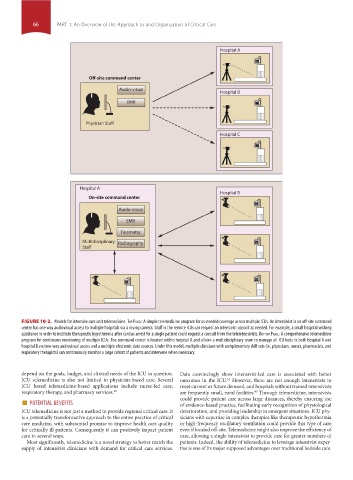
                 FIGURE 10-2.  Models for intensive care unit telemedicine. Top panel: A simple telemedicine program for as-needed coverage across multiple ICUs. An intensivist in an off-site command
                 center has one way audiovisual access to multiple hospitals via a roving camera. Staff in the remote ICUs can request an intensivist consult as needed. For example, a small hospital wishing
                 assistance in order to institute therapeutic hypothermia after cardiac arrest for a single patient could request a consult from the teleintensivists. BoTTom panel: A comprehensive telemedicine
                 program for continuous monitoring of multiple ICUs. The command center is located within hospital A and allows a multidisciplinary team to manage all ICU beds in both hospital A and
                 hospital B via two-way audiovisual access and a multiple electronic data sources. Under this model, multiple clinicians with complimentary skill sets (ie, physicians, nurses, pharmacists, and
                 respiratory therapists) can continuously monitor a large cohort of patients and intervene when necessary.


                 depend on the goals, budget, and clinical needs of the ICU in question.   Data convincingly show intensivist-led care is associated with better
                 ICU telemedicine is also not limited to physician-based care. Several   outcomes in the ICU.  However, there are not enough intensivists to
                                                                                       34
                 ICU based telemedicine-based applications include nurse-led care,   meet current or future demand, and hospitals without trained intensivists
                 respiratory therapy, and pharmacy services. 44        are frequently small, rural facilities.  Through telemedicine, intensivists
                                                                                                 45
                     ■  POTENTIAL BENEFITS                             could provide patient care across large distances, thereby ensuring use
                                                                       of evidence-based practice, facilitating early recognition of physiological
                 ICU telemedicine is not just a method to provide regional critical care. It   deterioration, and providing leadership in emergent situations. ICU phy-
                 is a potentially transformative approach to the entire practice of critical   sicians with expertise in complex therapies like therapeutic hypothermia
                 care medicine, with substantial promise to improve health care quality   or high-frequency oscillatory ventilation could provide this type of care
                 for critically ill patients. Consequently it can positively impact patient   even if located off-site. Telemedicine might also improve the efficiency of
                 care in several ways.                                 care, allowing a single intensivist to provide care for greater numbers of
                   Most significantly, telemedicine is a novel strategy to better match the   patients. Indeed, the ability of telemedicine to leverage intensivist exper-
                 supply of intensivist clinicians with demand for critical care services.   tise is one of its major supposed advantages over traditional bedside care.


            Section01.indd   66                                                                                        1/22/2015   9:37:10 AM

