


Page 67 - Psychology of Wounds and Wound Care in Clinical Practice ( PDFDrive )
P. 67
40   Chapter 2.  Pain


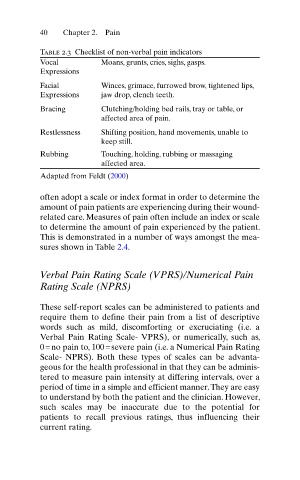
              Table 2.3   Checklist of non-verbal pain indicators
            Vocal          Moans, grunts, cries, sighs, gasps.
           Expressions
            Facial         Winces, grimace, furrowed brow, tightened lips,
           Expressions   jaw drop, clench teeth.
             Bracing       Clutching/holding bed rails, tray or table, or
                         affected area of pain.
             Restlessness     Shifting position, hand movements, unable to
                         keep still.
             Rubbing       Touching, holding, rubbing or massaging
                         affected area.
               Adapted from Feldt (  2000 )

           often adopt a scale or index format in order to determine the
           amount of pain patients are experiencing during their wound-
           related care. Measures of pain often include an index or scale
           to determine the amount of pain experienced by the patient.
           This is demonstrated in a number of ways amongst the mea-
           sures shown in Table   2.4 .


                 Verbal Pain Rating Scale (VPRS)/Numerical Pain
           Rating Scale (NPRS)


             These self-report scales can be administered to patients and
           require them to define their pain from a list of descriptive
           words such as mild, discomforting or excruciating (i.e. a
           Verbal Pain Rating Scale- VPRS), or numerically, such as,
           0 = no pain to, 100 = severe pain (i.e. a Numerical Pain Rating
           Scale- NPRS). Both these types of scales can be advanta-
           geous for the health professional in that they can be adminis-
           tered to measure pain intensity at differing intervals, over a
           period of time in a simple and efficient manner. They are easy
           to understand by both the patient and the clinician. However,
           such scales may be inaccurate due to the potential for
           patients to recall previous ratings, thus influencing their
            current rating.

