


Page 92 - Psychology of Wounds and Wound Care in Clinical Practice ( PDFDrive )
P. 92
66   Chapter 3.  Stress

               Assessing Stress


            It is well documented that psychological stress can result in
           delayed wound healing (Broadbent et al.   2003 ; Ebrecht et al.
             2004 ; Francis and Pennebaker  1992 ; Gouin et al.  2008 ; Jones
           et al.   2006 ; Marucha et al.  1998 ; Weinman et al.  2008 ). Also, as
           highlighted previously in this chapter, stress can result in dis-
           torted cognition and subsequent increased pain. Hence, it is
           essential for wound care professionals to assess patient’s
           psychological stress throughout the treatment regime. Self-
           report or physiological measures should be used to assess
           patient’s stress in addition to an awareness of patient’s
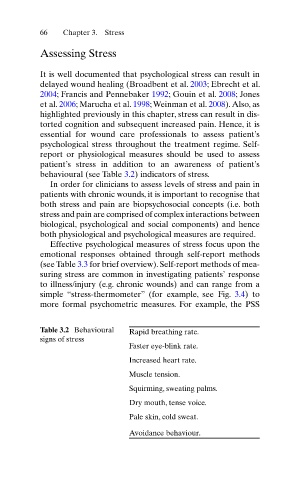
           behavioural (see Table   3.2 ) indicators of stress.
                   In order for clinicians to assess levels of stress and pain in
           patients with chronic wounds, it is important to recognise that
           both stress and pain are biopsychosocial concepts (i.e. both
           stress and pain are comprised of complex interactions between
           biological, psychological and social components) and hence
           both physiological and psychological measures are required.
               Effective psychological measures of stress focus upon the
           emotional responses obtained through self-report methods
           (see Table   3.3  for brief overview). Self-report methods of mea-
           suring stress are common in investigating patients’ response
           to illness/injury (e.g. chronic wounds) and can range from a
           simple  “stress-thermometer” (for example, see Fig.   3.4 )  to
           more formal psychometric measures. For example, the PSS


             Table 3.2    Behavioural     Rapid breathing rate.
           signs of stress
                                  Faster eye-blink rate.
                                  Increased heart rate.
                                 Muscle tension.
                                  Squirming, sweating palms.
                                  Dry mouth, tense voice.
                                  Pale skin, cold sweat.
                                 Avoidance behaviour.

