


Page 89 - Psychology of Wounds and Wound Care in Clinical Practice ( PDFDrive )
P. 89
Interactional Model of Stress  63


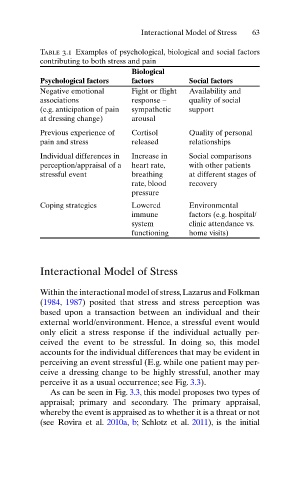
              Table 3.1   Examples of psychological, biological and social factors
           contributing to both stress and pain
                                  Biological
            Psychological factors   factors   Social factors
            Negative emotional     Fight or flight    Availability and
           associations          response –   quality of social
           (e.g. anticipation of pain   sympathetic   support
           at dressing change)   arousal

             Previous experience of    Cortisol     Quality of personal
           pain and stress       released     relationships
             Individual differences in    Increase in    Social comparisons
           perception/appraisal of a   heart rate,   with other patients
           stressful event       breathing    at different stages of
                                 rate, blood   recovery
                                 pressure
            Coping strategies     Lowered      Environmental
                                 immune       factors (e.g. hospital/
                                 system       clinic attendance vs.
                                 functioning   home visits)


               Interactional Model of Stress

            Within the interactional model of stress, Lazarus and Folkman
           (  1984 ,   1987 ) posited that stress and stress perception was
           based upon a transaction between an individual and their
           external world/environment. Hence, a stressful event would
           only elicit a stress response if the individual actually per-
           ceived the event to be stressful. In doing so, this model
           accounts for the individual differences that may be evident in
           perceiving an event stressful (E.g. while one patient may per-
           ceive a dressing change to be highly stressful, another may
           perceive it as a usual occurrence; see Fig.   3.3 ).
                   As can be seen in Fig.   3.3  this model proposes two types of
                                   ,
           appraisal; primary and secondary.  The primary appraisal,
           whereby the event is appraised as to whether it is a threat or not

           (see Rovira  et al.   2010a ,   b ; Schlotz et al.  2011 ), is the initial

