


Page 192 - Clinical Anatomy
P. 192
ECA3  7/18/06  6:45 PM  Page 177


                                                       The bones and joints of the upper limb  177


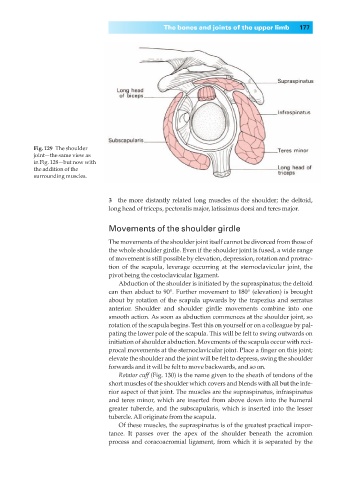
                  Fig. 129◊The shoulder
                  joint—the same view as
                  in Fig. 128—but now with
                  the addition of the
                  surrounding muscles.


                                        3◊◊the more distantly related long muscles of the shoulder; the deltoid,
                                        long head of triceps, pectoralis major, latissimus dorsi and teres major.

                                        Movements of the shoulder girdle

                                        The movements of the shoulder joint itself cannot be divorced from those of
                                        the whole shoulder girdle. Even if the shoulder joint is fused, a wide range
                                        of movement is still possible by elevation, depression, rotation and protrac-
                                        tion of the scapula, leverage occurring at the sternoclavicular joint, the
                                        pivot being the costoclavicular ligament.
                                          Abduction of the shoulder is initiated by the supraspinatus; the deltoid
                                        can then abduct to 90°. Further movement to 180° (elevation) is brought
                                        about by rotation of the scapula upwards by the trapezius and serratus
                                        anterior. Shoulder and shoulder girdle movements combine into one
                                        smooth action. As soon as abduction commences at the shoulder joint, so
                                        rotation of the scapula begins. Test this on yourself or on a colleague by pal-
                                        pating the lower pole of the scapula. This will be felt to swing outwards on
                                        initiation of shoulder abduction. Movements of the scapula occur with reci-
                                        procal movements at the sternoclavicular joint. Place a finger on this joint;
                                        elevate the shoulder and the joint will be felt to depress, swing the shoulder
                                        forwards and it will be felt to move backwards, and so on.
                                          Rotator cuff (Fig. 130) is the name given to the sheath of tendons of the
                                        short muscles of the shoulder which covers and blends with all but the infe-
                                        rior aspect of that joint. The muscles are the supraspinatus, infraspinatus
                                        and teres minor, which are inserted from above down into the humeral
                                        greater tubercle, and the subscapularis, which is inserted into the lesser
                                        tubercle. All originate from the scapula.
                                          Of these muscles, the supraspinatus is of the greatest practical impor-
                                        tance. It passes over the apex of the shoulder beneath the acromion
                                        process and coracoacromial ligament, from which it is separated by the

